“Over the years we’ve invested significantly in our field data team - focusing on producing trusted ratings. While this ensures the accuracy of our Ratings, it doesn’t allow the scale across the thousands of projects that buyers are considering.”

For more information on carbon credit procurement trends, read our "Key Takeaways for 2025" article. We share five, data-backed tips to improve your procurement strategy.
One more thing: Connect to Supply customers also get access to the rest of Sylvera's tools. That means you can easily see project ratings and evaluate an individual project's strengths, procure quality carbon credits, and even monitor project activity (particularly if you’ve invested at the pre-issuance stage.)
Book a free demo of Sylvera to see our platform's procurement and reporting features in action.
Across the world, landfills are a significant and growing source of methane, a greenhouse gas that is more than 80 times more potent than CO₂ over a 20-year period. As waste volumes rise and cities expand, unmanaged landfill gas poses both environmental and health risks.
In response, an increasing number of projects are installing systems to capture, destroy, or utilize methane emissions from landfills, generating carbon credits for the avoided emissions.
But what exactly are Landfill Methane (LFM) projects, and why are they becoming so important?
What are landfill methane projects?
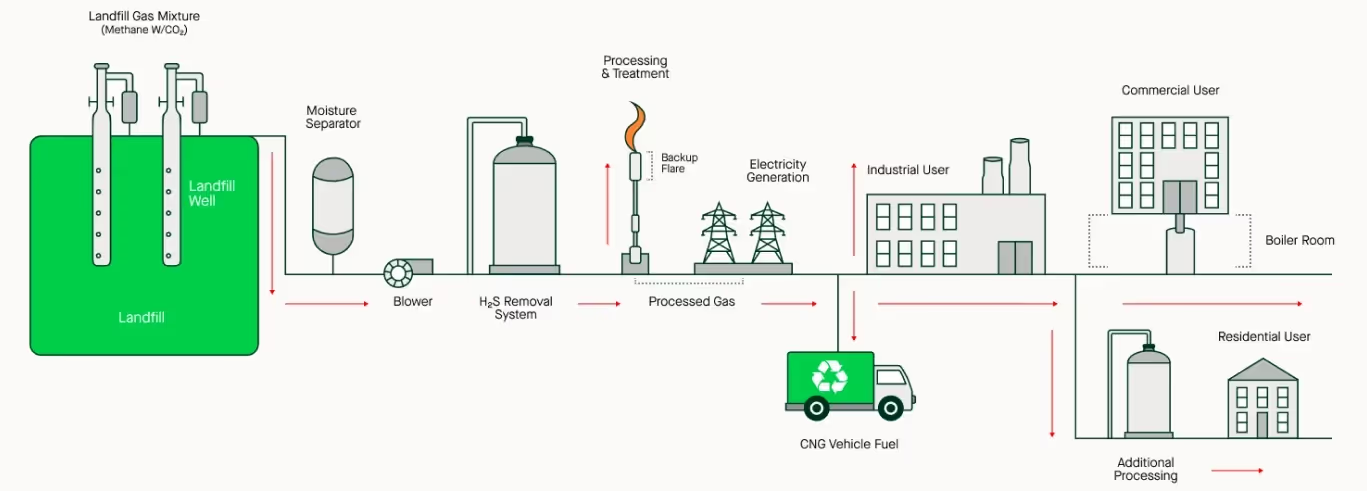
Landfill methane projects aim to capture methane produced from decomposing waste and either flare it (destroying it through combustion) or utilize it for energy generation. Without intervention, this methane would escape to the atmosphere and contribute significantly to global warming (27–30 times higher than CO₂).
These projects have become a central component of avoidance-based climate action. High-quality LFM projects have the potential to deliver immediate, measurable climate benefits by reducing methane emissions at scale. As climate policy increasingly targets methane reduction, understanding the quality of these projects has never been more critical.
Market potential
Methane mitigation is one of the fastest, most cost-effective levers for near-term climate impact, and the carbon market reflects this urgency.
Demand for high-integrity methane reduction credits is growing as corporates and investors seek tangible short-term climate action, and integrity initiatives are tightening expectations around monitoring and quantification.
However, the market faces challenges. Landfill gas systems vary widely in effectiveness, monitoring practices can be inconsistent, and crediting methodologies differ in how they model baselines and oxidation factors. These inconsistencies create uncertainty for buyers around the real climate impact of LFM projects.
Sylvera’s Landfill Methane Framework
To bring clarity and trust to this evolving space, Sylvera has developed a new Landfill Methane Ratings Framework.
This framework evaluates LFM projects using the same rigorous, data-driven approach that shapes the rest of Sylvera’s frameworks.
Our assessment focuses on the key drivers of climate impact for methane projects, including:
- Carbon accounting, capturing how effectively methane is collected, destroyed, or utilized.
- Baseline assessment, ensuring the scenario without the project is realistic and supported by evidence.
- Operational performance, including scrutinizing uptime, monitoring systems, maintenance, and historical data, to understand the real-world impact per vintage.
- Leakage and system-wide effects, including whether new waste practices or diversion activities create unintended emissions.
- Additionality, evaluating financial and regulatory conditions to determine whether the project would have happened without carbon finance.
A multi-disciplinary team of internal experts and external specialists in landfill engineering, methane modeling, and carbon accounting has developed the framework. Leading scientific studies, international methane guidance, and real-world developer data inform it.
To ensure quality and trust, the framework has undergone peer reviews and oversight by an external Framework Review Committee.
Engagement with the industry
At Sylvera, collaboration is key. We work closely with project developers to gather up-to-date, real-world data on project activities, life cycle assessments, and financial models. Our Assessments Team analyzes both developer-provided and public data to ensure transparency and reliability.
When developers engage in good faith, they receive their rating results with the opportunity to provide feedback. Even after publication, we stay engaged, addressing any concerns or new data within 30 days.
Landfill methane project ratings now available
With the launch of this new Framework, the first Landfill Methane Ratings are now available in the Sylvera platform.
This marks an important milestone in bringing transparency to methane avoidance projects. Our Framework sets a new bar for evaluating methane reductions with consistency, technical rigor, and market relevance.
Already using the Sylvera platform? Just log into the platform now to explore the new Ratings in detail.
Or, if you're not using our platform yet, you can access our project catalog and ratings via the free version of the Sylvera platform here.