

“Over the years we’ve invested significantly in our field data team - focusing on producing trusted ratings. While this ensures the accuracy of our Ratings, it doesn’t allow the scale across the thousands of projects that buyers are considering.”

For more information on carbon credit procurement trends, read our "Key Takeaways for 2025" article. We share five, data-backed tips to improve your procurement strategy.

One more thing: Connect to Supply customers also get access to the rest of Sylvera's tools. That means you can easily see project ratings and evaluate an individual project's strengths, procure quality carbon credits, and even monitor project activity (particularly if you’ve invested at the pre-issuance stage.)
Book a free demo of Sylvera to see our platform's procurement and reporting features in action.
COP30 cemented the importance of biodiversity, indigenous leadership, and community benefit-sharing when it comes to building an effective global climate strategy.
While the moral and ecological case for co-benefits is strong, new market data shows that projects with strong, verified co-benefits routinely earn measurable price premiums. As such, developers who invest early in biodiversity and community outcomes can increase both credit value and revenue resilience.
In this article, we explain which co-benefits matter most, why buyers are paying more for them, and how developers and investors can quantify ROI using Sylvera's Market Intelligence.
COP30 Reset the Market: Co-Benefits Are No Longer Optional
COP30 marked a fundamental shift in how the world approaches climate action.
Biodiversity conservation, indigenous peoples' rights, benefit-sharing with local communities, and tangible implementation dominated the agenda. So much so, in fact, that nature-based solutions captured 78% of capital flows—a strong signal of where the market sees impact and value.
Here's the truth: The voluntary carbon market is moving beyond carbon-only thinking toward holistic outcomes that address climate change, biodiversity loss, and community wellbeing.
This shift raises a critical question for developers and investors: Do carbon and biodiversity co-benefits actually translate into higher prices? The answer, according to emerging market data, is yes.
For all the latest intelligence around pricing, quality, and demand trends, check our comprehensive State of Carbon Credits report.

What Exactly Are Co-Benefits?
The term "co-benefits" refers to the positive impact a carbon project has beyond greenhouse gas emissions reductions. Buyers face pressure to provide comprehensive sustainability strategies. So, biodiversity offsets and social outcomes are now central to procurement decisions.
You might wonder, "Besides carbon sequestration, how do carbon projects make a positive impact?" Here are four community, corporate, and environmental co-benefits to know about:
- Community Co-Benefits: These benefits create jobs, improve health outcomes, expand education access, strengthen livelihoods, promote gender inclusion, and otherwise make communities better.
- Biodiversity Co-Benefits: These benefits protect species in biodiversity hotspots, conserve critical habitats, and restore degraded landscapes. Forest conservation and restoration projects that deliver verified biodiversity outcomes are examples of co-benefits in biodiversity markets.
- Economic Co-Benefits: These benefits generate local income, strengthen supply chains, and support local business growth. By prioritizing economic co-benefits, companies empower local communities with additional revenue streams that their citizens can use to improve their lives.
- SDG Co-Benefits: Finally, projects with co-benefits help corporate buyers align with specific Sustainable Development Goals, which matters for stakeholder reporting and ESG frameworks.
.avif)
Why Do Co-Benefits Matter So Much Now?
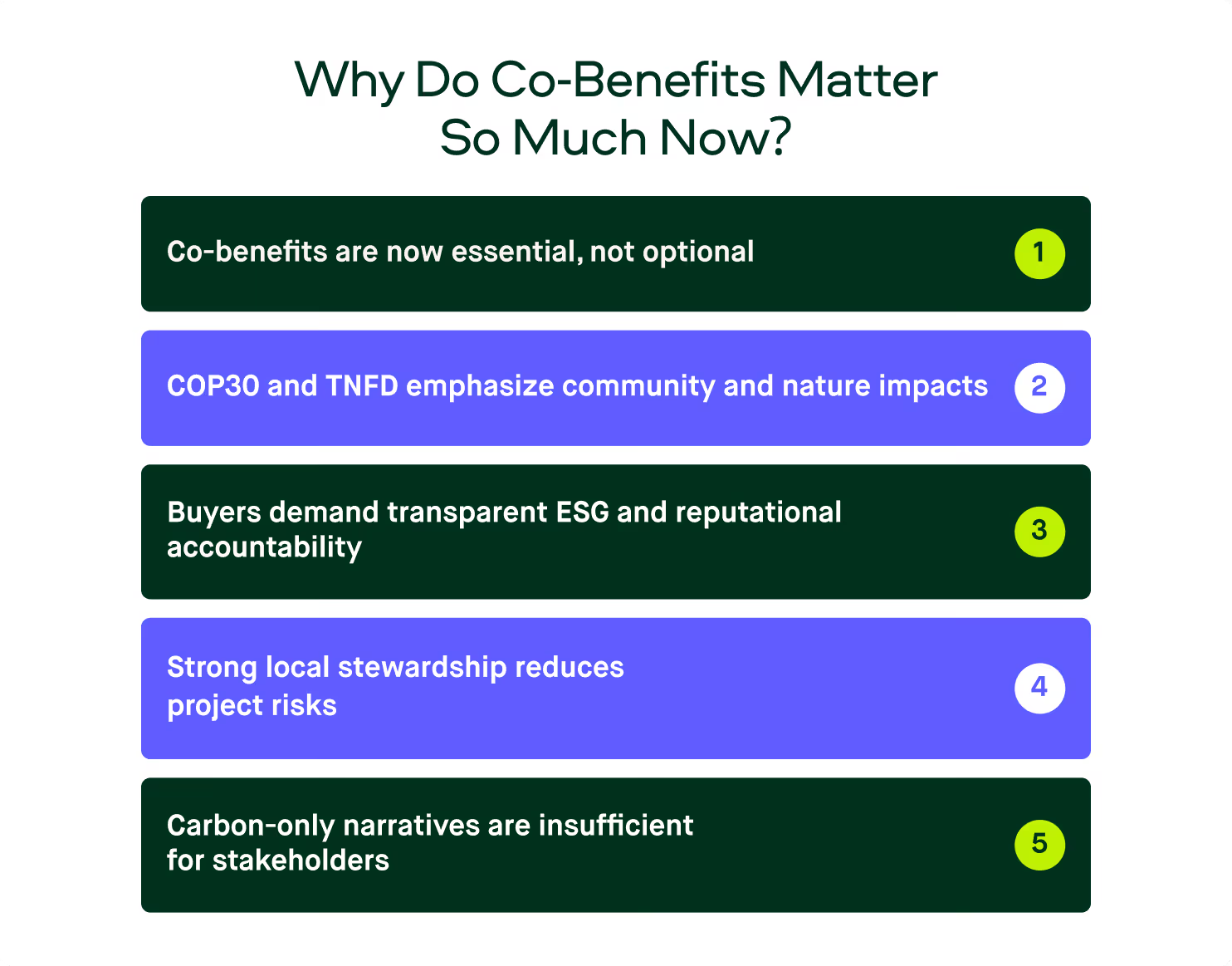
Several forces have converged to elevate carbon credit co-benefits from "nice to have" to "must have."
First, COP30's emphasis on benefit-sharing shows recognition that climate solutions must deliver for communities. The Taskforce on Nature-related Financial Disclosures (TNFD) is pushing companies to measure and report nature-related impacts alongside carbon metrics.
Second, buyer reputation and ESG scrutiny have intensified. Both shareholders and consumers expect transparent evidence that shows positive impacts beyond carbon dioxide equivalent reductions.
Third, projects with strong community stewardship also demonstrate lower reversal risk. After all, when local communities have genuine ownership stakes, they protect project areas from threats. And finally, carbon emissions-only narratives don't satisfy procurement teams or stakeholder reporting.
The question isn't if biodiversity and community co-benefits matter, it's how much they're worth.
The Data: What Co-Benefits Are Actually Worth in Today's Market
Market intelligence reveals what many developers suspected: high-quality carbon credits with verified co-benefits command premium pricing. We have the data to back it up:
Projects with Strong Co-Benefits Earn Price Premiums
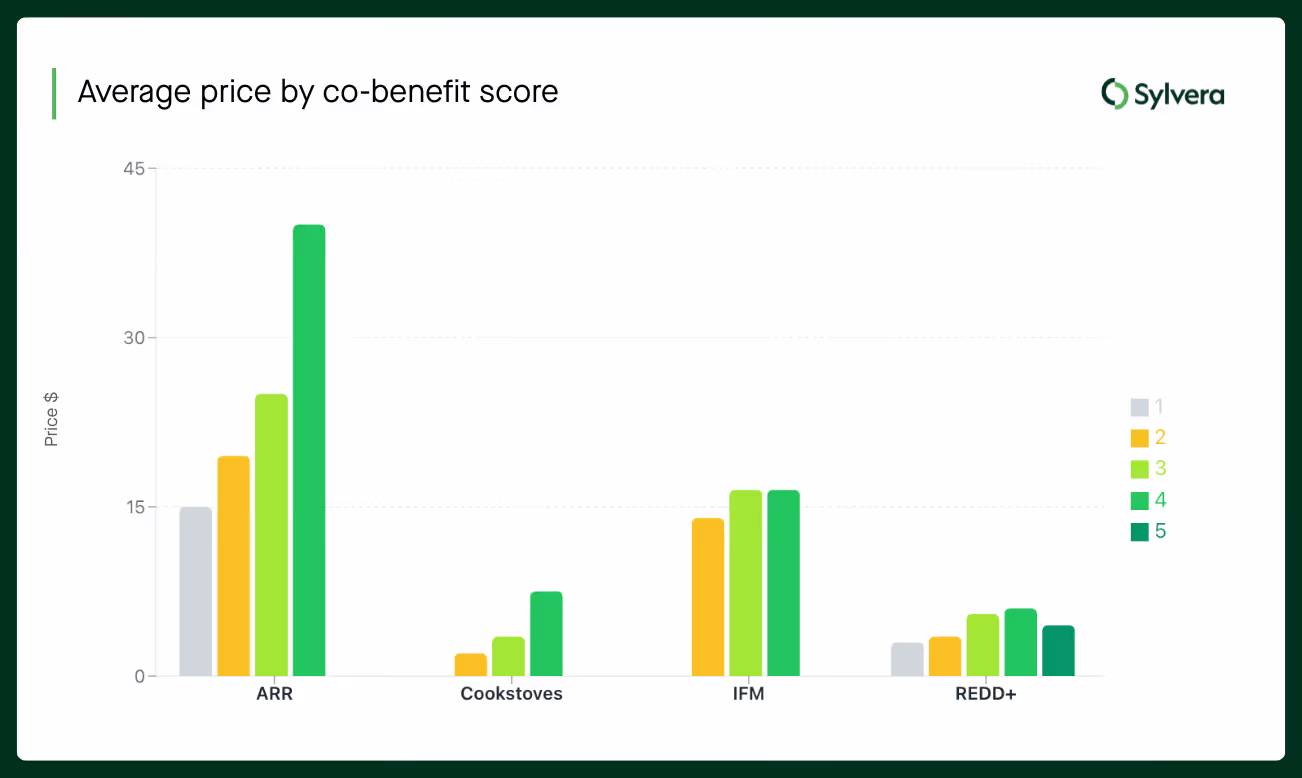
Data from Sylvera Market Intelligence shows compelling price differentiation.
The average price of nature-based projects with aSylvera co-benefit score of 5 is $25. This compares to $14.5 for a score of 4, $10.5 for a score of 3, and $9 for a score of 2.
And this premium is growing. For example, ARR projects with a co-benefit score of 4 were averaging $19 in December 2024, whereas these are now (at the time of writing in January 2026) over $30.
Some Co-Benefits Drive Higher Premiums Than Others
But not all co-benefits are equal, especially in the minds of buyers. Considerations can be found around:
- Projects that address biodiversity loss while securing carbon storage drive the most revenue. Buyers recognize that protecting biodiversity in endangered areas delivers irreplaceable value.
- Projects that support community health programs, especially in low-income countries, generate strong premiums. Buyers in pharmaceutical and healthcare sectors actively seek these benefits.
- Projects that support gender equality also attract premium pricing. This is particularly true in regard to, for example retail brands or othercompanies that prioritize and track gender equity goals.
- Projects that support Indigenous-led governance and FPIC processes signal quality because they install long-term stewards of forest landscapes. As such, these projects are priced higher.
- Projects that support education and/or digital inclusion programs can also increase prices. These benefits are especially popular in the technology sector, where buyers seek mission-aligned carbon offset projects as economic instruments against climate change.
Verification Matters
The gap between verified and unverified claims is stark.
Projects that meet CCB Standards or earn SD VISta certification will likely see stronger, more stable price premiums than similar projects without third-party verification.
On the other hand, "claimed but unverified" co-benefits will likely show little to no premium increase. If anything, a lack of verification alienates potential buyers. As scrutiny of carbon credit projects intensifies, verification has become table stakes for accessing premium pricing tiers.
Why Buyers Pay More: Strategy, Values, and Risk Management
Why do biodiversity carbon credits and community co-benefits command higher prices? It's not charity. It's strategic procurement driven by corporate objectives, stakeholder pressure, and risk mitigation.
Buyers Want Alignment With Corporate Values
Companies build carbon reduction strategies that reinforce their brand identity and core mission.
To this end, pharmaceutical companies often prioritize projects with health and community co-benefits that mirror their corporate purpose. Technology firms often pursue education and digital access initiatives related to their carbon credit projects. Consumer goods brands often seek biodiversity conservation and sustainable livelihoods that resonate with their customer base. And financial institutions often focus on gender equality to support economic empowerment narratives.
Alignment between corporate values and climate benefits transforms carbon credits from a compliance checkbox into a strategic asset that strengthens corporate storytelling.
Stakeholder Pressure and Reporting Frameworks
These days, companies have to invest in carbon projects that generate a net positive impact—for the environment, for indigenous and local communities, etc. If they don't, they'll receive backlash.
But an angry public is just the beginning. TNFD disclosures require companies to report nature-related risks and dependencies, making co-benefits relevant to corporate reporting. Plus, ESG ratings agencies penalize weak or unverified sustainability claims, which creates financial incentives for rigor.
Consumers also demand evidence of environmental benefits beyond carbon offsets. And shareholders push for holistic sustainability strategies that address environmental and social challenges.
Unlike carbon credits that only focus on emissions reductions, top projects in 2026 deliver verified co-benefits that help companies satisfy multiple stakeholder demands at the same time.
Co-Benefits Reduce Risk
Last but not least, co-benefits mitigate risk.
For example, community buy-in helps reduce reversals. When a local community benefits economically and/or socially from a project's success, they become active protectors in said project rather than passive participants. This community stewardship can have a significant impact on resilience.
Environmental investments also reduce political pressure on nature-based solutions. As national biodiversity strategies gain prominence, projects that support these goals face less regulatory risk.
Finally, verified co-benefits strengthen corporate climate claims and protect brand reputations. In a world where greenwashing accusations damage market value, verification provides protection.
Strategic Implications for Project Developers
For developers, the message is clear: co-benefits are a revenue strategy, not a cost center. Knowing how to design, implement, and verify meaningful co-benefits can improve project economics.
Co-Benefits as a Revenue Strategy
Strong co-benefits drive higher pricing. Based on Sylvera Market Intelligence data, projects with top-tier co-benefit scores can command over 50% premiums over baseline pricing.
Additionally, co-benefit premiums offset the capital and operational expenditure required for robust community programs and biodiversity monitoring. When said co-benefits lead to, say $5 more per credit, and the project issues 500,000 credits annually, the business case is extremely compelling.
And don’t forget about repeat buyers, who cluster around high-co-benefit projects. Once a buyer identifies a project that delivers strong verified outcomes, they often commit to multi-year offtake agreements. This repeat business improves revenue predictability and reduces transaction costs.
Here's the good news: As a developer, you can use real market data to prove ROI and justify a budget for biodiversity baselining, community health programs, and third-party verification.
Best Practices for Designing High-Value Co-Benefits
Meaningful partnerships with indigenous peoples and local communities starts with genuine FPIC processes and ongoing governance participation. It also requires transparent benefit-sharing mechanisms to ensure economic value flows equitably to the communities in which projects reside.
Next, focus on biodiversity baselining and continuous monitoring to provide a data foundation for credible claims. Then, set up digital MRV systems to track biodiversity and community indicators. Doing so will improve verification efficiency and reduce costs that many carbon credit projects struggle with.
Now it's time for third-party verification via CCB Standards or SD VISta certification. Alignment with national SDG priorities can help in this regard too, as it can lead to government support and long-term stability.
Finally, develop long-term community stewardship programs to signal your commitment beyond project registration periods. This will help build trust with buyers who focus on project permanence.
Risks of Superficial Co-Benefits
The downside of weak co-benefits strategies is significant.
Greenwashing accusations destroy project credibility. Local community opposition undermines social license and creates operational challenges. Plus, projects with superficial co-benefits sell at lower prices, have higher permanence risks, and could even face suspension and non-delivery issues.
The choice is clear: invest in genuine co-benefits to protect your revenue and reputation.
Strategic Implications for Investors
The correlation between strong co-benefits and financial performance is evident. As such, investors should view co-benefits as a signal of project quality and a driver of portfolio value.
Co-Benefits as a Signal of Project Quality
Strong co-benefits correlate with lower reversal risk because they garner community support.
Think about it: If a project garners community support, the citizens in the community will want to protect it. This simple fact often leads to better long-term issuance consistency.
Co-benefits also lead to future-proofed claims. Since regulations tend to emphasize biodiversity finance and nature-based solutions value, projects in these categories face less risk.
Portfolio Value Strategy
At COP30, it was declared how 78% of new investments flow to nature-based solutions.
Investors can capitalize on this trend by identifying undervalued projects with strong but underappreciated co-benefits before biodiversity premiums fully materialize in carbon credit pricing.
Also worth mentioning, price and comparables data from market intelligence platforms like Sylvera can help validate financial models, inform exit strategies, and refine IRR projections. When you know which co-benefits drive premiums, you can hedge against risk and build a successful portfolio.
How Sylvera Helps Developers, Buyers and Investors Navigate Co-Benefits
Sylvera Market Intelligence gives you data to accurately assess the co-benefit related to projects. That way, you can invest in better nature credits that ensure positive human and environmental impacts.
Here's exactly what you can do with Sylvera Market Intelligence:
- Measure price premiums associated with co-benefit scores
- Compare average co-benefits across methodologies
- Identify verified vs. unverified co-benefit patterns
- Benchmark pricing and demand against comparable projects
- Filter projects by co-benefits and associated SDGs
- Understand country-level nature and community priorities via Country Profiles
Ready to explore co-benefits data inside Sylvera Market Intelligence? Book a demo today.
Lower Your Carbon Footprint the Right Way
The voluntary carbon market is maturing. Buyers no longer accept the choice between carbon reduction and broader environmental benefits. They want both, and they're willing to pay for it.
For developers, this creates opportunity. Providing real biodiversity outcomes, community partnerships, and transparent benefit-sharing isn't just ethical, it's financially strategic. The data proves it.
For investors, co-benefits help identify quality projects. As biodiversity credits evolve and regulatory frameworks tighten, projects that deliver verified co-benefits will capture more market share.
The commercial case for holistic climate solutions is no longer theoretical. It's measurable, it's growing, and it's reshaping how the carbon market values impact.
For all the latest intelligence around pricing, quality, and demand trends, check our comprehensive State of Carbon Credits report.