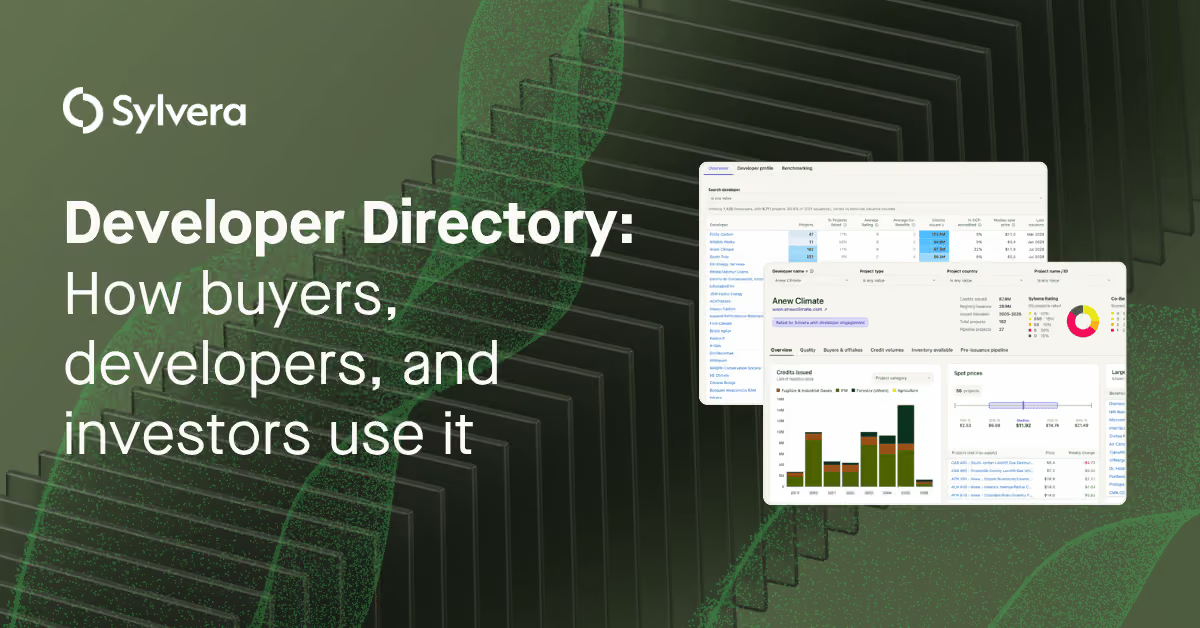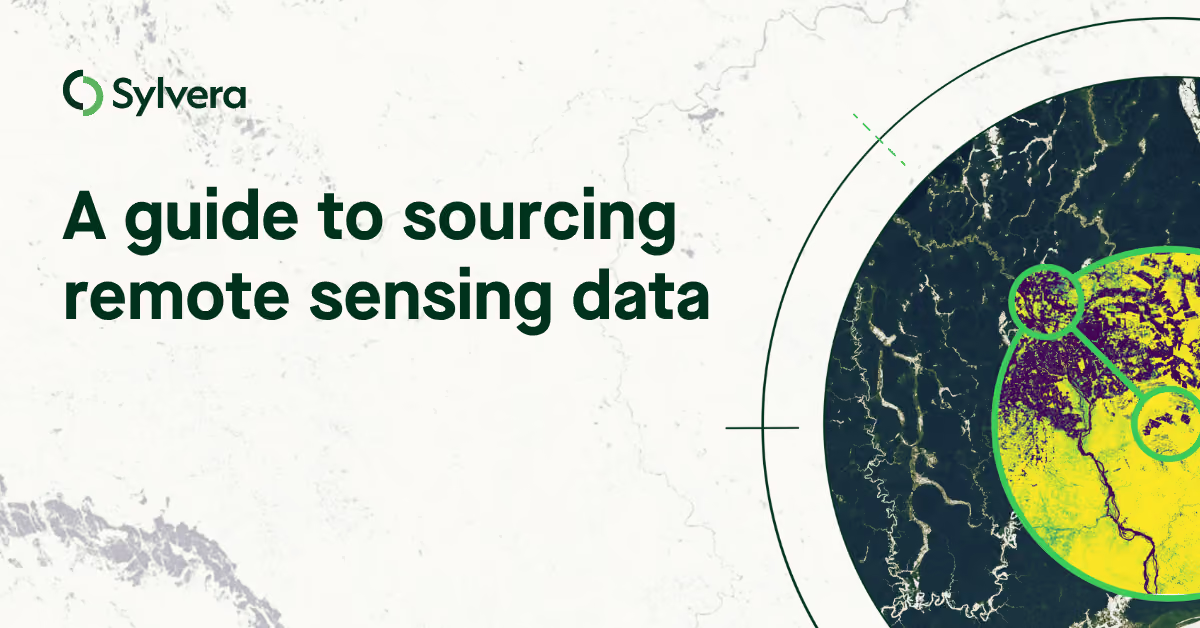


“Over the years we’ve invested significantly in our field data team - focusing on producing trusted ratings. While this ensures the accuracy of our Ratings, it doesn’t allow the scale across the thousands of projects that buyers are considering.”

For more information on carbon credit procurement trends, read our "Key Takeaways for 2025" article. We share five, data-backed tips to improve your procurement strategy.
One more thing: Connect to Supply customers also get access to the rest of Sylvera's tools. That means you can easily see project ratings and evaluate an individual project's strengths, procure quality carbon credits, and even monitor project activity (particularly if you’ve invested at the pre-issuance stage.)
Book a free demo of Sylvera to see our platform's procurement and reporting features in action.
Why Do Companies Buy Carbon Credits?
Carbon credits let companies fund climate action beyond their own operations.
Many organizations create emissions they can't eliminate – broadly categorised as Scope 1,2 or 3 emissions. Some of these emissions come from manufacturing processes, while others come from supply chains, air travel, etc. Carbon credits compensate for these activities, alongside the company continuing to invest in long-term decarbonization.
.avif)
Carbon credits are also uniquely practical. Building emissions-reduction infrastructure takes years, but companies can purchase carbon credits down to the individual tonne, scaling their program up or down as budgets and targets shift. This level of flexibility helps sustainability teams hit near-term climate targets while longer-term efforts to reduce carbon footprints press on in the background.
Carbon credits also open the door to diversification. A company can build a portfolio across multiple project types and geographies rather than betting everything on one solution.
We should discuss the strategic dimension as well. Bain's Torsten Lichtenau says, "Carbon credits are an asset and should be treated as such on the balance sheet." As such, the most strategic players move upstream to secure quality supply ahead of time. As demand for high-quality credits grows and supply tightens, early procurement starts to look less like an expense and more like a strategic positioning.
But credits are only one piece of a real corporate carbon offset strategy.
Start With the Mitigation Hierarchy: Avoid and Reduce, Then Offset
Before your company buys carbon credits, it needs to build a strong foundation.
Credible corporate climate programs follow the mitigation hierarchy. First, avoid creating new emissions and reduce the emissions you can't avoid. Then, offset what's left with carbon credits.
By doing things in this order, your company will earn credibility. Companies that purchase offsets without first reducing their own greenhouse gas emissions invite greenwashing accusations. Furthermore, the Science Based Targets initiative (SBTi) is explicit that high-quality credits should work alongside science-based emissions reductions. Credits shouldn't replace your efforts in this area.
This leads us to the debate between carbon neutrality and net-zero. While the terms are often used interchangeably, they're not the same. A carbon-neutral company offsets its annual emissions by purchasing and retiring credits. A net-zero company cuts emissions by roughly 90% or more against a baseline, then neutralizes whatever remains with carbon removal credits rather than avoidance credits.
Knowing which goal your company is pursuing changes what you buy and how you buy it. That's because removal projects like reforestation, biochar, and direct air capture (DAC) play different roles in a net-zero plan than they do in an annual carbon-neutral claim.
How Companies Actually Buy Carbon Credits: The Channels
Corporate carbon credit purchasing usually happens through one of four channels.
- Directly from project developers: You can buy credits straight from the source, often through offtake agreements. This channel works best for large volumes and long-term supply security. It also opens the door to real relationships with project teams and, in some cases, upstream investment. The tradeoff is due diligence. Without an intermediary, you carry that responsibility.
- Through brokers and intermediaries: You can buy from a carbon credit broker who sources credits on a company's behalf, matching supply to your needs. It's convenient, but adds a margin. Plus, the quality of credits you get depends on the rigor of the broker's due diligence process.
- Via marketplaces and exchanges: You can buy from digital platforms that list and trade credits. This channel offers more transparency and easier access than working with a broker. Your buying options range from one-off spot purchases to standardized, repeatable contracts. In addition, marketplaces and exchanges are valuable for price discovery in the voluntary carbon market.
- Through registries: You can buy from a registry like Verra, which issues the Verified Carbon Standard, and Gold Standard. Companies can both purchase and retire credits directly through these entities, which guarantees the credit is canceled and never resold.
.avif)
However a credit is purchased, retiring it is the step that counts. Retirement is the permanent cancellation of a carbon credit in a registry, so its climate impact is never claimed again. Buying credits without retiring them means the climate benefit isn't claimed. This practice opens the door to double counting, where the same tonne of avoided or removed carbon is claimed by multiple parties.
How to Build a Credible Carbon Credit Strategy
Building a defensible corporate carbon offset strategy is where the real work happens. Here's what separates sophisticated buyers from the rest.
1. Make Credits Part of an Overall Climate Strategy
Credits work best as part of a broader climate strategy, not as a standalone purchase. Before buying anything, know your "why". Are you closing a gap in an annual carbon-neutral claim? Building toward a long-term net-zero target? Funding carbon offset projects that align with a specific business goal?
Don't let the search for a perfect plan keep you from starting. Climate Impact X's Mikkel Larsen notes that companies often "Make the perfect the enemy of the good" by holding out for flawless plans rather than engaging with the global carbon credit market. Instead, figure out the quantity and type of credits you need, find a knowledgeable partner, and prioritize quality from day one.
Alignment matters too. For example, food or pharmaceutical companies might consider financing agricultural carbon projects. Personal care brands often invest in projects with strong community and women-focused co-benefits. This type of alignment will reinforce its own story and strengthen the case for community and industry buy-in.
2. Prioritize Quality Over Price
A few high-quality credits will deliver more reliable climate impact than a large volume of low-quality ones. They'll also protect your company from greenwashing accusations.
This quality difference shows up in price. Buyers typically pay about 3x more for high quality (rated BBB or above by Sylvera) ARR projects, and about $7 more for higher quality REDD+ projects. That premium reflects the market's recognition that high-integrity, independently verified credits reduce risk. As a carbon credit buyer, prioritize quality over quantity to more reliably reduce greenhouse gas emissions.
3. Treat Credits as an Asset and Secure Supply
Strategic buyers move upstream to secure high-quality supply in advance. They don't buy reactively on the spot market. This approach – investing in pre-issuance projects – balances two goals. First, it manages liability against future price increases as demand grows. Second, it secures a growing asset needed for global decarbonization.
For finance teams, a strategic approach reframes carbon credit procurement from a recurring line-item cost into a portfolio decision. Because of this, market intelligence on pricing and supply has become incredibly valuable to sustainability and finance teams who work together.
4. Educate Stakeholders and Evaluate Rigorously
Sustainability decisions increasingly start at the board and C-suite level, then flow down to the rest of the company. As such, CSOs need to educate CFOs, procurement leads, and treasurers.
Each of these groups thinks differently. CSOs focus on impact, while CFOs and procurement teams focus on price and risk. To bridge the gap, you'll need to walk through different options, show carbon credit price points, and explain why credits of the same vintage and project type can carry different costs.
Many CFOs and treasurers find it easier to evaluate quality ratings than raw project documentation. This is because the logic behind carbon credit ratings mirrors the logic behind credit ratings on bonds, which they're familiar with. Put simply, independent ratings translate carbon credit quality into a language finance teams already speak, which speeds up the internal approval process.
5. Build Long-Term Project Relationships
The most strategic buyers treat purchases as partnerships, not one-off transactions.
To do the same, you'll need to build long-term relationships with projects (and the project developers who run them) that align with your company's brand. This means visiting the project, involving employees, and making the relationship public. Don't treat it as a line item in a sustainability report.
Tokyo Gas is a prime example of this approach. Before committing to a Ghana-based forest restoration project developed by Three Trees (3T), the Japanese energy company used an independent pre-issuance assessment to validate the project's quality and scalability. The process brought Tokyo Gas, the assessor, and 3T, the developer, into direct collaboration, working through identified gaps together over several months. The result strengthened the project's rating trajectory and gave Tokyo Gas a stronger claim to being a market-building partner rather than only a credit buyer.
Consistent pre-issuance involvement will deepen your supply security, strengthen the credibility of your company's climate claims, and turn your offsetting strategy into a genuine part of your brand story.
.avif)
The Real Work: Due Diligence Before You Buy
The main work of buying carbon credits isn't the transaction. It's the due diligence that ensures each credit represents a real, measurable climate outcome. These three factors matter most.
- Additionality: Would the carbon emissions reduction or removal have happened anyway? A non-additional credit doesn't deliver real climate benefits, no matter how well it's marketed.
- Quantification: Is the claimed tonnage accurate, or is the project over-credited due to an inflated baseline? Getting this wrong leads companies to pay for climate impact that doesn't exist.
- Permanence: Will the stored or avoided carbon stay stored or avoided? Put another way, how high is the risk of reversal from fire, land-use change, and poor project management?
You should also review co-benefits. Many buyers care about the community and biodiversity outcomes tied to carbon offset projects. This is especially true for nature-based solutions, whose co-benefits often align with a company's broader sustainable development goals and commitment to climate change.
However, carefully reviewing verification reports and assessing potential risks across dozens of possible purchases is more than most in-house sustainability teams can handle. This is where independent ratings and market intelligence step in to fill an important role. By making due diligence scalable and defensible, independent ratings providers add real value to the carbon credit system.
Where Sylvera Stands
Sylvera provides the independent ratings and market intelligence that make carbon credit procurement decisions defensible, without acting as a broker that pushes its own inventory.
.avif)
- Independent ratings for due diligence: Sylvera rates carbon credits across additionality, carbon accounting accuracy, permanence, and co-benefits. Even better, we've built project-type-specific frameworks and update them as new evidence emerges to ensure peak accuracy. This commitment gives carbon buyers a defensible, independent basis for their procurement decisions.
- A language finance teams understand: Sylvera's Ratings translate carbon credit quality into the same ranking logic that CFOs and treasurers use to evaluate bond credit ratings. This approach makes it easier to win sign-off because financial teams automatically understand the data.
- Market intelligence for pricing and supply: Sylvera's pricing data, forecasts, and buyer activity data help companies secure supply in the most strategic ways. Our platform also supports "treat credits as an asset" approaches and keeps procurement teams from overpaying.
- Greenwashing protection: Buying independently rated, high-quality credits as part of a mitigation-hierarchy strategy is one of the best ways to defend against greenwashing accusations. Sylvera gives you the data you need to buy high-quality carbon credits with confidence.
- Direct access to supply and developers: Sylvera's Market Gateway connects buyers directly with project developers and available inventory, matching them against their sourcing criteria. This cuts out intermediary friction and lets buyers move from identifying quality supply to actually transacting, all within the same platform where they're already assessing ratings and pricing.
Ready to see how independent ratings and market data can change your procurement decisions? Book a demo or try Sylvera for free to explore our ratings and market intelligence solutions for yourself.