

“Over the years we’ve invested significantly in our field data team - focusing on producing trusted ratings. While this ensures the accuracy of our Ratings, it doesn’t allow the scale across the thousands of projects that buyers are considering.”

For more information on carbon credit procurement trends, read our "Key Takeaways for 2025" article. We share five, data-backed tips to improve your procurement strategy.
One more thing: Connect to Supply customers also get access to the rest of Sylvera's tools. That means you can easily see project ratings and evaluate an individual project's strengths, procure quality carbon credits, and even monitor project activity (particularly if you’ve invested at the pre-issuance stage.)
Book a free demo of Sylvera to see our platform's procurement and reporting features in action.
As COP31 in Antalya approaches, the rulebook for international carbon trading, corporate targets and claims, and compliance schemes has largely been written. What's missing is real commitment and execution.
That means cutting emissions at source first, then using every other lever available to companies and governments, with claims that hold up.
COP31's priorities point the same way. Türkiye holds the COP31 Presidency, with Australia leading the negotiations under a shared arrangement. The Presidency has put electrification, AI, industry, and implementation at the center of its agenda, a sign that climate action is becoming a central part of energy security, technology, and trade policy.
The formal negotiations will focus mostly on climate finance, technology transfer, and reviewing progress, including a review of the UN's Financial Mechanism. Much of the real movement will come around them: pledges, coalitions, bilateral deals, and what governments and companies do next.
Here are the three areas we see as critical to watch.
1. Scaling carbon markets
Given how much carbon credit demand is expected to come from domestic compliance systems, Article 6 of the Paris Agreement, and the aviation sector's CORSIA scheme, many eyes will be on these markets in Antalya.
Previous COPs set the rules for how host countries authorize credits and apply corresponding adjustments, which Article 6 and CORSIA both depend on. COP31 is expected to focus on implementing those rules rather than renegotiating them, ahead of a formal review starting in 2028.
Each COP is also a moment for carbon market announcements, from new bilateral agreements and Letters of Authorization (LoAs) to national frameworks. Those announcements are vital, as demand for authorized credits is growing faster than supply.
CORSIA is a case in point. Sylvera estimates demand for the scheme's First Phase (2024–2026) at 193M–220M credits, against only around 53M eligible credits so far. Airlines need authorized supply, and few host countries can provide it yet. That is starting to change. Assessments in Sylvera's Article 6 & CORSIA Hub show LoA and corresponding adjustment risk falling in a number of host countries, and we expect COP31 to bring further progress that unlocks new supply.
The buyer base for Article 6 may also be widening. Almost all of the 108 Article 6.2 bilateral agreements to date involve just six buyer countries, and traded volumes remain small. Most corresponding adjustments applied so far have no buyer country attached, so a large government buyer would change that picture.
China could announce concrete plans to buy, and Brazil has been in talks to sell Internationally Transferred Mitigation Outcomes (ITMOs). China's entry would add a major new source of demand, so any signal in Antalya will be closely watched, alongside more Article 6 bilateral deals.
In the formal talks, keep a close eye on the Technical Expert Review (TER), the process in which expert teams check countries' Article 6.2 reporting. The UNFCCC's latest annual synthesis of TER results found inconsistencies across all 16 review reports so far, mostly on authorization, ITMO tracking, corresponding adjustments, and environmental integrity.
Funding is the main negotiated item: Article 6.2 has a EUR 10.7M budget for 2026–2027, but had received only EUR 1.7M by August. Watch the Article 6.2 Ambition Dialogue on 9 November for signals on authorization, and the dialogue on TERs on 13 November for how countries plan to follow up. Progress on both could build confidence among host countries and buyers.
Article 6.4, the Paris Agreement Crediting Mechanism (PACM), is also on the agenda. Countries will review the Supervisory Body's annual report and can give it new guidance on methodologies and standards, the transition of projects from the Clean Development Mechanism (CDM), and how the mechanism is funded, which is projected to run short of resources from 2028.
PACM now has five approved methodologies, but supply is slow to arrive: most CDM projects are set to miss the transition deadline, and large issuance discounts have raised concerns about project viability, particularly for cookstoves. Guidance at COP31 could speed up or slow down PACM supply, and shape how relevant it becomes for compliance buyers such as CORSIA airlines.
Governments are also setting clearer expectations for corporate use of credits. The Coalition to Grow Carbon Markets, now 14 governments including host Türkiye, will publish a policy playbook at COP31 with policy options to drive demand for high-integrity credits. Watch which countries endorse it and commit to acting on it. The UK, one of the Coalition's co-chairs, is also expected to set out its policy position on voluntary carbon and nature markets.
Corporate demand has a firmer footing, too. SBTi V2 gave carbon credits a clear role in credible climate strategies for neutralizing residual emissions, and the market is increasingly rewarding quality: value is rising even as volumes hold flat, and the premium for higher-rated credits is widening.
What to watch
For corporates:
Watch for new LoAs, bilateral deals, and any signal that China will start buying. More authorizations would widen the pool of credits that qualify for CORSIA and other uses that need corresponding adjustments. A large new government buyer, however, would compete for that same supply and could push up prices. Either outcome makes each host country's LoA and corresponding adjustment status more important to check before contracting.
For governments:
Watch the TER dialogue and the Coalition's playbook. A credible plan to resolve TER findings and fund the process would make authorizations more bankable, and wide endorsement of the playbook would show buyers that policy will back high-integrity demand. Countries that come away with clear LoA procedures and timelines will be best placed to attract that demand.
For developers and producers:
Watch the guidance on PACM methodologies, the CDM transition, and funding. Clearer guidance could open PACM credits to compliance buyers such as CORSIA airlines, while tighter rules or larger issuance discounts would change project economics. Any host country moving faster on authorization would also shorten the path from project design to authorized issuance.
2. Decarbonizing supply chains and heavy industry
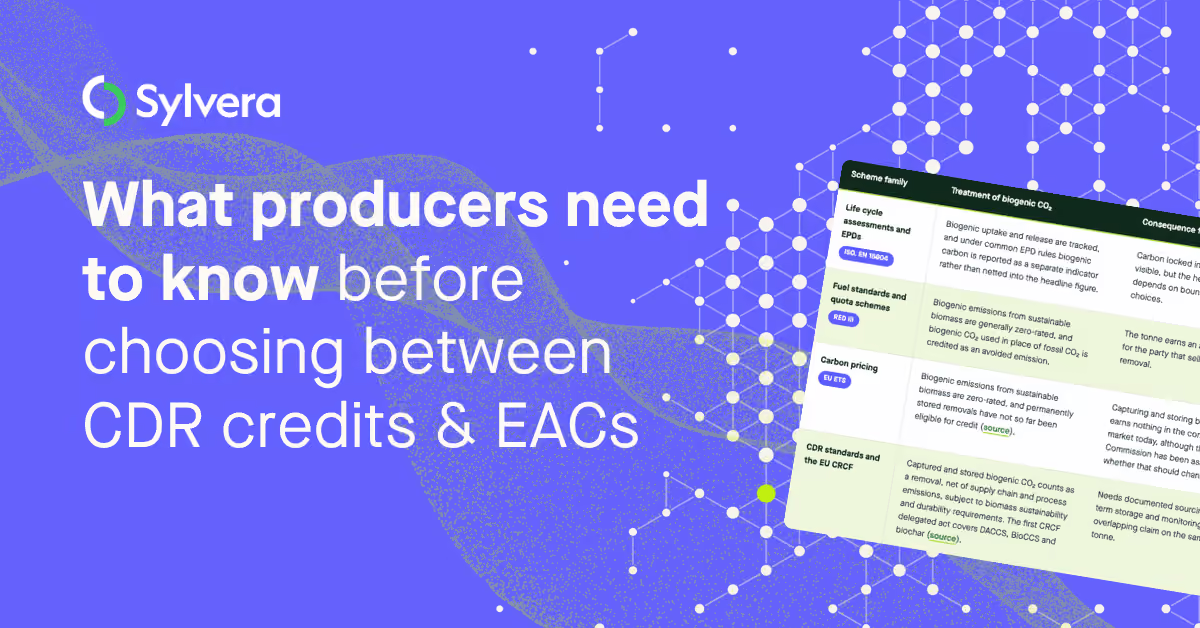
Buying lower-carbon steel, cement, fuels, and chemicals is how companies actually cut Scope 3. But supply is scarce: fewer than 2% of cement products currently qualify for environmental attribute certificates (EACs). Carbon intensity also varies more than fortyfold between cement facilities, for example, so prices should reflect actual, proven, low-carbon performance.
Until physical supply scales, EACs can bridge the gap, letting companies fund lower-carbon production before they can buy it directly.
COP31 brings this to the fore. The Built Environment day on 12 November and the Science, Industry and Technology day on 16 November will spotlight the Presidency's compact to cut energy use in buildings, its AI for Clean Technologies Initiative, and its matchmaking platform for industrial decarbonization in the least developed countries. In the formal talks, technology transfer sits alongside them.
What to watch
For corporates:
Watch for demand-side commitments on lower-carbon materials, such as procurement pledges and buyers' groups, and for how the buildings compact defines its targets. More commitments would mean more competition for scarce supply, making supplier carbon intensity data and early offtakes more valuable. Certificates remain a useful bridge in the meantime, but they earn a contribution claim; only physical purchases reduce reported Scope 3 emissions.
For governments:
Watch which countries back public procurement rules for cement and steel, or shared carbon intensity standards. Wider adoption would make low-carbon products easier to compare across borders, and give producers a clearer and more predictable market to invest for.
For developers and producers:
Watch whether the industry and technology initiatives come with finance or offtake commitments attached. If they do, they could help make new low-carbon capacity financeable. Either way, verified, plant-level carbon intensity data is what will earn a premium as demand grows.
3. Making carbon pricing and trade work together
Compliance demand is what turns climate commitments into substantial markets. In the US, renewable energy certificates used for compliance trade at many times the price of voluntary ones.
Carbon pricing and trade policy are converging fast, through the EU's Carbon Border Adjustment Mechanism (CBAM), the EU ETS revision, and a growing number of national emissions trading systems. CBAM is also widening: EU importers can buy certificates from February 2027, and the UK's own CBAM starts in January 2027.
As costs become real, CBAM is moving from compliance teams to finance teams. Companies increasingly treat it as a financial exposure, and banks and traders now offer ways to fix certificate prices in advance. The cost doesn't stay with importers either. Contracts often pass part of it back to exporters, so producers outside the EU carry some of the bill.
Türkiye was the EU's second-largest supplier of CBAM-covered goods by volume in 2023–25, mainly cement and steel. Its new ETS is designed with CBAM in mind, but companies don't surrender allowances until 2027, so EU importers can't deduct any Turkish carbon price from their 2026 CBAM bill.
Expect trade to be one of COP31's main talking points. The Finance and Trade day on 13 November will bring carbon pricing and CBAM to the main stage, and the forum on response measures is where countries raise the impact of each other's climate policies, including border measures. Coalitions are important here, too, and Türkiye has joined the Open Coalition on Compliance Carbon Markets alongside the EU, Brazil, and China.
What to watch
For governments:
Watch how the response measures debate and the Open Coalition on Compliance Carbon Markets handle border measures. Any progress toward recognizing carbon prices across borders would reward countries whose carbon pricing is designed, and timed, to be deductible under CBAM. Coalition announcements on linking compliance schemes to credit and certificate markets would also be worth noting.
For corporates:
Watch for new national carbon pricing announcements and any signals on CBAM implementation. Each would change suppliers' effective carbon costs and how CBAM exposure is shared in contracts, which is why finance and procurement teams should be following COP31 as closely as sustainability teams.
For developers and producers:
Watch for countries launching or tightening their own ETSs, and whether those schemes will accept credits. A domestic carbon price that EU importers can deduct lowers exporters' CBAM bills, and verified data proving lower emissions protects their margins either way.
What progress at COP31 would look like
Signs of progress would include:
- Demand-side commitments for lower-carbon materials.
- Further signals that compliance schemes will use credits and certificates.
- New Article 6 bilateral agreements, LoAs, and corresponding adjustments that help close the supply gap.
Ultimately, success across commodity and carbon markets is when buyers can source, price, compare, purchase, and claim low-carbon steel or a high-quality credit more easily.
That means connecting the data and decisions that are usually made separately, across carbon credits, lower-carbon materials, certificates, and compliance schemes.
Sylvera provides independent data and insights across carbon and commodity markets, so governments, corporates, developers, and producers can see what each option costs, what it counts for, and how the options fit together. Get started with free access here.