


“Over the years we’ve invested significantly in our field data team - focusing on producing trusted ratings. While this ensures the accuracy of our Ratings, it doesn’t allow the scale across the thousands of projects that buyers are considering.”

For more information on carbon credit procurement trends, read our "Key Takeaways for 2025" article. We share five, data-backed tips to improve your procurement strategy.

One more thing: Connect to Supply customers also get access to the rest of Sylvera's tools. That means you can easily see project ratings and evaluate an individual project's strengths, procure quality carbon credits, and even monitor project activity (particularly if you’ve invested at the pre-issuance stage.)
Book a free demo of Sylvera to see our platform's procurement and reporting features in action.
Producers of cement additives, construction materials, chemicals and fuels are weighing CDR credits and EACs side by side - but each mechanism plays by different rules
Producers of cement additives, construction materials, chemicals and fuels are looking for more ways to get paid for the carbon performance of what they make. A new plant usually needs signed offtake agreements before lenders and investors will commit capital, and a product sold on price alone is hard to finance.
One stream of carbon revenue is rarely enough to close that gap, so producers are diversifying, and in particular looking at carbon dioxide removal (CDR) credits and environmental attribute certificates (EACs) at the same time.
The difficulty is that the landscape is fragmented and difficult to navigate. Each mechanism comes with its own carbon accounting, its own treatment of upstream emissions, and its own rules on who can claim what, so a producer that spans several gets a different answer from each.
And buyers face the same problem from the other side. They find it hard to compare claims built on different rulebooks, and many do not trust carbon intensity figures that producers have calculated themselves. Convincing an offtaker of the number is often the slowest part of a deal.
This post sets out:
- Where CDR credits and EACs are starting to overlap
- How producers are weighing the two
- Where market intelligence, mechanism eligibility work and independent assurance make the difference
Where CDR credits and EACs overlap
The overlap shows up at several points in the value chain, and the producers involved share similar concerns even when their products have little in common.
Construction materials
In construction materials, developers that mineralize biogenic CO₂ from biogas often sell the product with its negative carbon footprint bundled into the price on an environmental product declaration, and customers have been willing to pay more for that than producers expected two years ago.
That works at pilot volumes, but as production scales, a premium that depends entirely on the physical market becomes harder to hold. Producers therefore need a way to monetize the carbon attribute beyond the physical sale, and EACs are the natural candidate, because they allow the attribute to be recognized and valued separately from the product and so help keep the premium up. Some are also weighing whether to split the footprint so that part is sold as removal credits and the rest stays with the product.
Supplementary cementitious materials (SCMs)
Supplementary cementitious materials (SCMs) add a further complication. Demand for new SCMs is rising because fly ash and slag supplies are shrinking as coal power and conventional steelmaking decline in Europe, and producers that mineralize CO₂ into them need a steady supply of it.
Much of the biogenic CO₂ available in parts of Europe already sits under the RED III greenhouse gas quota scheme, where the biomethane producer earns revenue by treating each tonne sold as a replacement for fossil CO₂. That tonne therefore already carries a claim, which raises the question of whether a removal credit can also be issued on it.
Fuels and chemicals
Fuels and chemicals sit closer still to the compliance world. A planned biomass plant with carbon capture, for example, might send part of its stack CO₂ to storage and combine the rest with hydrogen to make methanol, which leaves storage incentives, removal credits and fuel sales to reconcile.
The question is whether the removal outcome can be folded into the methanol’s carbon intensity to push it below zero, which would matter to buyers under maritime fuel rules. No single methodology covers the whole chain, so the certification picture is a combination of fuel, hydrogen and removal schemes that treat upstream biomass, grid electricity and fossil gas differently.
Minerals
Minerals face a version of the same problem at the product level. A carbonated mineral can be sold into cement, paint fillers, and cosmetics:
- Cement is a long-duration use that could support both EACs and removal credits
- Paint has uncertain permanence
- Cosmetics are single-use, so the claim there is closer to avoided emissions through substitution
One material therefore carries three different claims depending on where it ends up, and producers need to decide early what data to collect so that no option is lost as they scale.
Fuels and chemicals: the compliance layer
Across fuels and chemicals more broadly, producers often face a mix of compliance schemes — such as fuel standards, quota schemes and carbon pricing — alongside voluntary markets, and each treats the same plant differently. Compliance eligibility rarely covers the full value of a project, so voluntary credits or attribute certificates end up as part of the plan, and the producer has to understand how the layers interact before it can say what a tonne of product is worth.
How producers are weighing the two routes
The questions that come up every time
Producers rarely frame this as a choice between two labels. They frame it as a set of questions about one plant, and the same questions come up each time:
- What claim can they truthfully make on a tonne of product, and who else already holds a claim on the inputs?
- What is each route worth, and how quickly does the money arrive? A removal credit sold before issuance and an attribute certificate sold alongside a product have very different cash profiles, and lenders want to see contracted revenue before a plant is built.
- What data should they start collecting now?
The market question
Underneath these questions sits a market question. Producers want to understand:
- How large the potential markets are for each route
- How those markets are shifting
- How prices are changing, and who is buying
Removal credits and certificates sell to different buyer groups at different price levels, and those prices move at different speeds, so a producer needs that picture before it can compare the routes on expected value rather than on labels.
Does site choice matter?
Site choice feeds into this as well. For a producer choosing between several locations, electricity sourcing and downstream schemes can differ enough between sites that the value of each mechanism shifts with the location, so a cross-site comparison is worth running before committing to a plant.
Why eligibility is the hard part
In most cases the difficulty sits in eligibility rather than in the technology, and the same issues keep recurring: double counting, additionality and allocation.
How schemes treat biogenic CO₂, and why they disagree
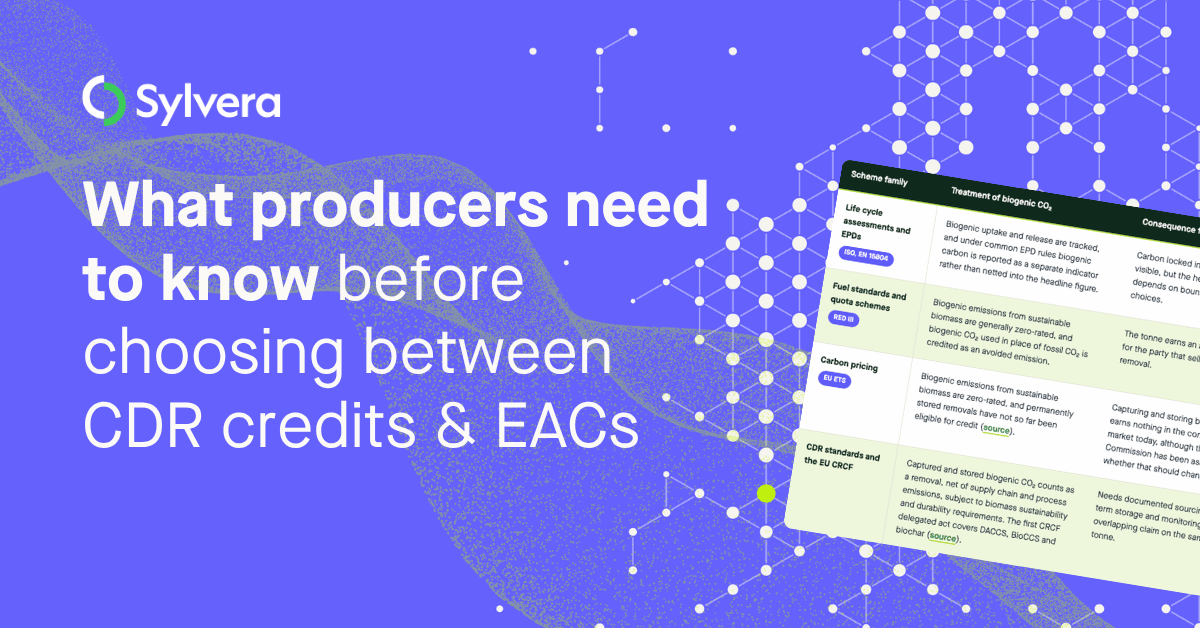
Biogenic CO₂ is where the rulebooks diverge most. The same tonne can be treated as neutral, as an avoided fossil emission, or as a removal, depending on which scheme is asking, and the treatments were not designed to fit together.
This is why an eligibility screen has to look at how each scheme treats biogenic CO₂ before any value is attached, and why a producer’s answer can differ so much from one route to the next.
Double counting: the most visible problem
Double counting of the CO₂ itself is the most visible issue. When biogenic CO₂ is sold out of a biomethane plant under a quota scheme, that tonne is already being counted as a replacement for fossil CO₂ — an avoidance claim. Issuing a removal credit on the same tonne raises the question of whether it has been counted twice, and the answer depends on how the scheme and the credit standard define exclusivity.
Additionality: often the bigger problem
In our view additionality is often the bigger problem. Take an SCM producer using CO₂ from biomethane plants. Double counting could in principle be addressed, but a removal credit built on CO₂ that was already being captured and sold would probably score poorly on financial additionality.
The economics point the same way. When a CO₂ source already earns several hundred euros per tonne under a quota, and removal credits sell for less than that, buying the CO₂ and reselling the credits does not close. In that situation CDR credits are probably not the right route to start with, and EACs or insetting through the product certificate deserve a closer look.
Allocation: where the schemes diverge most
Allocation is where the schemes diverge most. Once a plant produces a product and a removal at the same time, someone has to decide how much of the impact goes to each claim, and the schemes do not agree.
An ISO-style LCA accounts for upstream emissions in full, while RED III and the renewable fuels rules zero-rate certain inputs such as biomass or renewable electricity. The same plant can therefore show a different carbon intensity depending on which rulebook is applied, and whether a renewable power tariff is accepted or the grid average is used can move the result further.
Why independent assurance matters
Self-reported numbers are the first thing buyers question
Most of the carbon numbers in this market start in a self-reported LCA, and buyers are aware of that. Offtakers of low-carbon fuels and materials are therefore skeptical of carbon intensity figures that come only from the developer or from a consultant the developer hired, and removal buyers apply the same scrutiny to pre-issuance projects that have not yet generated data. For a producer raising financing, an unconvincing number delays the offtake agreement that the financing depends on.
What independent review typically finds
Independent review tends to find the same weak points:
- Capture rate assumptions are often optimistic and rarely modeled for degradation over a 15-year project life
- Grid electricity use is frequently underestimated, especially where power purchase agreements are involved
In one Sylvera carbon intensity assessment of a producer’s LCA, underestimated grid electricity use moved the carbon intensity by roughly 20%, although the result still cleared the buyer’s threshold. Finding that before production starts is far cheaper than finding it after an offtake has been signed.
What assurance does for both sides of a deal
Whichever route a producer takes, assessments of this kind do the same job. They show how a producer or developer is accounting for the risks in a project — from the carbon intensity of the product and the integrity of the claim to delivery, permanence and double counting — and they let an offtaker see that those risks have been examined by someone with no stake in the sale.
In effect the assessment takes part of the diligence burden off the buyer, which shortens the path to a signed agreement and gives lenders more confidence in the revenue behind the project.
How Sylvera supports producers across both streams
Start with data: understanding where demand is
Data is the starting point, as choosing the right route depends on understanding where demand is. Sylvera’s Market Intelligence covers:
- How large the potential markets are
- How they are shifting
- How prices are changing, and who is buying
It draws on proprietary pricing and demand data, and shows a producer which markets are worth pursuing — but not yet which of them a given facility can sell into.
Mechanism eligibility and value: answering the second question
Mechanism eligibility and value work answers that second question.
Starting from the market view, we:
- Map every voluntary, compliance, and stackable mechanism that could apply to the facility
- Run its LCA inputs through a common framework and screen each mechanism for eligibility with a plain reason for each result
- Price what is eligible using the same pricing and demand data
- Model how the value changes as allocation choices change — for example, how much of the impact goes to a removal claim and how much stays with the product
The output is a view of which combination of mechanisms is available, what each is worth over time, and where the double counting and additionality risks sit — which a producer can take to offtakers and financiers.
Assurance products: sitting next to the eligibility work
That work sits next to the assurance products:
- For CDR: Sylvera Ratings cover pre-issuance projects through integrity, delivery, value, and continuous improvement modules
- For EACs: EAC Assurance and Market Intelligence provides an independent assessment of carbon intensity, baseline integrity, additionality, and double-counting exclusivity
- For commodity producers whose buyers question the LCA: a carbon intensity assessment reviews the methodology and boundaries, tests the assumptions that matter most, and shows how the result moves under different mechanisms
As an independent provider, we do not run a registry and we do not run a mechanism, so there is no reason for us to steer a producer toward one route over another — and sometimes the data points away from the route the producer was expecting.
What producers can do now
Producers do not need to pick a route today, but they do need to avoid decisions that indirectly choose one for them.
In practice, that means:
- Building an LCA with clear boundaries and documented allocation choices
- Recording where the CO₂ comes from and who holds the environmental attributes attached to it
- Keeping monitoring data at a level that would satisfy more than one methodology
Those steps cost little early and are expensive to reconstruct later.
If you’re weighing CDR credits and EACs for a facility and want to see how the options compare, get in touch with the Sylvera commodities team.