“Over the years we’ve invested significantly in our field data team - focusing on producing trusted ratings. While this ensures the accuracy of our Ratings, it doesn’t allow the scale across the thousands of projects that buyers are considering.”

For more information on carbon credit procurement trends, read our "Key Takeaways for 2025" article. We share five, data-backed tips to improve your procurement strategy.
One more thing: Connect to Supply customers also get access to the rest of Sylvera's tools. That means you can easily see project ratings and evaluate an individual project's strengths, procure quality carbon credits, and even monitor project activity (particularly if you’ve invested at the pre-issuance stage.)
Book a free demo of Sylvera to see our platform's procurement and reporting features in action.
Data in this post is powered by Sylvera's Market Intelligence and Article 6 & CORSIA Hub.
Central Asia rarely features as a focus on most carbon market maps. Yet the region runs one of the world's oldest emissions trading systems, hosts the first policy crediting deal of its kind, and has a growing pipeline of projects. It’s showing clear progress, and the market is slowly taking notice.
Volumes remain modest, and much of the regulatory framework is still being finalized. Kazakhstan, Uzbekistan, Kyrgyzstan, Tajikistan, and Turkmenistan are each at a different stage, and together they offer a growing set of opportunities for buyers, investors, and developers who understand the region’s specific rules and risks.
Supply: small today, broad potential
Central Asia has issued ~30M credits to date, but only ~12.6M come from projects still active today. A pipeline of 30 projects could add ~11.9M credits a year once they start issuing.
Project type potential
The region's emissions profile points to several project types:
- Methane abatement. Aging gas networks and upstream oil and gas leak large volumes of methane. Leak detection and repair projects already dominate Uzbek issuance.
- Renewables. Strong wind and solar resources in Kazakhstan and Uzbekistan, plus hydropower in Kyrgyzstan and Tajikistan.
- Agriculture and land restoration. Vast steppe and degraded land. In August 2026, Kazakhstan's Ministry of Ecology and Natural Resources identified 5.2M hectares of non-forested state forest fund land for potential carbon projects.
- Energy efficiency. Soviet-era district heating, industrial plants, and building stock with high energy intensity.
- E-mobility and waste. Early-stage electric mobility programs in both Kazakhstan and Uzbekistan, and landfill gas capture.
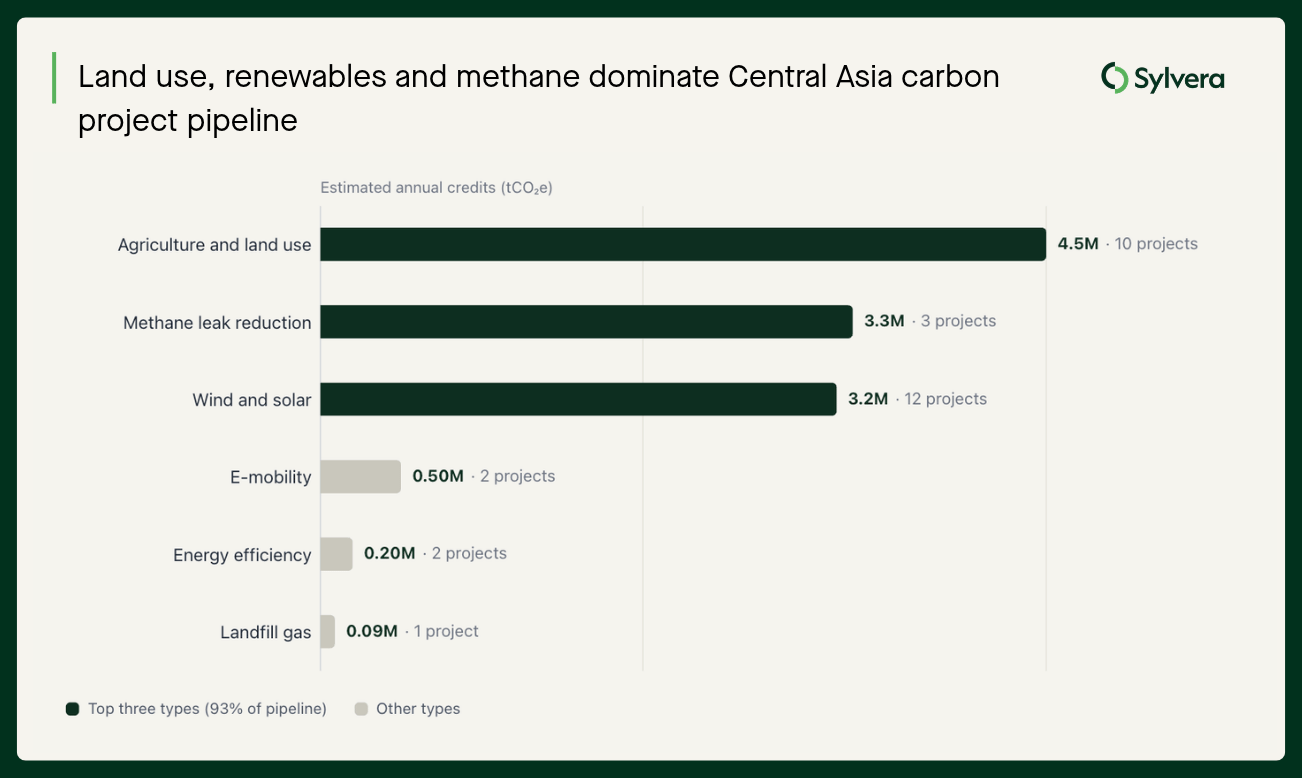
Source: Sylvera data as of 26 October 2026. Pipeline = registered or listed projects yet to issue.
Current supply
Each country is at a different stage. Uzbekistan accounts for most of the volume issued so far, largely thanks to a single Verra project, Hududgaz gas leak reduction (VCS4531), which cuts methane leaks across the country’s gas distribution networks. It has issued 9.5M credits, about 75% of issuance from active projects in the region.
Kazakhstan has the largest pipeline of projects in development, and Turkmenistan has yet to register its first project. Around 2.1M credits have been retired to date, so most recent issuance remains available to buyers looking for new sources of supply.
Source: Sylvera data as of 26 October 2026. Pipeline = registered or listed projects yet to issue.
CORSIA ready supply
Hududgaz is the only Central Asian project with CORSIA-eligible credits today, but more could follow. Sylvera data flags 15 more projects in the region as potentially CORSIA-eligible. They meet CORSIA’s program, methodology, and vintage criteria and need only an LoA and a corresponding adjustment to qualify. Eleven are in Kazakhstan, three in Uzbekistan, and one in Kyrgyzstan. None has issued yet.
Methane leads here too. Three advanced leak detection and repair projects, covering Uzbekneftegaz and KazMunayGas upstream facilities and Almaty’s gas distribution network, together estimate ~3M credits a year. The rest of the list includes soil carbon projects on Kazakhstan’s steppe, landfill gas capture in Karaganda, e-mobility in Uzbekistan, and heat pumps in Kyrgyzstan. How quickly host countries issue LoAs will decide how much of this supply reaches buyers.
Case study: Uzbekistan, from policy crediting to ITMOs
Uzbekistan has moved faster than its neighbors on international carbon markets.
iCRAFT. In October 2023, Uzbekistan and the World Bank signed a $46.25M agreement for the Innovative Carbon Resource Application for Energy Transition (iCRAFT) project. It was the Bank's first policy crediting program and the first international carbon transaction in Central Asia under the Paris Agreement. Instead of crediting individual projects, iCRAFT pays for emission reductions from national energy reforms: cutting subsidies, raising tariffs toward cost recovery, and improving efficiency.
In June 2026, Uzbekistan received the third and final payment under the purchase agreement. In total, the program paid $20M for 1.33M verified tonnes. Between 2022 and 2024, the reforms avoided an estimated 23.7M tonnes, so most of the impact remains uncredited. iCRAFT also funded the national monitoring, reporting, and verification (MRV) system Uzbekistan needs for Article 6. The program runs to 2028, and the World Bank says Uzbekistan is now preparing its first international carbon market transaction.
ITMOs and CORSIA. In 2025, Presidential Decree PD-110 set out Uzbekistan's approach to Article 6, including ITMO budgets and authorization. Uzbekistan has bilateral arrangements with Japan and South Korea. In December 2025, the Ministry of Economy and Finance issued its first Letter of Authorization (LoA) for VCS4531. It authorizes the credits for use toward other countries' NDCs or CORSIA, and some are already CORSIA-eligible.
Project types to watch. Uzbekistan's interim rules for voluntary market projects, Cabinet Decision No. 117 (2024), approve renewable energy, energy efficiency, industrial, reforestation, waste management, water and sanitation, and green building projects. No Article 6 positive list has been published yet. The strongest near-term opportunities are methane leak reduction, which is already authorized and CORSIA-eligible, and industrial gases from legacy CDM projects.
Energy efficiency, agriculture, and utility-scale renewables also have momentum, though grid-connected renewables are largely excluded from CORSIA's First Phase.
Demand: compliance, not voluntary, will drive the market
Local voluntary demand is minimal. The real demand signal comes from compliance: CORSIA, the EU's Carbon Border Adjustment Mechanism (CBAM), and domestic carbon pricing.
Voluntary demand: limited
Few Central Asian companies have made public climate commitments. Of the 14,353 companies on the SBTi Target Dashboard, Kazakhstan is the only Central Asian country represented. No companies from Uzbekistan, Kyrgyzstan, Tajikistan, or Turkmenistan appear.
Low retirements tell the same story, and the most visible recent buyer is an airline.
CORSIA: the nearest-term opportunity
CORSIA is the region's biggest near-term demand opportunity. Sylvera estimates CORSIA First Phase (2024–2026) demand at 193M–220M credits, against only ~50M eligible credits tagged so far. Airlines need authorized supply, and few host countries can provide it yet.
Uzbekistan is already moving to capture that gap. Its first LoA covers the Hududgaz methane project. About 500K of its 2024-vintage credits are now tagged as CORSIA First Phase eligible, backed by an insurance product that protects buyers if the CA is not applied. In July 2026, Singapore Airlines Group retired these credits, making them the first Uzbek and the first fugitive emissions credits used for CORSIA. Those retirements account for roughly half of all CORSIA retirements to date.
The constraint is the export ratio. Under interim Cabinet Decision No. 117, credits sold outside Article 6 are capped at 1% of national emissions, or ~2.1M credits based on Uzbekistan's latest inventory. At least 50% of net credit sales from privately led projects also go to the state. Forthcoming Article 6 regulation is expected to replace these rules. The ITMO volume it allows abroad will decide how much of the CORSIA gap Uzbekistan can fill.
Compliance demand: CBAM changes the math
Compliance systems can create steady local demand for carbon credits and help a country build its carbon ecosystem. For example, Colombia’s carbon tax, lets companies meet part of their obligation with credits from eligible projects. That created a reliable domestic buyer base and helped grow local developers, validators, and even carbon standards and registries.
CBAM gives Central Asia a reason to follow suit. Since January 2026, EU importers of steel, aluminum, cement, fertilizers, electricity, and hydrogen pay for embedded carbon, minus carbon prices already paid at home. Kazakhstan exports more than €600M of steel and aluminum to the EU each year, and CBAM could cost its steel exporters over €100M a year. A stronger domestic carbon price would keep more of that money at home.
Kazakhstan has the region’s only working compliance market, and its ETS accepts domestic credits, giving local projects buyers at home. Uzbekistan is developing an ETS. Kyrgyzstan, Tajikistan, and Turkmenistan have no carbon pricing in place.
Case study: the Kazakhstan ETS
The Kazakhstan ETS is one of the world's longest-running emissions trading systems, and the most mature carbon market in the region.
Source: ICAP, October 2026.
The system has longevity but little price signal. Free allocation and a price below $1 give firms little reason to cut emissions, and almost nothing to deduct against CBAM. Exchange trading has been suspended since 2022.
Reform is underway. Phase 6 began in 2026 and runs to 2030. The draft allocation plan proposed annual cap cuts of 10.4%–23% from the 2025 level, and auctioning is in development. New rules on Article 6 projects (Ministerial Order No. 145) took effect on 10 August 2026, covering validation, authorization, and international transfers. If the cap tightens and prices rise, domestic offset demand could grow quickly.
Regional collaboration: building the market together
Regional cooperation could help Central Asia’s carbon markets grow faster together than apart. Each country brings different strengths. Kazakhstan has more than a decade of ETS experience, Uzbekistan is developing its own ETS and has issued its first Article 6 authorization, and both now have Article 6 rules in place. Across the region, Kazakhstan, Uzbekistan, and Kyrgyzstan have signed 6 Article 6 bilateral agreements between them. That mix of experience is an opportunity for countries to learn from each other. The Kyrgyz Republic’s new iFIRST program, for example, builds directly on Uzbekistan’s iCRAFT, adapting a proven model rather than starting from scratch. Aligning rules and sharing infrastructure could make the region easier for international buyers to navigate, and international partners are already supporting that work.
The next step is to join these national efforts up. Shared MRV standards, registries that can talk to each other, and common approaches to authorization would let buyers treat Central Asia as one market rather than five small ones.
A market gaining readiness
Central Asia is not yet a major source of carbon credits, but the direction is clear. Uzbekistan has shown that policy crediting and Article 6 authorizations can work. Kazakhstan has 13 years of ETS experience and is reforming under CBAM pressure. A pipeline of ~11.9M credits a year is waiting to be issued. With CORSIA supply this short, authorized Central Asian credits should not struggle to find buyers.
What happens next depends on execution: corresponding adjustments applied on time, registries that work, and carbon prices high enough to matter. Buyers who understand these risks early will be best placed to act.
Sylvera's Article 6 & CORSIA Hub tracks LoA and CA risk for Uzbekistan and other host countries.