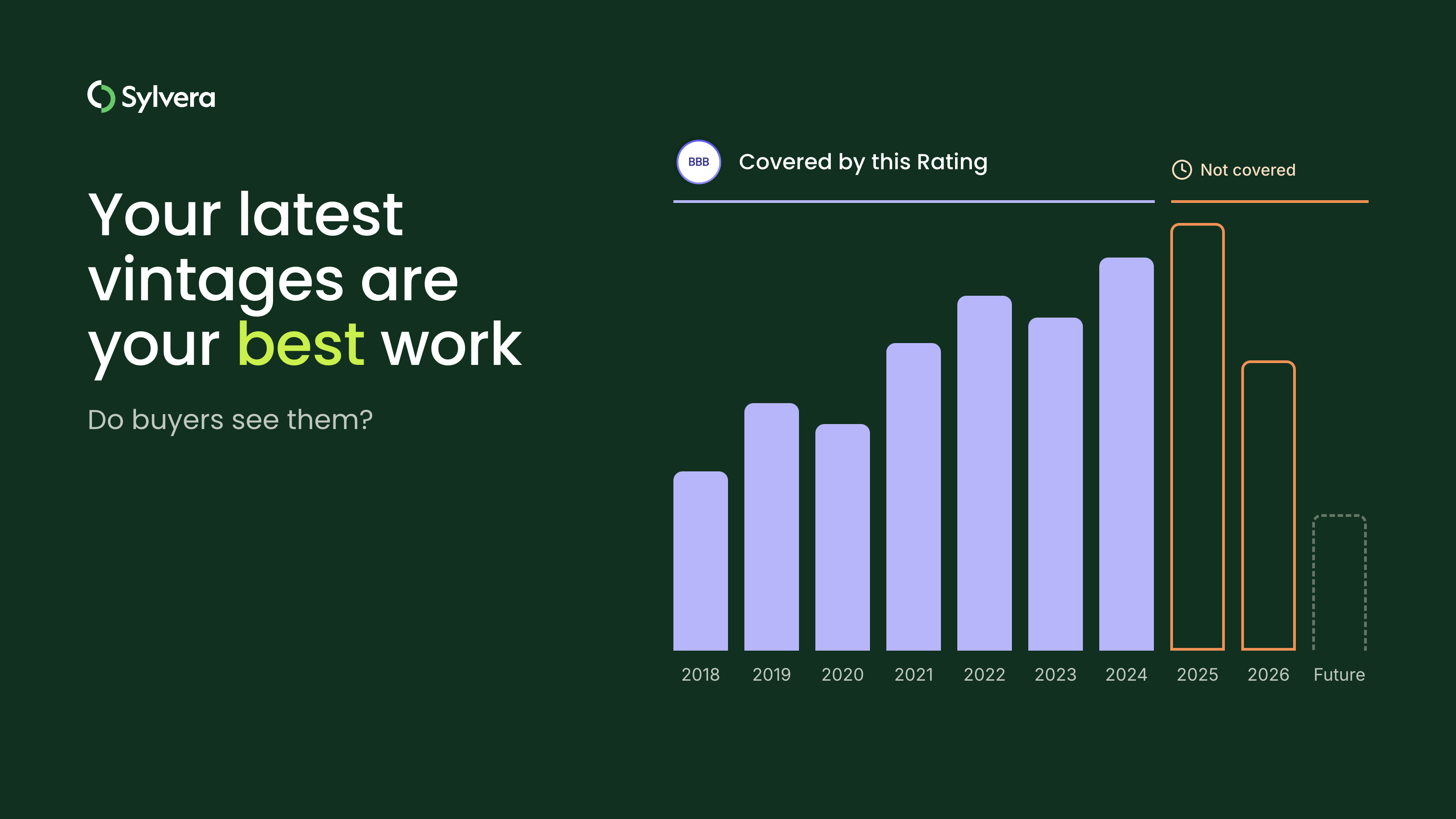


“Over the years we’ve invested significantly in our field data team - focusing on producing trusted ratings. While this ensures the accuracy of our Ratings, it doesn’t allow the scale across the thousands of projects that buyers are considering.”

For more information on carbon credit procurement trends, read our "Key Takeaways for 2025" article. We share five, data-backed tips to improve your procurement strategy.
One more thing: Connect to Supply customers also get access to the rest of Sylvera's tools. That means you can easily see project ratings and evaluate an individual project's strengths, procure quality carbon credits, and even monitor project activity (particularly if you’ve invested at the pre-issuance stage.)
Book a free demo of Sylvera to see our platform's procurement and reporting features in action.
What are EACs?
Environmental attribute certificates (EACs) - also called commodity certificates - separate the environmental benefit of a lower-carbon commodity from the physical commodity itself, allowing that benefit to be sold independently.
The concept is well established in the energy market through Renewable Energy Certificates (RECs) and Guarantees of Origin (GOs). It’s now extending rapidly into hard-to-abate commodities such as cement, ammonia, steel, hydrogen and fertiliser.
Three developments have accelerated this shift. ISO published its first book-and-claim chain-of-custody standard, ISO 22095-3, and opened consultation on ISO 14060, its first net zero standard for organisations, which sets out how commodity certificates can be claimed against a net zero pathway. Alongside this, SBTi's final Corporate Net-Zero Standard v2.0, published in June 2026, set out how EACs can be used against Scope 3 targets.
This guide is to help buyers and producers better understand EACs, how they work, and key considerations right now.
EAC questions for buyers
If I buy a certificate instead of the physical product, what can I actually claim?
The key distinction is between a) insetting and b) an EAC.
- If a lower-carbon product physically reaches you within your value chain - either with its attributes kept bundled to the product, or via mass balance - that is insetting, and it counts as an in-value-chain Scope 3 reduction.
- If the environmental benefit has instead been separated from the physical product and sold to you independently, that is book-and-claim: an environmental attribute certificate. In this case, you are purchasing the claim to an emissions reduction, not the underlying product, and matching that claim to a product you are already sourcing elsewhere in your value chain.
Book-and-claim sits separately from your physical value chain reporting. It is not a substitute for it, and should be tracked and disclosed as a distinct instrument rather than folded into physical supply-chain claims. Physical delivery of the lower-carbon product should always be the priority; EACs are a bridge to use where physical delivery isn't yet possible, not a replacement for it once it is.
Under ISO 22095-3 and SBTi guidance, that claim holds up when the certificate matches the commodity, falls within a similar time window, carries third-party verification, and is not claimed by any other party. Many buyers assume a credible claim requires physical delivery of the lower-carbon product.
For most of today's market, physical delivery simply isn't possible yet. Until it is, EACs are designed to close that gap, not replace the goal of physical delivery.
For example: in May 2026, PepsiCo signed its first low-carbon ammonia EAC agreement with TalusAg, covering approximately 30,000 tonnes with an option for a further 41,000, structured as a book-and-claim deal with certificates issued by S3 Markets. Deals like this position EACs as a catalytic investment tool - a way to scale lower-carbon commodity production now, with physical lower-carbon supply as the end goal.
How do I know if one EAC is better than another?
An EAC is a claim, so its quality depends entirely on how defensible that claim is. Three factors determine this:
- Carbon intensity - the emissions associated with one tonne of commodity production, and the scale of reduction against the relevant baseline
- Additionality - whether the reduction would have happened regardless of the certificate transaction, a factor different buyers weight differently
- Delivery risk - whether the promised volume is actually realised
There is currently no reliable quality-to-price correlation in the EAC market, because the market has not yet matured enough to establish one. Understanding what a specific certificate represents - and what it is actually worth - is essential before committing to a purchase.
How are EACs priced when so little has traded, and how do I know I'm not overpaying?
Very few EAC transactions have been made public, and most visible market activity consists of bids and offers rather than closed deals. But EAC pricing decisions shouldn't be made by comparing certificates in isolation - they should be assessed against the value a given certificate delivers toward your decarbonisation goals, both voluntary and compliance-driven.
A useful anchor is your organisation's internal cost of carbon, benchmarked against relevant counterfactuals. A defensible price sits between a floor - roughly the cost of producing the reduction - and a ceiling, representing what that reduction is worth to your organisation.
That ceiling should account for carbon intensity, integrity, and the underlying commodity, and should be weighed against your other decarbonisation purchase options. For example, under SBTi, comparing EACs against carbon removal credits in terms of how each is accounted for, how each can be used, and the value each brings.
EAC FAQs for producers
Can I sell the environmental benefit separately if I can't sell the physical lower-carbon product?
Yes - this is exactly where book-and-claim creates value. You separate the environmental attribute from the physical commodity and sell the certificate to a buyer seeking that benefit, while the physical commodity continues to move through its normal market channel.
Unbundling in this way is a revenue lever, capable of funding decarbonisation investment that a physical green premium alone rarely can. There is one rule that cannot be broken: once the environmental attribute has been sold, the buyer of the physical product can no longer claim it as low-carbon.
Selling the same reduction twice constitutes double counting, and the claim collapses for every party attached to it. This is precisely why robust third-party verification and systems of record are critical to a credible EAC market.
If I sell the certificate, do those emissions stay on my books?
As a general rule, the producer retains the physical reduction against its own Scope 1 and Scope 2 emissions at the facility, while the certificate carries the environmental benefit into the buyer's Scope 3 accounting. The two should not overlap. ISO 22095-3 and SBTi guidance set the conditions required for that split to hold: commodity match, a similar time window, third-party verification, and no double counting.
In practice, treatment depends heavily on how the specific deal is structured. The GHG Protocol is still developing its Actions and Market Instruments Standard, which will govern exactly how this nets out, meaning this is still developing ground, and any specific transaction should be checked against current guidance rather than assumed from a general rule.
This is also the area where credibility is most easily won or lost, making it worth resolving before any certificate changes hands.
My carbon intensity changes between where I produce and where the product is delivered. What baseline applies?
Baselining is the unglamorous part, and it is where certificates get challenged most often. A weak baseline is the fastest way to watch a claim unravel under scrutiny. If you are a producer, this deserves more of your attention than the pricing conversation, because the pricing means nothing if the baseline does not hold.
Start by separating two things:
The certificate - this carries the product carbon intensity and a baseline, which is the carbon intensity of the product yours most likely displaced. This baseline is set at issuance and uses the same measurement boundary and PCR as the product, as well as being third-party verified and updated over time. How exactly it is determined depends on whether you are decarbonising an existing facility or building a new one.
The buyers' claim - this is where the reduction is realised. Using enhanced substitution, the buyer compares your intensity to the baseline to adjust their own inventory, floored at zero. Where their market differs from yours, they may apply a baseline matched to their market, following the same selection rules, on the same PCR.
Where the EAC market is heading
What Sylvera's 2026 EAC market survey tells us
Sylvera's recent survey of producers and buyers across the commodity landscape found a market forming faster than its supporting infrastructure. Headline findings include:
- 75% of producers expect to begin issuing EACs within three years, with 2027 the most commonly cited start date
- Buyer demand is building too, with respondents indicating annual appetite of 1.7–2.1 million EACs through 2030
- SBTi compliance is the leading driver of buyer intent - shortly before the SBTi V2 was released, 78% of buyers cited published SBTi targets as their main reason for purchasing
- Pricing remains the biggest open question: 31% of producers named pricing benchmarks as their top need, with stated prices ranging anywhere from $5 to just under $400 per certificate
- Cement and concrete was the largest producer segment surveyed (27%), followed by biofuels (24%)
Download the EAC Market Survey Report here.

Reliable pricing data, and clearer visibility into supply and demand, are the missing pieces that will let both buyers and producers set strategy with confidence rather than guesswork.
Until that data infrastructure matures, the producers who understand the underlying systems, frameworks and baselining requirements - and the buyers who interrogate certificate quality before the market forces them to - are the ones securing the better deals.
How Sylvera supports the EAC market
Sylvera applies the same independent, science-led rigour behind Sylvera Ratings - the industry standard for carbon credit quality assessment - to environmental attribute certificates.
Our EAC Assurance and Market Intelligence is the assurance and intelligence layer that lets buyers and producers transact in the EAC market with confidence, backed by a proprietary framework that is mechanism-agnostic, repeatable, transparent, and free of conflicts of interest.
The offering covers three core areas:
Pre-issuance assessments. Independent assessment of an EAC's eligibility and integrity before issuance, de-risking offtake agreements before production even begins.
Independent verification and assurance. Independent verification at the point of issuance, plus ongoing integrity checks for the life of the certificate, replacing one-off due diligence that goes stale the moment it's signed off.
EAC value modelling and forecasting. Built on historic and live market activity - including proprietary offtake and pricing data - to produce long-term supply and demand scenarios out to 2050.
Book a demo to see how Sylvera's EAC Assurance and Market Intelligence can support your next transaction.
More Levers, Harder Choices: Carbon Credits, Commodities & EACs Under SBTi V2
Now that there's more than one way to move a scope 1/2/3 number, the core questions buyers keep asking is simple: what are the real options? What does each cost per tonne? And where do they actually count?
Carbon credits, physical lower-carbon supply, and EACs are usually priced and evaluated on their own terms. This webinar will place them in one room and price them against each other.