“Over the years we’ve invested significantly in our field data team - focusing on producing trusted ratings. While this ensures the accuracy of our Ratings, it doesn’t allow the scale across the thousands of projects that buyers are considering.”

For more information on carbon credit procurement trends, read our "Key Takeaways for 2025" article. We share five, data-backed tips to improve your procurement strategy.
One more thing: Connect to Supply customers also get access to the rest of Sylvera's tools. That means you can easily see project ratings and evaluate an individual project's strengths, procure quality carbon credits, and even monitor project activity (particularly if you’ve invested at the pre-issuance stage.)
Book a free demo of Sylvera to see our platform's procurement and reporting features in action.
Buyers no longer treat carbon credit quality as pass or fail. They look at specific attributes, and they pay for them: in Q3 2026, ARR credits rated BBB and above averaged $23.47, almost twice the $12.80 paid for those rated BB and below.
So what actually separates a BBB-rated project from a BB-rated one? Using the scores across Sylvera-rated projects, this post compares how projects at each Rating level score on the pillars that make up quality. It looks at which patterns hold across project types, what high- and lower-rated projects have in common, and where developers can focus.
Download the 2027 Developer's Guide to see how your project's attributes compare, and what it takes to reach investment grade. Download the guide.

How carbon credit ratings assess quality
Sylvera Ratings assess the risk-adjusted climate impact of each credit, on a scale from AAA to D. A BBB Rating is increasingly seen as the benchmark for investment-grade credits.
Each Rating combines three carbon attributes:
- Carbon Accounting: did the project reduce or remove what it claims, with honest uncertainty ranges? Its Carbon Score estimates how much of a project's claimed carbon impact is real, on a scale of 0 to 100.
- Additionality: would this impact have happened without carbon finance? Scored from 1 to 5.
- Permanence: will the impact last, given natural and human reversal risks? Scored from 1 to 5.
Co-benefits, the wider benefits for local communities and biodiversity, are scored separately from 1 to 5. They don't count toward the Rating, so a strong co-benefits story can't mask a weak carbon claim.
How the attributes compare across Ratings
We analysed the average score on each attribute for rated projects at every Rating level, across five project types. To compare high- and lower-quality projects, we grouped those levels into two bands, BBB and above and BB and below, and compared their average scores.
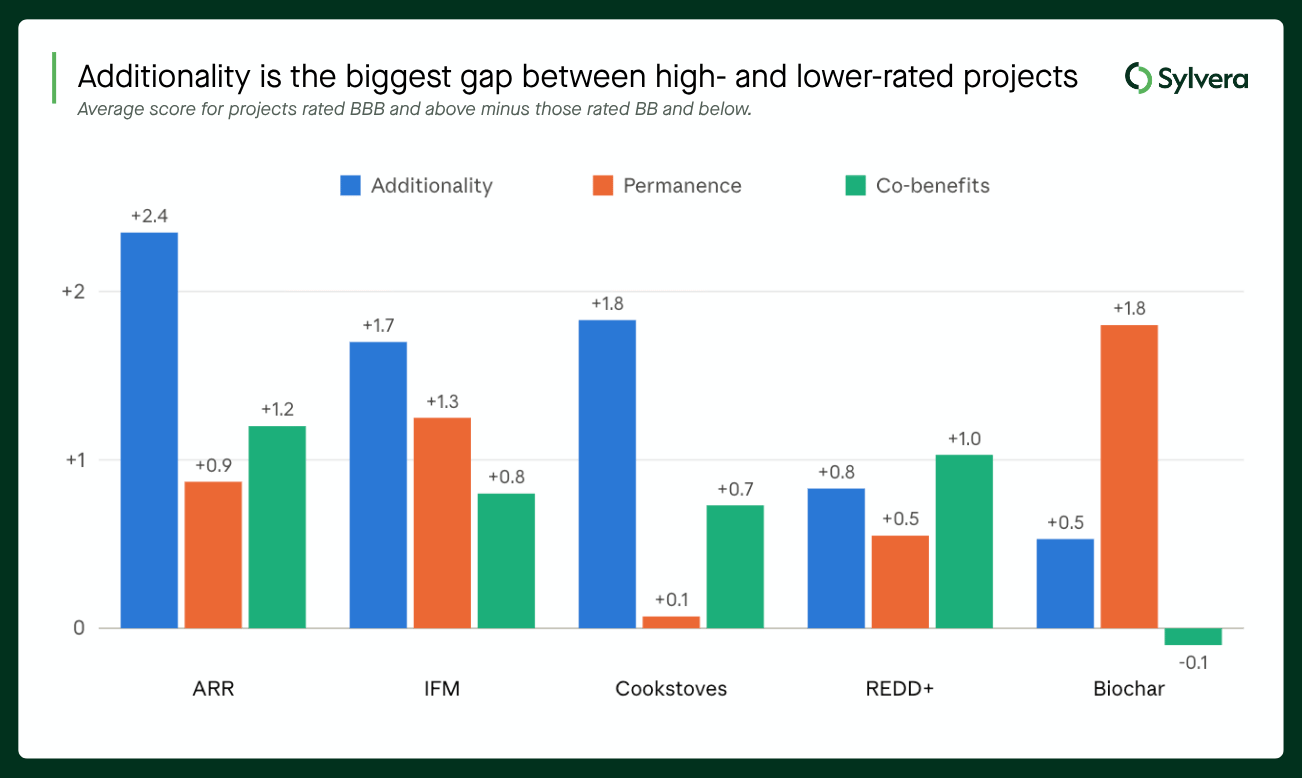
Average score for projects rated BBB and above vs BB and below. Simple average of each Rating level's score. Some levels, especially the highest and lowest, are based on small samples. Source: Sylvera, Q3 2026.
The trends that carry across project types
1. Additionality is the biggest differentiator. In ARR, IFM, and cookstoves, additionality shows the widest gap between high- and lower-rated projects. ARR projects rated BBB and above average 4.2 on additionality, against 1.9 for those rated BB and below. It's also the clearest step at the investment-grade threshold: average ARR additionality jumps from 2.4 at BB to 3.6 at BBB.
2. A strong Carbon Score is necessary, but not enough. Carbon Scores don't rise neatly with Ratings. C-rated ARR projects average 81.3, higher than BBB-rated ones at 74.9, and IFM and REDD+ projects score in the 90s at almost every Rating level. Where Carbon Score does separate projects, it's at the extremes: D-rated REDD+ projects average just 25.8, pointing to significant over-crediting.
3. Permanence matters most where reversal risk is highest. The permanence gap is largest for biochar (4.8 vs 3.0) and IFM (3.3 vs 2.0), and smallest for cookstoves, where reversal risk is less of a factor.
4. Co-benefits track quality, even though they're scored separately. In four of five project types, projects rated BBB and above also score higher on co-benefits. For REDD+, co-benefits show the biggest gap of the attributes scored from 1 to 5, rising from 2.8 at BB to 4.0 at BBB. Projects built with strong carbon integrity tend to deliver for communities and nature too.
What high-quality projects have in common
Projects rated BBB and above tend to share four traits:
- A well-evidenced additionality case. Investment-grade ARR, IFM, and cookstove projects average 3.7 to 4.2 on additionality, with clear evidence that carbon revenue overcomes real financial or policy barriers.
- Credible carbon accounting. Conservative baselines and honest uncertainty ranges keep Carbon Scores high. Investment-grade REDD+ projects average 96.6.
- Managed reversal risk. Permanence scores of 3 or more, backed by monitoring, buffer coverage, and protection strategies. For biochar, investment-grade projects average 4.8.
- Verified co-benefits. Co-benefits scores of around 3.4 to 3.9, typically backed by evidence rather than claims.
What holds lower-rated projects back
Projects rated BB and below usually fall short on at least one attribute, and the weak spot differs by project type:
- ARR, IFM, and cookstoves: weak additionality. Lower-rated ARR and IFM projects average around 2.0, suggesting the project might have gone ahead without carbon finance.
- REDD+: over-crediting and weaker co-benefits. Lower-rated REDD+ projects average a Carbon Score of 75.6, against 96.6 for investment-grade ones, largely driven by D-rated projects.
- Biochar: permanence. Lower-rated biochar projects average 3.0 on permanence, against 4.8 for investment-grade projects.
A single weak attribute is enough to pull a Rating down. Because a Rating combines several attributes, a project can score well on one and still receive a lower Rating if another is weak.
Prices by quality split
Higher-rated credits sell for significantly more across every major nature-based project type:
Average retirement price by Rating band, Q3 2026. Source: Sylvera.
The premium continues above investment grade. AAA-rated biochar projects command around 40% more than BBB equivalents, and AAA cookstove projects around 25% more. Co-benefits pay too: nature-based projects with a Sylvera co-benefits score of 5 average $25, against $14.50 for a score of 4 and $10.50 for a score of 3. Those premiums are stronger and more stable when co-benefits are verified through standards such as CCB or SD VISta.
Quality has costs as well as rewards. A stronger Rating may mean fewer credits issued, or extra spending to reduce reversal risk. And revenue sharing with communities can represent 20–90% of project costs, based on Sylvera research with 25 projects in 2026. What matters is net price, not headline price.
What developers can focus on
The data points to a clear set of priorities.
Make additionality airtight. For ARR, IFM, and cookstoves, it's the attribute most likely to decide whether a project reaches investment grade. Document the financial and policy barriers that carbon revenue overcomes, and test your argument before registration, when it's still fixable.
Be conservative on carbon accounting. A defensible baseline and honest uncertainty ranges protect your Carbon Score, and they protect your relationship with investors when projections are tested.
Plan for reversal risk from day one. Monitoring, buffer coverage, and protection strategies matter most for project types where impact can be reversed.
Verify your co-benefits. They don't count toward the Rating, but they track quality and carry their own price premium.
If an attribute requires improvement, developers have options:
A weak additionality argument that would cost a Rating level at issuance might take weeks to address during design, but be impossible to fix after registration. A Pre-Issuance Rating shows where your project stands on each attribute while there's still time to act, and highlights areas for improvement that could lead to a higher Rating. After issuance, sharing new documentation keeps your Rating current.
What buyers are looking for
Buyers are increasingly looking past labels to the underlying attributes. Even CCP-accredited projects span a wide range: 36% are rated BBB and a further 36% are rated B. So buyers ask attribute-level questions:
- Is the project baseline visible, with an uncertainty disclosure?
- Is additionality clearly proven and documented?
- Are reversal and permanence risks managed transparently, with buffer coverage?
- Has the project been independently rated or reviewed?
- Are safeguards and stakeholder benefits demonstrated, including free, prior, and informed consent?
- Is there a regular verification cadence, with published monitoring, reporting, and verification data?
The emphasis shifts by project type. For nature-based projects, buyers focus on baseline accuracy, leakage, and monitoring. For durable carbon removal, they look at energy sources, lifecycle emissions, and long-term storage liability. In every case, an independent Rating with a detailed breakdown of each attribute answers many of these questions in one place.
Get the full guide
The 2027 Developer's Guide includes the full attribute score tables for every Rating level, alongside pricing by region and vintage, eligibility rules for compliance and Article 6 markets, and a stage-by-stage checklist for bringing your project to market.
Download the 2027 Developer's Guide to see how your project's attributes compare, and what it takes to reach investment grade. Download the guide