





“Over the years we’ve invested significantly in our field data team - focusing on producing trusted ratings. While this ensures the accuracy of our Ratings, it doesn’t allow the scale across the thousands of projects that buyers are considering.”

For more information on carbon credit procurement trends, read our "Key Takeaways for 2025" article. We share five, data-backed tips to improve your procurement strategy.
One more thing: Connect to Supply customers also get access to the rest of Sylvera's tools. That means you can easily see project ratings and evaluate an individual project's strengths, procure quality carbon credits, and even monitor project activity (particularly if you’ve invested at the pre-issuance stage.)
Book a free demo of Sylvera to see our platform's procurement and reporting features in action.
Why the Decarbonization Choice Is So Complicated
For years, most companies followed a single path to corporate decarbonization. First, you cut greenhouse gas emissions, usually through energy efficiency measures. Then, you bought carbon credits to offset the rest of your company's carbon footprint. There was generally considered this one lever to pull, one market to operate within, and one decision to make. Many organizations still plan that way.
But the supply side has evolved. Producers now sell lower-carbon steel, cement, ammonia, and fuels at scale, and attribute certificates let buyers claim the carbon benefit without physical delivery. Supply chain decarbonization has further tools beyond supplier engagement.
However, regulatory frameworks haven't kept pace. SBTi, the GHG Protocol, and the EU's Carbon Border Adjustment Mechanism (CBAM) treat these levers differently. Furthermore, SBTi and the GHG Protocol have published or are finalizing revised rules that take effect through 2027 and 2028.
The result? A plan built around one lever concentrates risk.
A plan that sequences several, on the other hand, usually holds up better, costs less, and gives business leaders an easier story to defend to auditors, investors, and other stakeholders. In other words, a diversified approach is preferred.
The Four Decarbonization Levers
The levers below play a crucial role in a strong decarbonization strategy. It's important to understand the differences between them and what you're actually buying with each lever.
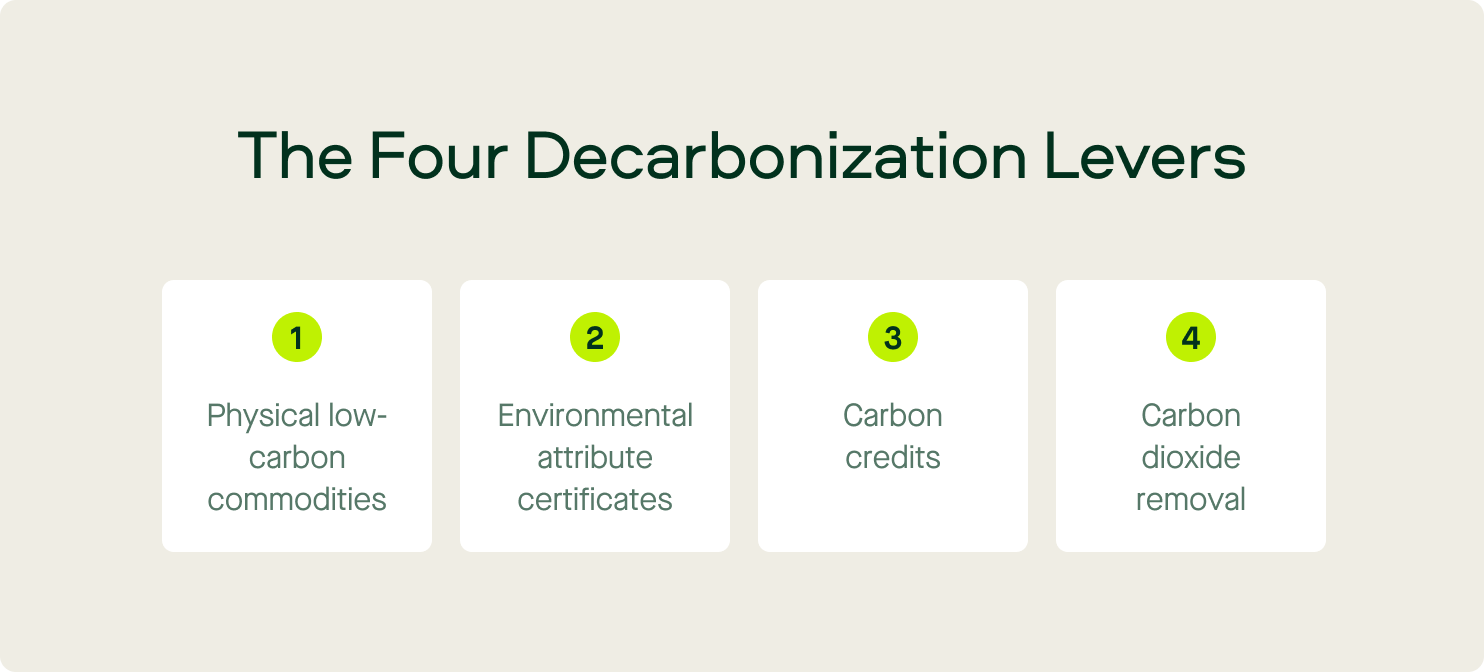
1. Physical Low-Carbon Commodities
With this lever, you buy the lower-carbon product itself, such as steel from mills that use hydrogen instead of fossil fuels. Its embodied carbon is lower, so this lever cuts Scope 3 supply chain emissions directly. However, availability, geography, and logistics limit what your supply chains can deliver today, and you need to account for these constraints when developing your strategy.
2. Environmental Attribute Certificates
Environmental attribute certificates (EACs) are another lever, and they separate the carbon benefit from the physical product, which solves the logistics problem. Just remember, the market uses the acronym "EAC" for two different instruments: commodity certificates and renewable energy certificates. You need to understand the differences between them to properly use the EAC lever in your strategy.
3. Avoidance or Reduction Carbon Credits
Avoidance carbon credits are the most established lever. Going back to basics, a credit represents one tonne of CO2e avoided or removed outside your value chain. The market for them is mature, but quality varies. Most frameworks treat credits as compensation rather than as reductions in your own emissions inventory.
4. Carbon Dioxide Removal Credits
Finally, the carbon dioxide removal (CDR) lever pays for the durable removal of CO2 that's already in the atmosphere via direct air capture (DAC), biochar, enhanced rock weathering, or bioenergy with carbon capture and storage (BECCS). Compared to avoidance or reduction credits, it has a generally much higher cost per tonne, and most frameworks expect it to be used against residual emissions.
How the Four Levers Compare
Note: Commodity premiums apply per tonne of product, while credit and removal prices apply per tonne of CO2e, so convert both to cost per tonne abated before comparing.
Now, there are two things you need to know about the comparison above:
- Inventory treatment is a common stumbling block. Physical commodities reduce Scope 3 when verified carbon data backs the purchase. Credits compensate for emissions that remain in the inventory, and SBTi's Corporate Net-Zero Standard V2 bars companies from netting them against it. Attributes sit in between. Under V2, mass balance within the supply pool you buy from can shrink your footprint, while book-and-claim certificates are separate and only support a "system contribution" claim. CDR neutralizes residual emissions rather than reducing them at the source.
- Compliance recognition varies by jurisdiction. CBAM prices the embedded carbon in EU imports of covered goods like cement, steel, and fertilizers. CORSIA recognizes specific eligible fuels and emissions units for international aviation. So, not every lever counts in every jurisdiction.
Why the Levers Are Not Substitutes
Ranking levers by cost per tonne seems logical, but this is the wrong framing because the cheapest options usually hit volume limits before they cover a meaningful share of emissions.
Commodities and attributes reduce emissions inside your value chain, while credits and CDR address what remains. A plan built exclusively on the first pair will never hit net zero emissions. A plan built exclusively on the second invites greenwashing accusations.
You must consider the different availability curves, too:
- Physical supply is tight today, but will likely loosen as low-carbon capacity comes online.
- Removals cost the most today, but prices will likely fall (though not fast enough to rely on alone).
- Avoidance or reduction credits are available at volume right now, but they vary widely in quality.
The most effective decarbonization strategies sequence all four levers. Secure physical supply as early as possible, use attributes to fill the gaps, and procure high-quality credits to compensate for remaining emissions in the meantime while you build a removals position ahead of the price curve. That way, you'll enter the next decade in a better place than if you were to spend the same total reactively.
How to Build a Defensible Decarbonization Strategy
A defensible decarbonization roadmap starts with emissions data and ends with an audit trail. These five steps will connect your sustainability strategy to your business strategy.
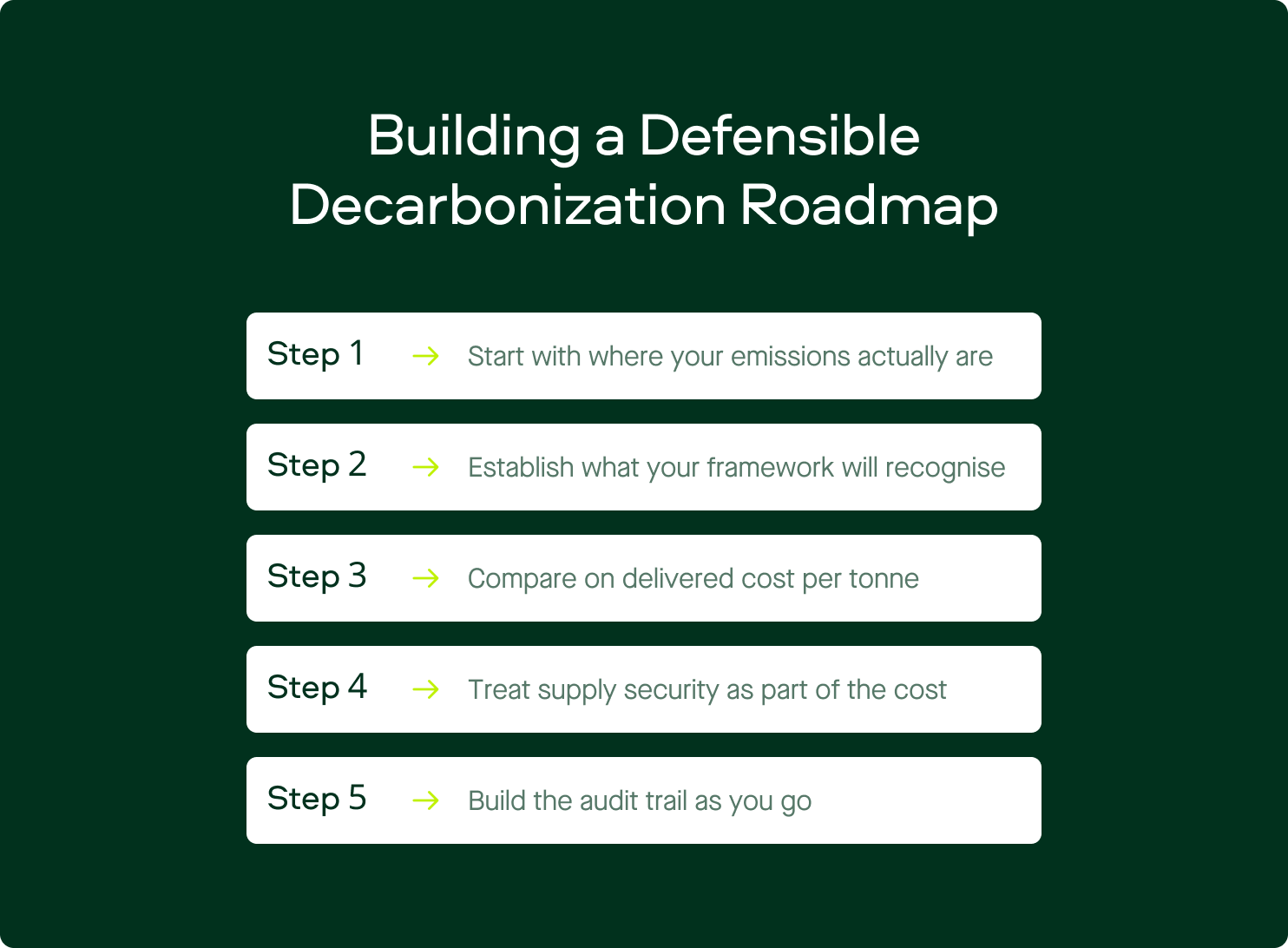
1. Start With Where Your Emissions Actually Are
Carbon footprints vary. A large enterprise whose footprint centers on purchased steel needs a different mix than one where the footprint is dominated by business travel. Direct emissions and energy use respond to energy efficiency, electric alternatives, renewable energy sources like solar and wind power, and alternative fuels. Supply chain emissions call for the four levers. Set your emissions baseline, then map levers to emission sources, not preferences, to ensure the proper mix for your organization.
2. Know What Your Framework Will Recognize Before You Optimize for Cost
A cheaper lever that doesn't count toward your target won't offer savings. This kind of recognition is a critical requirement for target setting, so check each option against your science-based targets, Paris Agreement commitments, and reporting requirements before you set targets.
3. Compare on Delivered Cost Per Tonne, Not Headline Price
A green premium and a credit price aren't comparable until you account for what each lever lets you claim. Cost savings vanish when a tonne doesn't count toward your emissions targets, so weigh quality, eligibility, and claim type to find the real business value of each potential option.
4. Treat Supply Security as Part of the Cost
Like other climate risks, scarcity has a price. Physical low-carbon supply and high-quality removals are both limited. Buyers who wait have fewer options and pay more for them. As such, build precise timing into your investment decisions. That way, you’re more likely to get the quality you need at an affordable price.
5. Build the Audit Trail as You Go
Each lever needs evidence: verified carbon intensity for commodities, chain-of-custody records for attributes, and independent quality assessment for credits and removals. If you build the audit trail as you go, it will cost you less than if you assemble it later. You'll also be able to show measurable progress along the way, and you'll help protect your brand reputation from greenwashing claims.
What Changes in 2027 and 2028
Several frameworks plan to tighten what organizations can count toward their climate targets.
SBTi's Corporate Net-Zero Standard V2 takes effect in early 2027, though the previous version will still be available until early 2028. In addition, the GHG Protocol and ISO are planning a consultation draft of a unified carbon accounting standard in Q2 2027, with the final standard set to take effect in 2028. And ISO's net-zero standard, ISO 14060, is in draft, with finalization expected in 2027.
The overall direction of travel points toward a strict treatment of anything that isn't a true reduction inside the value chain, and clearer requirements for durable removals against residual emissions. The ISO 14060 draft, for example, prohibits the use of credits when claiming progress toward reduction targets.
The planning implication is that auditors will judge today's decisions under still-developing rules. In this environment, flexibility is often worth more than precise optimization.
Compare Your Decarbonization Options With Sylvera
Sylvera provides independent ratings and market intelligence for carbon credits and low-carbon commodities. As such, we can play a pivotal role in your company's adaptation to a low-carbon economy.
- Pricing that spans the levers: Weighing a green steel premium against a removal price requires data. Sylvera's Market Intelligence offers 20,000+ spot price estimates powered by 300,000+ real transactions, eight confidence-banded price indices, and projections to 2050 by project type and region. Also worth mentioning, coverage spans more than 23,000 projects across 20 registries. Then, Commodity Insights adds verified carbon intensity for cement, ammonia, hydrogen, and fuels.
- Quality drives cost: Sylvera's Ratings data shows that buyers pay a consistent premium per rating band. By late 2025, for example, ARR credits with a BBB rating or higher averaged over $26 per tonne, versus around $14 for lower-rated equivalents. This is valuable information because a cost comparison that ignores quality is really just comparing different products.
- See what comparable buyers actually do: Sylvera's Buyer Directory tracks 40,000+ retirements with click-through to project pages. That way, you can track progress against industry peers without waiting for a survey. Then, you can adjust your strategy based on your competitors' actions.
- Make the physical lever auditable via verified carbon intensity data: Sylvera's Commodity Insights provides facility-level carbon intensity across 3,000+ cement facilities and 700+ ammonia facilities, which we calculate under multiple compliance frameworks from a single data input.
- Independence you can rely on: Finally, at Sylvera, we don't sell, broker, or take commission on the credits and commodities we assess, so we're not hindered by conflicts of interest.
Want to build a portfolio for a net zero economy? Request a demo of Sylvera or get free platform access.


