“Over the years we’ve invested significantly in our field data team - focusing on producing trusted ratings. While this ensures the accuracy of our Ratings, it doesn’t allow the scale across the thousands of projects that buyers are considering.”

For more information on carbon credit procurement trends, read our "Key Takeaways for 2025" article. We share five, data-backed tips to improve your procurement strategy.

One more thing: Connect to Supply customers also get access to the rest of Sylvera's tools. That means you can easily see project ratings and evaluate an individual project's strengths, procure quality carbon credits, and even monitor project activity (particularly if you’ve invested at the pre-issuance stage.)
Book a free demo of Sylvera to see our platform's procurement and reporting features in action.
Latin America and the Caribbean produce roughly a quarter of the world's carbon credits. The region is home to nearly a quarter of active project developers globally. It hosted COP30 in Belém in November 2025. And it sits at the center of nearly every serious conversation about nature-based solutions, jurisdictional REDD+, and Article 6 implementation.
And yet — relative to that supply weight — Latin America is significantly underrepresented on the buy side, and almost invisible in the supply pool that matters most over the next 24 months: CORSIA-eligible credits with corresponding adjustments. Only 5 of the more than 60 active publicly available Letters of Authorization globally come from the region. One programme in Guyana accounts for essentially all of it.
This is the central tension in the LATAM story right now. The region has the supply, the quality, and increasingly the compliance infrastructure. What it doesn't yet have is the authorization pipeline to convert that supply into the highest-value demand of the coming decade.
This article walks through how the region's carbon markets actually work — what makes them structurally distinct, how they break down country by country, why the CORSIA gap matters so much commercially, and what buyers, developers, and investors should be doing about it in 2026.
What makes Latin America's carbon market different
Before getting to the country-level detail or the commercial gaps, it's worth being precise about why Latin America behaves the way it does. Three structural features set the region apart from every other major carbon market geography — and each one shapes the rest of the story.
.avif)
1. It is the world's largest nature-based supplier, with serious domestic demand.
Most regions lean either supply-heavy or demand-heavy. Latin America is both. The Amazon, Cerrado, Chaco, Andes, mangroves, and Atlantic Forest collectively make the region the dominant source of REDD+, ARR, and other nature-based credits globally. At the same time, established compliance systems that accept carbon credits to meet obligations such as in Colombia, Chile, or several Mexican states — and the future SBCE launching in Brazil — create domestic demand. Crucially, the credits eligible for compliance are largely the same credits voluntary buyers procure.
2. The region has a long carbon market memory.
Latin America was deeply involved in the Kyoto-era Clean Development Mechanism (CDM). That history left institutional infrastructure that's still relevant — government bodies, registries, project developers, lawyers, and consultants who have been doing this work for two decades. Latin America is updating from an existing baseline, which is sometimes a head start and sometimes a constraint.
3. Regional pride is a real commercial force.
This is easy to underestimate from outside the region. Latin American corporates increasingly prefer to procure Latin American credits. LATAM Airlines indicated its preference for sourcing CORSIA credits from within the region. Two of the world's independent carbon standards — Cercarbono and BioCarbon — were developed in Colombia, and they are the only standards originating from the Global South. Regional supply, regional demand, and regional standards are converging in a way that has commercial implications for buyers everywhere.
"There are two international independent carbon standards that came from Colombia, the rest come from the global north. That's significant. And on the demand side, Latin American companies are actively choosing Latin American credits, driven not only by national loyalty but regional identity. That pride is a real market force we can't ignore. " — Carmen Álvarez Campo, International Carbon Policy Lead at Sylvera.
Compliance systems across the region
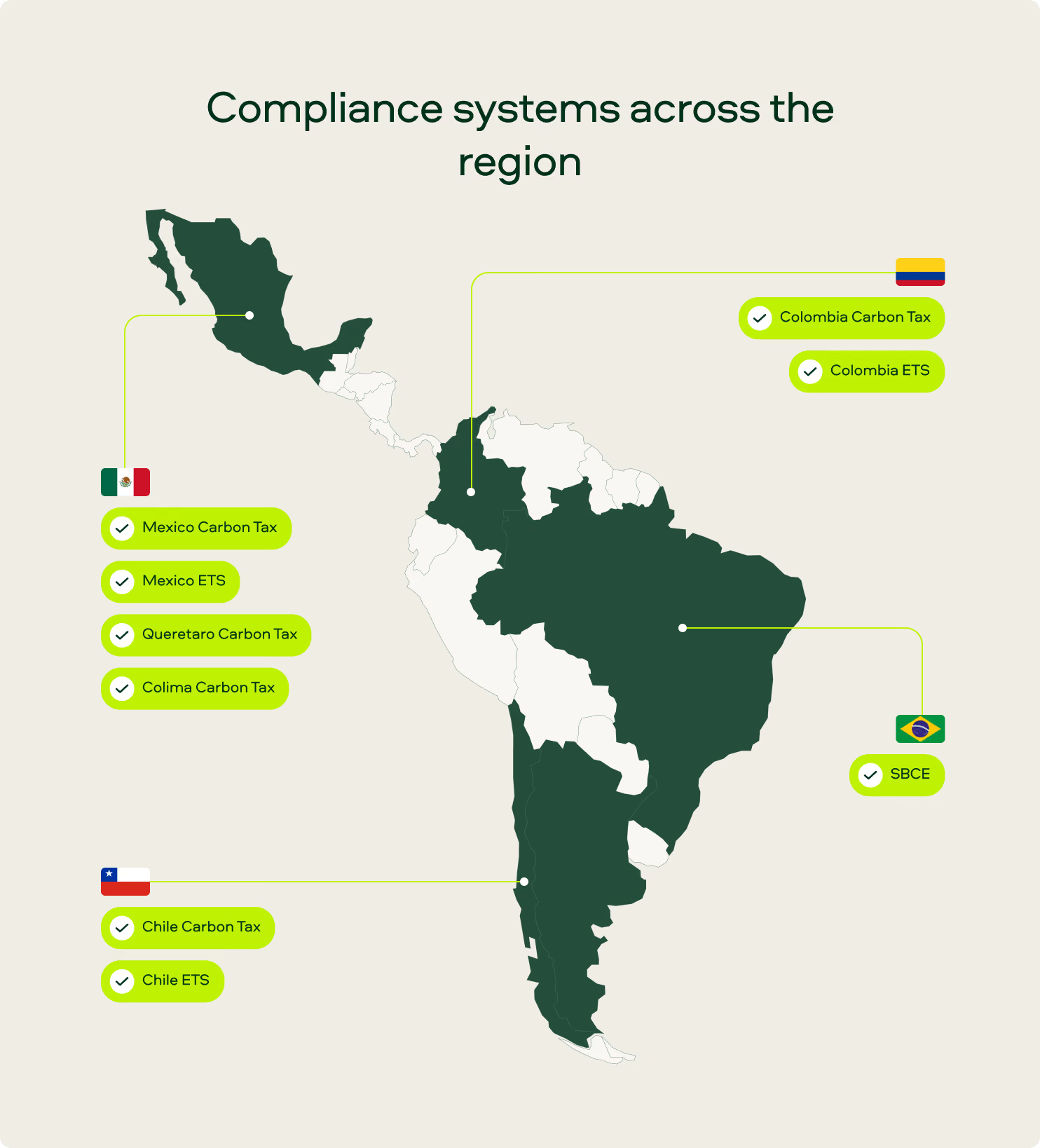
Point 1 above (the point on supply and demand) only works because policy is actively connecting the two. Carbon pricing is now operating, in some form, in most of Latin America's major economies.
The compliance landscape is a mix of carbon taxes (with credits accepted for compliance), emissions trading systems, and subnational instruments. Table below seems to list the ones that accept or are planning to accept carbon credits.
Examining how compliance systems incorporate carbon credits offers some of the most revealing insights into where carbon markets are heading. Sylvera's models expect a significant share of future credit demand to come from compliance systems — a trend explored in depth in the State of Carbon Credits 2025. Colombia and Brazil stand out as interesting case studies — the former an established carbon tax with a track record of accepting voluntary carbon credits for compliance, the latter an emissions trading scheme still taking shape, with credits set to play a role but the rules yet to be defined.
Colombia: the model the region was built on
Colombia's carbon tax allows companies to meet part of their obligations with domestic carbon credits — originally up to 100%, currently capped at 50%, and likely heading toward 30% in the coming years.
Because credits accepted for compliance are the same Verra and Gold Standard credits voluntary buyers procure, the Colombian carbon tax drove genuine market development rather than parallel infrastructure. Project developers, intermediaries, consultancies, and academic capacity all scaled in response. The two carbon standards developed in the country — Cercarbono and BioCarbon — gained international recognition. And the Colombian model is now being studied and replicated by countries that have carbon credit supply potential. And for example, Chile has already implemented a similar approach.
Sylvera data shows how Colombia has issued 92.6 million REDD+ credits across 69 projects and 22.1 million ARR credits across 64 projects — making it one of the most important supply countries on earth for nature-based credits. The compliance framework has helped build this supply ecosystem.
"Colombia's decision to open compliance use to the same credits traded in the voluntary market was a catalyst — it deepened the sector in ways few other policy choices have. Other countries would do well to take note." — Carmen Álvarez Campo
Brazil: SBCE and the country everyone is watching
If Colombia's carbon tax is the proven model, Brazil's emissions trading scheme is the test of whether that approach can scale to the largest economy in the region. The Sistema Brasileiro de Comércio de Emissões (SBCE) regulation is in place — the most consequential structural development in Latin America's carbon market in a decade — but a critical question remains open: will Brazil follow Colombia's lead and make credits certified by independent standards eligible for compliance?
Brazil's supply credentials are clearly significant: 148 REDD+ projects have issued 97.1 million credits, 91 hydropower projects have issued 42 million credits, and 82 landfill methane projects account for a further 77.6 million credits. Brazil, Colombia, and Peru combined have issued approximately 280 million REDD+ credits — the single largest project-type concentration in the global VCM.
But the details that matter most to buyers and developers are still unresolved: which credit types and vintages will be accepted, how the system will interact with the voluntary market, and how Article 6 corresponding adjustments will be treated. Brazil's carbon market law currently limits corresponding adjustments to methodologies approved for the SBCE, but there is yet no clarity around which those would be. Progress is likely to be gradual.
The CORSIA gap: LATAM's biggest commercial story
The framework above hints at something important. Guyana — a single country, with a single jurisdictional REDD+ programme — is the region's CORSIA story. That fact alone tells you almost everything about LATAM's commercial position in the most important demand pool of the next decade. It deserves a section of its own.
Of all carbon credits globally that meet CORSIA's technical requirements — the right standard, methodology, and vintage — below 10% are fully eligible today. The difference is the corresponding adjustment or insurance instrument to cover for non adjustment risk.
Latin America has roughly 25% of global supply and the potential to be a significant CORSIA supplier. It isn't. Only 5 of more than 60 active Letters of Authorization globally come from the region. And of the region's CORSIA-eligible supply, essentially all of it comes from a single Guyana programme — 24.96 million credits from its jurisdictional HFLD REDD+ program. Strip that out and LATAM's share of structural CORSIA readiness is close to zero.
The reason isn't project quality. Sylvera ratings consistently show LATAM projects above the global quality average. The reason is that the authorization process — the bridge between a high-quality credit and a CORSIA-eligible one — runs through a host country layer that the region has been slow to operationalize.
"Latin America is lagging behind on Article 6 and authorizations and corresponding adjustments — all of the things you need to play in the CORSIA market. There's big supply potential, but there's a limitation in terms of authorizations. It affects the utility of the carbon credits." — Carmen Álvarez Campo
Three structural factors explain why the region has moved more slowly than its supply weight would suggest:
- Complex carbon landscapes. Latin America's slower pace on Article 6 isn't a lack of ambition — it's a consequence of complexity. The region has one of the longest histories with carbon markets globally, and many countries are already running or building compliance systems of their own. Aligning Article 6 across that landscape takes time. Starting from scratch is simpler than reconciling what's already there.
- Article 6 framework design is still evolving. Brazil's Law 15.042 limits corresponding adjustments to nationally accredited methodologies. Peru's RENAMI framework is more permissive but still being operationalized. The details determine how much LATAM supply can actually reach CORSIA.
- Sovereignty calculations. Authorization is partly a NDC trade-off: every credit authorized for international transfer is mitigation the host country can't count toward its own target. Countries are weighing credit export revenue against domestic climate ambition. That balance takes time to settle.
.avif)
The commercial implication of those three factors is direct. Compliance demand is projected to overtake voluntary demand globally in 2027, with CORSIA Phase 1 compliance beginning in January 2028. Credits with corresponding adjustments will trade at premiums as supply tightens. LATAM developers and investors without LoA pathways secured will miss the premium window — even if their projects are technically among the best in the world.
The quality–price gap: why LATAM developers are leaving money on the table
The CORSIA gap is the buyer-facing version of the region's commercial story. There's a developer-facing version that runs in parallel — and it has the same root cause: the market can't yet fully see what it's looking at.
Sylvera's ratings data shows two things that should sit together but currently don't:
- LATAM has a higher proportion of high-quality projects than the global average.
- On average, each additional rating band delivers a 32% price premium.
Multiplied together, those two facts should mean LATAM developers are commanding consistent premiums on the global VCM. They aren't — at least not at the level the underlying data supports. Why?
Information asymmetry
In project types where LATAM dominates supply — REDD+ and ARR especially — quality variance is high. Without independent ratings making that variance legible, buyers can't easily distinguish a strong LATAM REDD+ project from a weaker one in the same registry, same methodology, same country. Price compresses toward the lower end.
Domestic compliance demand isn't yet quality-sensitive
Buyers under the Colombian carbon tax, Chilean carbon tax, and Mexican subnational carbon taxes have historically optimized for the cheapest credit that meets the technical eligibility criteria. That's natural for early-stage compliance markets, but it means LATAM developers selling primarily domestically haven't been forced to build the credibility infrastructure international premium buyers require.
The premium market is changing this
As compliance demand overtakes voluntary in 2027 and CCP, CORSIA, and other standards converge into a de facto premium tier, the developers who can demonstrate both quality and eligibility will capture disproportionate value.
A practical way to think about it: a project generating 500,000 credits annually at $10 per credit, moving up a single Sylvera rating band, could generate $1.5M+ in additional annual revenue. Quality investment is a commercial decision with a calculable return.
REDD+ and the jurisdictional shift
Both commercial gaps above — CORSIA authorization and the quality premium — converge most acutely in one project type: REDD+. Nature-based projects dominate LATAM supply, and within nature-based, REDD+ is the largest single category.
Brazil (97.1M credits, 148 projects), Colombia (92.6M credits, 69 projects), and Peru (90.0M credits, 30 projects) together form the world's dominant REDD+ supply base — approximately 280M credits combined.
The integrity story around REDD+ has been the dominant carbon market narrative of the past three years — baseline inflation, leakage concerns, overcrediting investigations. Latin American projects have been at the center of it.
Two structural shifts are reshaping how the region delivers REDD+ credibility — and both directly affect the value of credits already in buyers' portfolios.
.avif)
Verra's VM0048 and shift to other REDD+ methodologies
The first shift is at the methodology level. Verra's consolidated REDD methodology is now in active rollout, and VM0048 addresses many of the baseline credibility concerns raised in earlier methodologies. Projects across the region are transitioning. The methodology change matters for buyers: a project that has migrated to VM0048 carries different risk and credibility characteristics than one operating under the older approach.
Jurisdictional REDD+ (JREDD+)
The second shift is bigger and more structural. Rather than individual projects accounting for their own baselines, jurisdictional programmes set baselines at the state or country level. Sylvera has conducted pre-issuance assessments for jurisdictional programmes in Acre (Brazil) and Misiones (Argentina), and the region is the global testing ground for the approach.
The open question — and the one that matters most to existing buyers — is how individual REDD+ projects are accounted for inside jurisdictional programmes. "Nesting" is the term of art, and the answer determines whether existing project-level credits hold their value or face dilution as jurisdictional programmes scale. This is being worked out in real time, particularly in Brazil. Buyers holding portfolios of project-level LATAM REDD+ credits should be tracking the nesting conversation closely.
Why field data matters disproportionately in this region
Every claim above — REDD+ baseline integrity, VM0048's improvements, JREDD+ accounting, the ratings that distinguish high-quality projects from weaker ones — ultimately rests on a single technical question: how accurately do you know how much carbon is actually standing in the forest? Carbon accounting accuracy depends on biomass measurement, and that's where most of the world's data infrastructure falls short.
Most biomass datasets rely on allometric models with large uncertainties and infrequent field surveys. In a region where the dominant project types are nature-based and the dominant geographies are tropical forests, that measurement gap translates directly into ratings uncertainty.
Sylvera has invested in multi-scale lidar field data across five continents, including campaigns in Tambopata (Peru) and Chiquibul (Belize), and ongoing work in Brazil including independent assessment of forest carbon credits in the State of Acre. That field-validated grounding is what makes Sylvera's Ratings, Pre-Issuance Solution, and Biomass Atlas meaningful in a region where small measurement errors compound into large credit-quantity errors.
For developers operating in LATAM, the practical implication is that the difference between a credible biomass estimate and a contested one is increasingly the difference between a project that prices into the premium tier and one that doesn't. That technical reality sits underneath every commercial decision the next section discusses.
What to watch in the next 12 months
Everything to this point has been a diagnosis: what the region is, what's working, and what isn't. The next 12 months will determine which of those gaps narrow and which widen. Six concrete signals are worth tracking for anyone with LATAM exposure on the buy or sell side.
.avif)
1. Brazil's SBCE design choices
Watch for credit type and vintage eligibility, voluntary-market interlinkages, and Article 6 treatment. Dimer's institutional pace matters as much as the legislative detail.
2. Article 6 LoA pipelines
Peru's pipeline progression, Chile's bilateral agreement activity, Brazil's framework for international transfers, or Bolivia as a new market entrant, are some of the most important authorization streams to track.
3. The CORSIA Phase 1 supply ramp
LoA issuances accelerating in the second half of 2026 would signal regional readiness for January 2028. The opposite would mean LATAM ceding share to African and Asian competitors.
4. The jurisdictional / project-level nesting framework
Particularly in Brazil. The decisions made here will affect the value of every existing project-level REDD+ credit in the region.
5. Coal transition credits in the Dominican Republic
If the sectoral crediting pilot under Article 6.4 succeeds, it could open a new credit category with meaningful supply implications.
Three actions for LATAM developers and investors
Watching is necessary; acting is what changes outcomes. The argument running through this article is that LATAM has the supply and the quality, but isn't yet capturing the commercial value its data supports. Three practical actions move that needle — and all three are feasible inside the next two issuance or procurement cycles.
1. Get independently rated before your next issuance cycle
Pre-Issuance assessments identify quality gaps while they can still be addressed. Rating after issuance is reactive. Rating before is investment-grade information that compounds across every credit sold.
2. Build your CORSIA and CCP eligibility path now
These are becoming pricing differentiators, not just compliance checkboxes. Engaging with host country authorization processes early — and aligning project documentation with CCP requirements — sets up the supply pathways that will matter most as Phase 1 compliance approaches.
3. Use market intelligence to set pricing expectations on actual transactions
Broker estimates compress price expectations. Independent transaction data shows what credits like yours are actually selling for, and where the quality-price relationship is heading. The data exists. It just needs to be in the room when commercial terms are negotiated.
.avif)
How Sylvera supports the Latin American market
Each of those three actions — getting rated, securing eligibility pathways, anchoring pricing to real transaction data — depends on independent, verifiable data infrastructure. That's where Sylvera fits. The region's centrality to global carbon markets is reflected in the depth of Sylvera's coverage: Country Profiles for 16 LATAM countries (15 live, with Ecuador launching Q2 2026), Jurisdictional REDD+ Intel for the major host countries, multi-scale lidar field campaigns including Tambopata, Chiquibul, and ongoing work in Brazil, and 85% coverage of existing global REDD+ credits via Ratings. Specifically:
- Ratings: Independent quality assessments across carbon accounting, additionality, permanence, and co-benefits — covering 85% of existing REDD+ credits globally.
- Country Profiles: Risk, regulatory, Article 6 readiness, and supply context for 16 LATAM jurisdictions.
- Jurisdictional Intel: Pre-issuance assessments of jurisdictional REDD+ programmes, including Acre and Misiones.
- Market Intelligence: Pricing, issuance, and retirement data with the CORSIA, CCP, and compliance-system tags that LATAM buyers and developers need for procurement and commercial decisions.
- Biomass Atlas: Field-validated biomass measurement infrastructure for forest carbon, with sub-10% project-area error rates for projects above 400ha.
To see how this applies to your portfolio or project pipeline, book a demo with the Sylvera team.
.avif)
What’s next?
This article opened with a paradox: Latin America has roughly a quarter of global supply, above-average quality, and the institutional history to be the most consequential carbon market region in the world — yet sits with only 5 of more than 60 active CORSIA Letters of Authorization. Whether the region captures the role its fundamentals support, or cedes ground on Article 6 authorization to faster-moving competitors elsewhere, is the open question of 2026.
The region's structural strengths are real: dominant supply, high average quality, sophisticated compliance pioneers, and a genuine sense of regional cohesion that translates into commercial behavior. The region's structural weaknesses are also real: slow Article 6 framework development, federal complexity, and a quality-price gap that developers haven't yet fully captured. Both can be addressed. Neither resolves itself.
The buyers, developers, and investors who treat the next 24 months as preparation — building ratings infrastructure, securing authorization pathways, mapping country-level risk before the compliance demand wave hits — will be the ones holding the strongest positions when CORSIA Phase 1 begins in January 2028. The region's window to convert structural strength into commercial value is open. It won't stay open forever.
For country-level data, ratings, pricing, and Article 6 readiness intelligence across Latin America, request a Sylvera demo.