


“Over the years we’ve invested significantly in our field data team - focusing on producing trusted ratings. While this ensures the accuracy of our Ratings, it doesn’t allow the scale across the thousands of projects that buyers are considering.”

For more information on carbon credit procurement trends, read our "Key Takeaways for 2025" article. We share five, data-backed tips to improve your procurement strategy.

One more thing: Connect to Supply customers also get access to the rest of Sylvera's tools. That means you can easily see project ratings and evaluate an individual project's strengths, procure quality carbon credits, and even monitor project activity (particularly if you’ve invested at the pre-issuance stage.)
Book a free demo of Sylvera to see our platform's procurement and reporting features in action.
Stellar Green Co., Ltd. and Sylvera, a global provider of carbon credit ratings and data, have launched an initiative aimed at making the quality of Japan's forest J-Credits visible — re-examining Japan's domestic J-Credit system through a global evaluation lens, so that credit-purchasing companies can fulfill appropriate accountability to internal and external stakeholders.
This initiative is not intended to publish evaluation results for individual forest projects or to certify or guarantee specific credits. Rather, its purpose is to examine Japan's distinctive forest management practices and institutional context alongside global standards, and to explore what "explainable quality" means — quality that purchasing companies can clearly present to stakeholders as the basis for their own decisions.
The concrete action taken by both companies is rooted in the rapidly changing market environment surrounding credit-purchasing companies and the new challenges that come with it.
Background
The carbon credit market is at a major turning point. In the past, the main questions were which standard's credits to procure, how many credits, and at what price — and compliance with a given standard was considered sufficient. Today, however, that is no longer enough.
When companies procure carbon credits, they are increasingly asked to explain: "Why did you determine that these credits are appropriate as a means of achieving your environmental targets?" and "How can you justify this to internal stakeholders, shareholders, and your supply chain?"
Three factors underline this shift:
- Tightening of International Target-Setting
In international corporate climate discussions including SBTi, companies are expected to prioritize reduction efforts while facing higher accountability for how they use environmental value and how feasible their target pathways are. - Growing Awareness of Quality
There is now widespread recognition that carbon credits, like any product, have both a price and a quality. Buyers are compelled not merely to purchase credits, but to rigorously examine the quality of their environmental value, intended use, potential risks, and explainability. - Securing Credibility
Companies now require an information foundation that allows them to avoid greenwashing and communicate transparently with stakeholders (shareholders, supply chain, etc.).
Why is Regulatory Compliance Alone No Longer Sufficient?
The J-Credit scheme plays an important role as an accessible, official domestic system in Japan. For credit-purchasing companies, alignment with national reduction targets (NDC) and domestic systems, along with ease of procurement and retirement procedures, holds enormous practical value.
However, for companies operating globally or those directly accountable to overseas headquarters, investors, or supply chains, the fact of being compliant with a domestic standard alone is increasingly insufficient as an external explanation.
In the case of forest-derived J-Credits in particular, properly evaluating and explaining quality requires more than a surface-level review of J-Credit methodology (calculation rules). It demands a comprehensive understanding of Japan's multi-layered legal framework — the Forest Act, regional forest plans, municipal forest management plans, and forest management visions — as well as the role local governments play on the ground, the economics of forestry, the reality of reforestation, specific forest measurement methods, and risk responses to natural disasters and pest damage.
In short, the true quality of forest J-Credits should not be assessed merely in terms of formal compliance — whether a project meets regulatory requirements — but should integrate the regulatory framework, locality, forest management, measurement, sales operations, and the purchasing company's accountability. This is the underlying current shaping the field.
The Seven Layers That Constitute Forest J-Credit Quality
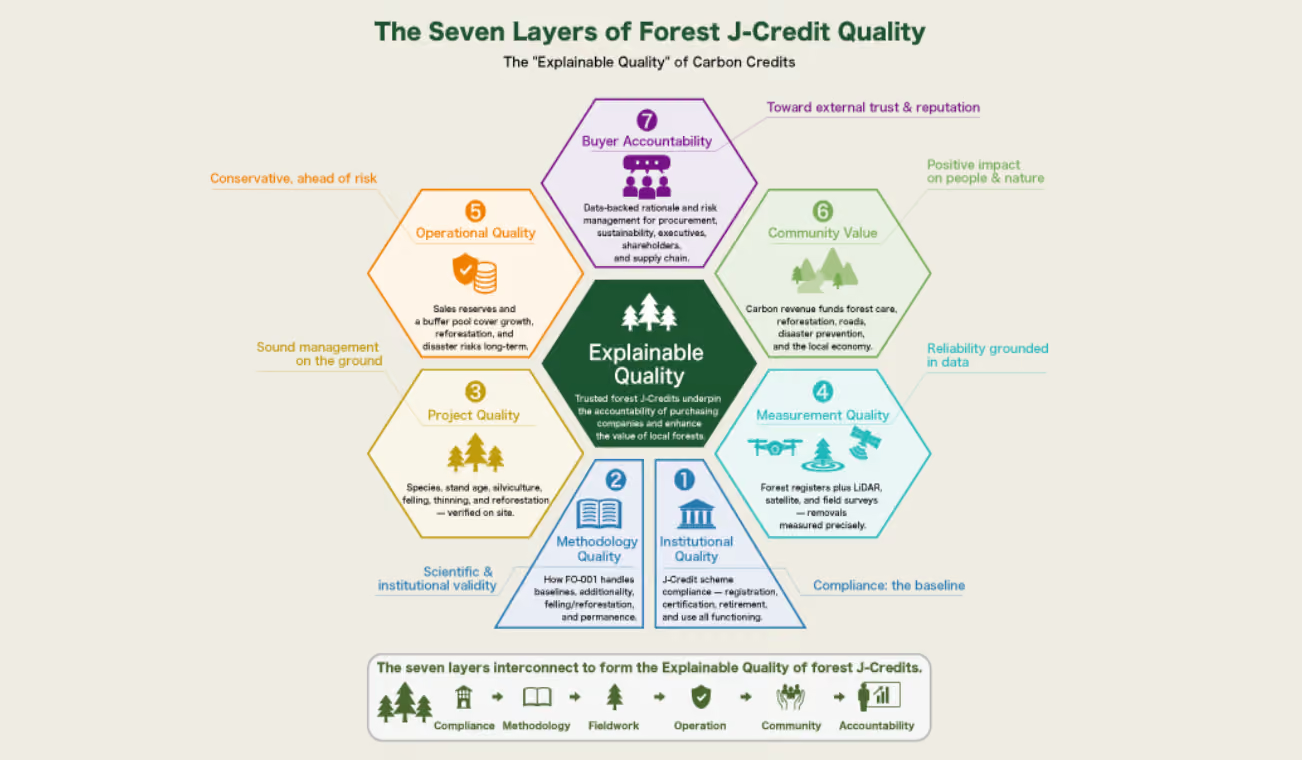
Through this dialogue, Stellar Green and Sylvera have concluded that forest J-Credit quality cannot be captured by a single metric; it must be broken down into at least the following seven layers:
- Regulatory Quality
Compliance with the J-Credit scheme — whether the rules for registration, certification, retirement, and use are clearly functioning as an official domestic standard. - Methodology Quality
Understanding how methodologies such as FO-001 calculate CO2 absorption — including how baseline setting, additionality, harvesting and reforestation, and permanence are handled under the rules. - Project Quality
Verification of actual on-the-ground forest conditions — tree species, stand age, management history, forest management plans, and the real implementation of harvesting, thinning, and reforestation — to ensure the soundness of actual operations. - Measurement Quality
Going beyond paper-based estimates from forest registers and yield tables to combine LiDAR (laser scanning), satellites, and field surveys for higher-precision understanding of forest conditions. - Operational Quality
Rather than mechanically selling all issued credits to market, a conservative management approach where developers independently set sales reserves or buffer pools, accounting for future growth projections, reforestation risk, and permanence risks from disasters. - Community Value
A clear explanation of how carbon revenue from credit sales is used for regional forest management, forest road development, reforestation, undergrowth clearing, patrolling, disaster response, watershed conservation, disaster prevention, and local economic revitalization. - Purchasing Company Accountability
The information foundation enabling companies to provide procurement staff, sustainability teams, legal/finance departments, management, and supply chains with documented, data-backed explanations of why specific credits were purchased and how risks are being managed.
Stellar Green believes that beyond simply selling credits, it must provide the information infrastructure that enables purchasing companies to fulfill their accountability across all seven of these layers.
Merging Global Evaluation Perspectives with Japan's Distinctive Forest Management
Sylvera, the partner in this initiative, is a global carbon credit ratings and data provider, bringing assessment expertise cultivated primarily in the voluntary carbon credit market overseas. Sylvera assesses project risks and quality across dimensions such as carbon accounting, additionality, permanence, and safeguards & co-benefits.
Japan's J-Credits, by contrast, have the character of compliance credits grounded in a domestic legal framework. Simply applying overseas voluntary market evaluation criteria as-is makes it difficult to properly understand and assess Japan's complex forest legislation and locally rooted forest management practices.
This initiative goes well beyond interpreting methodology. It digs into the foundational forest laws and planning frameworks, as well as the measurement, monitoring, sales reserves, and community value visualization that developers independently implement — reaching into the deeply practical, on-the-ground level.
The process of individually verifying local regulations, forest management history, operational practices, measurement methods, and sales operations for each forest project is far from efficient. However, both companies share the view that precisely this level of deep assessment is critical to building a market in which purchasing companies can confidently use J-Credits over the long term.
How Going Beyond Regulatory Requirements Creates Future Competitiveness
J-Credits' greatest strength lies in their overwhelming ease of use as a domestic standard. For purchasing companies that are mindful of global quality standards, however, project-specific quality information beyond mere regulatory compliance is essential.
This initiative also involves concrete discussion of what enhancements project developers can implement beyond the minimum requirements set by the standard:
- High-precision measurement and monitoring using digital technology — building precise forest measurement systems using LiDAR and permanence monitoring through satellite and AI.
- Conservative risk management frameworks — developer-defined credit pool concepts and methods set outside the regulatory framework, and the formulation of risk management and compensation policies including post-sale periods.
- Logical transparency assurance — detailed explanation of financial additionality and acquisition of third-party forest certification.
- Visualization of regional and natural impact — visualizing the potential for carbon revenue to be returned to local communities, establishing regional circular models including biomass utilization, and developing co-benefit metrics that can connect to TNFD (Taskforce on Nature-related Financial Disclosures).
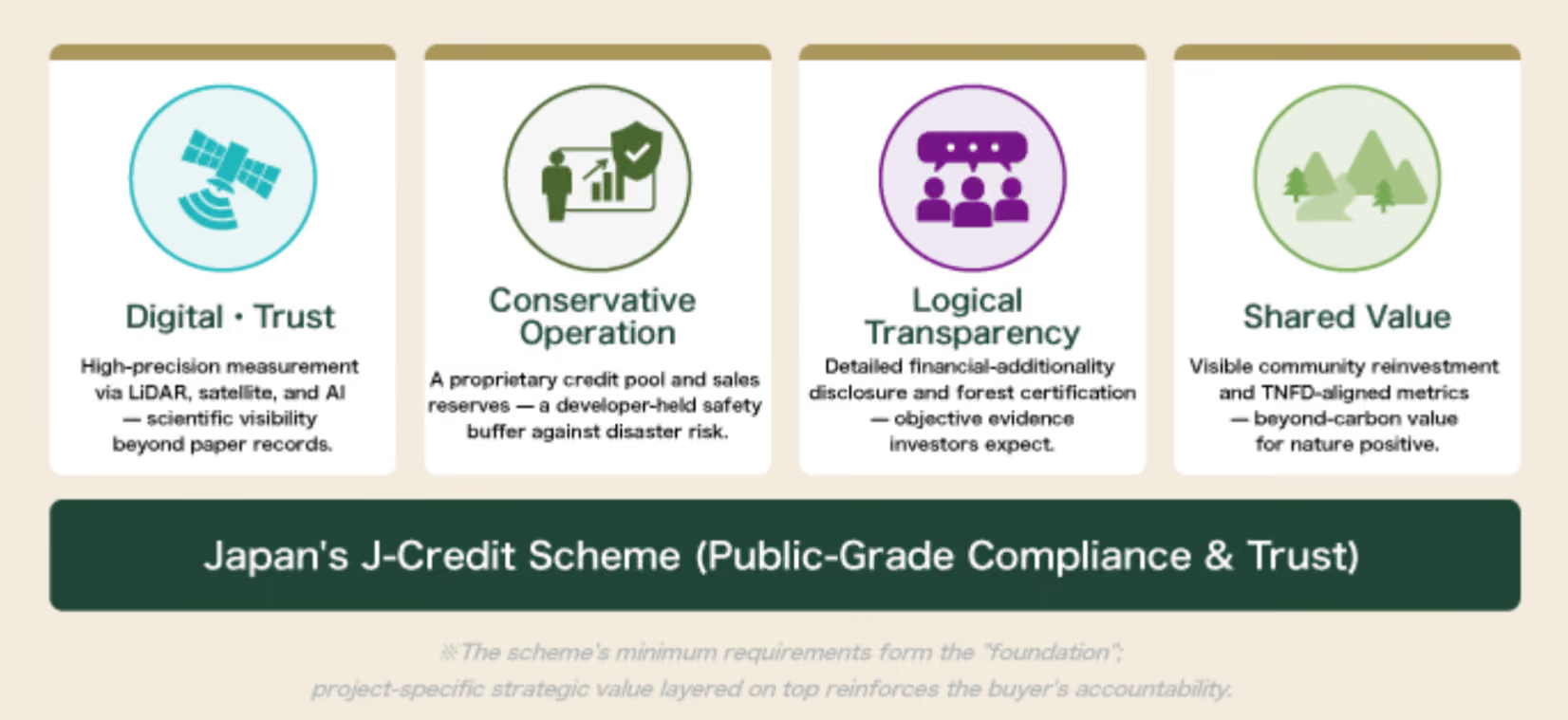
In Sylvera's "Above Compliance" analysis — which examines practices that go beyond regulatory requirements — approaches such as LiDAR measurement, proprietary credit pools, detailed financial analysis, forest certification, community returns, and biomass utilization are already identified as advanced practices that exceed methodology minimums. Stellar Green positions these enhancements as the most important competitive differentiator in future forest J-Credit development.
Improving Quality Means Improving Returns to Local Communities
Bringing high-quality credits to market does more than resolve purchasing companies' greenwashing concerns. It also carries enormous significance for the local forests that generate those credits.
Credits that can logically explain their selection rationale, risk management, and community value can escape a market competition defined solely by price. When credits are evaluated holistically — for measurement accuracy, transparency, conservatism, and contribution to local communities — their environmental value is properly recognized and higher per-unit sale prices become sustainable.
Credits trading at higher values mean more capital flowing back to local communities. This makes it easier to sustainably channel funding to small-scale forest projects that have struggled to be economically viable, as well as to on-the-ground operations — forest road construction, reforestation, undergrowth clearing, patrols, disaster prevention, watershed conservation — that are essential to maintaining healthy forests in Japan yet chronically underfunded.
Addressing purchasing companies' quality concerns and making local forest management both drive progress in the same direction.
Future Outlook: Standardizing Explainable Quality Beyond Regulatory Compliance
Stellar Green is advancing a new approach to forest credit quality — one that maximizes the ease of use advantage of the J-Credit scheme while enabling purchasing companies to confidently explain their decisions to stakeholders as sound business judgments.
To this end, Stellar Green carefully documents measurement, additionality, permanence, conservatism in sales operations, community value, and co-benefits on a project-by-project basis, and where necessary adopts strict standards that exceed regulatory minimums.
In some projects, concrete steps are already underway: LiDAR-based measurement, credit sales reserves in anticipation of future reforestation risks, detailed financial analysis, forest certification acquisition, and articulation of community return potential. Going forward, the aim is to standardize these practices — not leave them as isolated examples — including supplementary baseline analysis, satellite- and AI-based permanence monitoring, credit reserves and buffer pool operations, and the development of co-benefit metrics connectable to TNFD and similar frameworks.
Stellar Green's goal is not simply to issue credits and sell them onward. It is to build a forest J-Credit market with both transparency and conservatism — one where purchasing companies can confidently explain their value externally, and where investment capital flows back healthily to local forest management.

"J-Credits are an extremely accessible and critically important framework for Japanese companies advancing toward carbon neutrality. At the same time, for purchasing companies to fulfill accountability on the global stage, it is becoming essential to go beyond basic regulatory compliance and be able to logically explain the unique quality, risks, and community value of each project. Through our dialogue with Sylvera, we have gained a valuable opportunity to re-examine Japan's forest J-Credits through a global evaluation lens. We intend to layer our own quality dimensions — high-precision measurement, conservative sales operations, permanence management, and co-benefit visualization — on top of the existing J-Credit foundation. We aim to build a forest J-Credit market that delivers dual sustainability: one where purchasing companies can select credits with confidence, and where that capital flows richly back into local forest management."
Akinori Nakamura, Representative Director, President & CEO, Stellar Green Co., Ltd.

"Japan's J-Credit scheme is a highly credible and important carbon credit framework within the domestic market. However, to deeply understand forest J-Credits from a global evaluation perspective, it is necessary to take a comprehensive view that encompasses not only the scheme's methodology, but also Japan's forest laws and forest planning systems, regional forest management practices, and the additional operational innovations that project developers implement independently. Our initiative with Stellar Green is an extremely valuable opportunity to explore how the quality of Japan's forest J-Credits can be made visible and elevated into a form that purchasing companies can explain with confidence. Sylvera will continue to contribute to improving transparency and credibility in carbon credits as a whole, while deeply respecting the unique institutional context of each country's market."
Allister Furey, CEO, Sylvera

.png)
