

“Over the years we’ve invested significantly in our field data team - focusing on producing trusted ratings. While this ensures the accuracy of our Ratings, it doesn’t allow the scale across the thousands of projects that buyers are considering.”

For more information on carbon credit procurement trends, read our "Key Takeaways for 2025" article. We share five, data-backed tips to improve your procurement strategy.
One more thing: Connect to Supply customers also get access to the rest of Sylvera's tools. That means you can easily see project ratings and evaluate an individual project's strengths, procure quality carbon credits, and even monitor project activity (particularly if you’ve invested at the pre-issuance stage.)
Book a free demo of Sylvera to see our platform's procurement and reporting features in action.
The Problem Book-and-Claim Solves
Your company wants to purchase lower-carbon cement, but the best producer is two thousand miles away. Cement is heavy, low-value per tonne, and economically regional. Shipping it thousands of miles can emit more than the production saves and cost more than the green premium you’d pay. What should your company do?
Other commodities have similar issues. Aviation fuel, for example, flows into communal airport hydrants. You can purchase sustainable aviation fuel (SAF), but there’s no guarantee it will power the flights your employees take or your freight travels on. And the electricity on a shared grid is fungible by definition.
Book-and-claim resolves these problems. Producers sell the physical product where it makes the most physical sense, like a local construction company that needs cement. Then, the producer sells the attribute to a different entity in a separate transaction. Finally, a registry tracks each attribute so only one party can claim the emissions benefit.
Put another way, demand that could never physically consume a product can finance its production instead. This financial arrangement is especially relevant to heavy industries that drive a large share of global greenhouse gas emissions and need book-and-claim at scale.
Energy vs. Environmental Attribute Certificates
People use the term “EAC” to reference two different instruments. But each instrument does different things, and mixing them up will almost always lead to bad procurement decisions.
- Energy attribute certificates: These certificates certify that a unit of electricity came from a particular source. In the US, renewable energy certificates (RECs) represent the attributes of one megawatt-hour of renewable generation delivered to the grid. In Europe, Guarantees of Origin do the same thing, while many other markets use I-RECs. Put simply, grid consumers around the world use these EAC certificates to substantiate claims about renewable energy use in Scope 2 reporting.
- Environmental attribute certificates: These certificates certify that a tonne of steel, cement, or ammonia, or a volume of fuel, was produced with a verified lower carbon intensity than the conventional alternative. Buyers use these commodity certificates to address Scope 3 emissions, which contribute to the segment of their carbon footprints that sit within their physical supply chain.
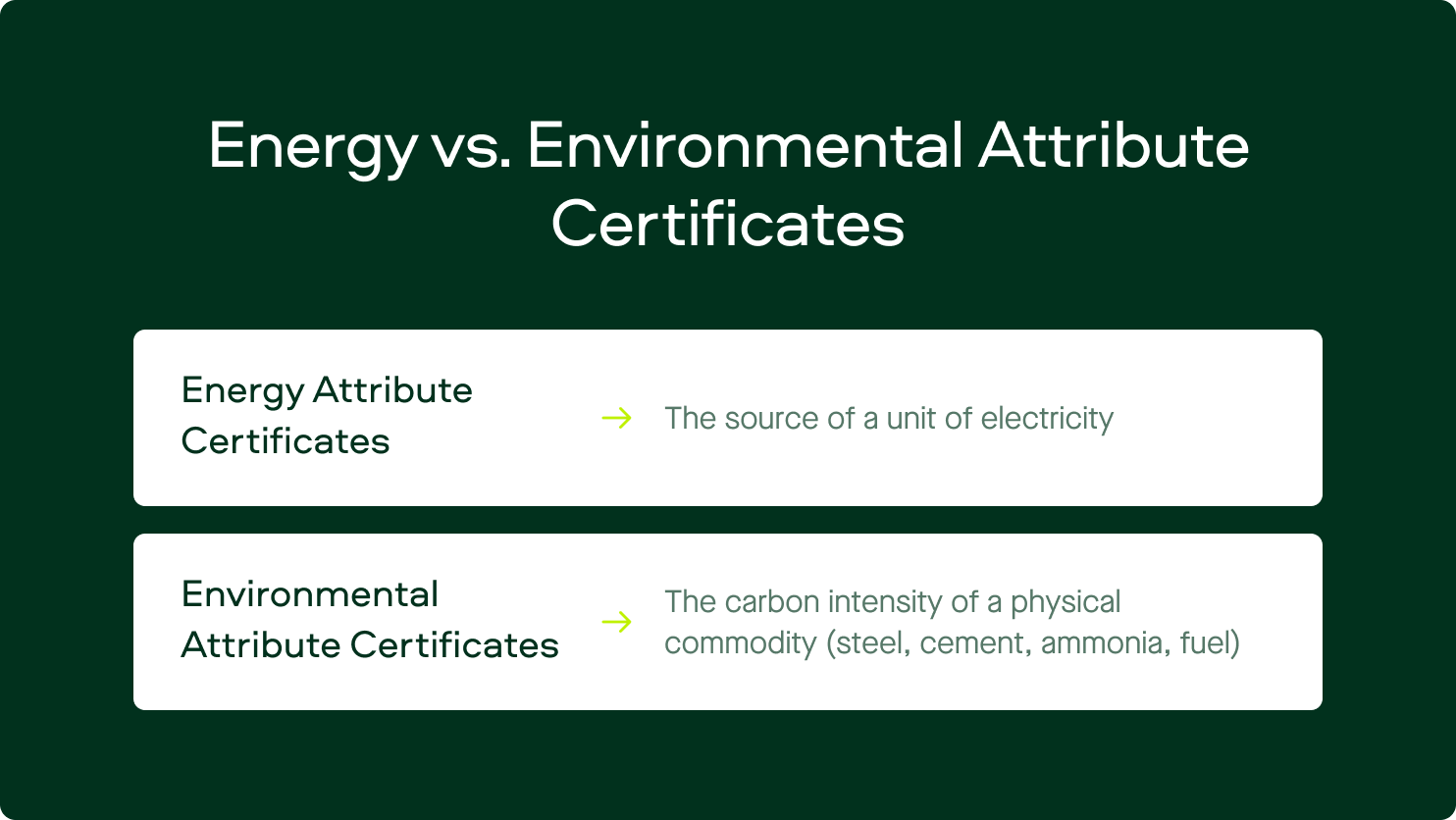
As you can see, both energy and environmental attribute certificates share an acronym, book-and-claim mechanism, and registry logic. But they differ in what they certify, which scope they touch, and the maturity of their surrounding infrastructure. As such, you can’t assume that an environmental attribute certificate will work the same way or be as equally recognized as an energy attribute certificate.
How Book-and-Claim Works
Book-and-claim systems follow the same sequence. Here’s how EACs work for physical commodities:
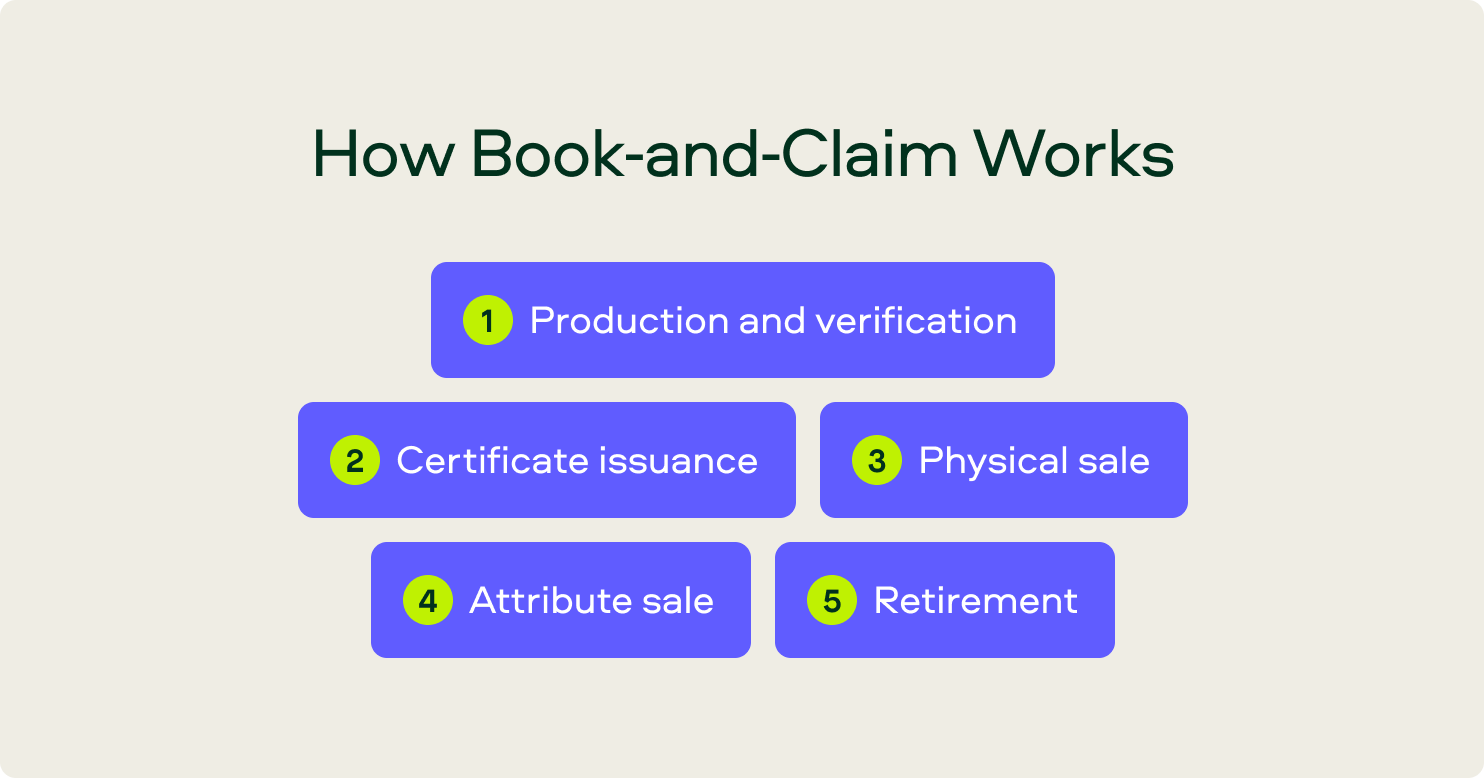
- Production and verification: A producer manufactures their product with lower carbon emissions per unit than the relevant baseline. However, if a trusted entity doesn’t independently verify the carbon intensity level, the certificate means nothing, so independent verification is invaluable.
- Certificate issuance: A claim registry issues certificates for the verified emissions reduction, counted in tonnes of CO2e avoided or units of product.
- Physical sale: The producer sells the physical product to a buyer in the nearest viable market at conventional pricing, with no carbon claim. These sales are just “business as usual.”
- Attribute sale: The producer sells the certificate to a buyer who wants to claim the sustainability benefits. The physical product and certificate sales are individual transactions.
- Retirement: The buyer, as a registry account holder, retires the certificate. Doing so prevents double-counting risks, i.e., stops anyone else from claiming the same reduction.
The whole model rests on the final step. If the physical purchaser and certificate holder can both claim the same avoided tonne, the market mechanism collapses. So, the buyer pays for chain of custody.
This is also what separates book-and-claim from mass balance, where low-carbon and conventional material mix in a tracked system where claims are linked to the physical flow. Book-and-claim cuts that link entirely, which extends its reach but puts more pressure on the book-and-claim registry.
Book-and-Claim for SAF
Sustainable aviation fuel (SAF) offers the clearest case for the book-and-claim system. So, it’s not surprising that it’s the most developed commodity market in terms of EACs.
SAF is blended at specific airports and burned by whichever aircraft draws from the hydrant. As such, corporate travel and freight buyers can’t physically consume the fuel. With book-and-claim SAF programs, said buyers claim sustainability benefits and join aviation decarbonization anyway.
The market for book-and-claim in SAF is comparatively developed. Registry infrastructure exists, several airlines and freight forwarders run programs, and accounting treatment is better established than for most commodity attributes. For example, the Roundtable on Sustainable Biomaterials ran a book-and-claim pilot with Air bp, Microsoft, and United Airlines – and they ran it way back in 2021.
However, open questions remain regarding how SAF certificates interact with airline-side claims, CORSIA obligations, and mandates such as ReFuelEU Aviation, which requires suppliers to blend a rising share of SAF at EU airports. Each overlap creates double-counting risk, where one volume of fuel supports more than one claim. This is a serious consideration for low-carbon fuels.
While you may not need to purchase SAF, the conventions in this industry will likely impact the conventions in other industries, such as cement, steel, and ammonia.
When to Buy the Attribute Rather Than the Product
To make the right decision, ask yourself this question: “Does it make sense to move the product?”
Buy the attribute when:
- It’s economically difficult to transport the commodity. Cement is a clear example.
- The product is fungible in shared infrastructure, like fuel in an airport hydrant or power on a grid.
- You want to support production before local supply exists.
- Your incumbent supplier has no low-carbon option, and switching suppliers isn’t practical.
Buy the physical product when:
- It travels well. Steel trades globally, so the case for attributes is less strong (but still exists).
- Supplier relationships matter from a strategic perspective.
- You need the claim to be as defensible as possible.
- The premium gap between physical supply and the attribute is small.
Most sophisticated buyers purchase physical products and attributes. The split they use follows the logic outlined above: buy physical products when they travel and attributes when they don’t.
What Makes an Attribute Certificate Credible
Certificates are only as strong as the evidence behind them. Check for these six things before you buy.
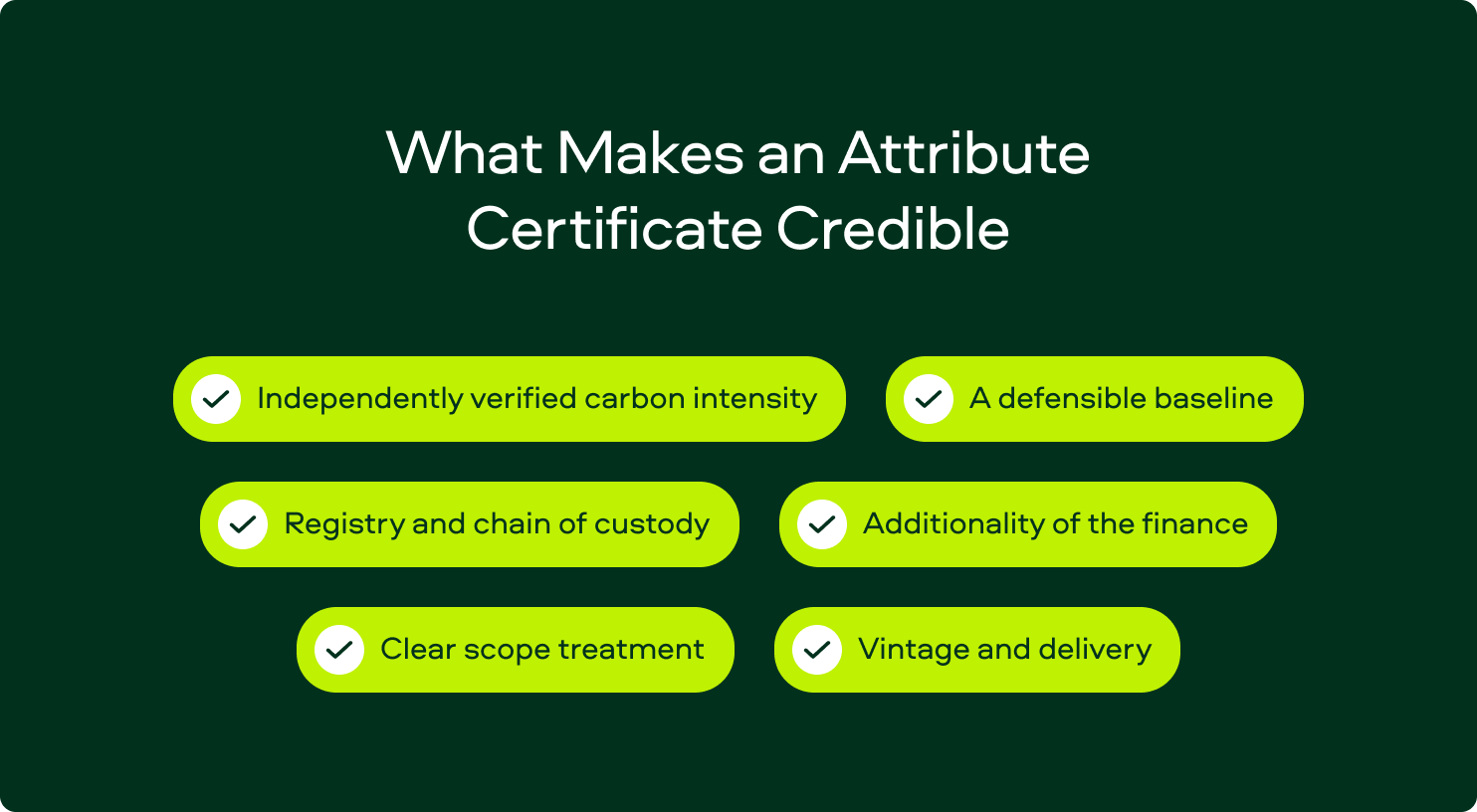
- Independently verified carbon intensity: The certificate represents the gap between a production CI and a baseline. When producers self-report carbon intensity without independent verification, they’re really selling self-assessments with registry entries. Independent verification guards against this.
- A defensible baseline: Does the reduction use a regional average, a technology benchmark, or the producer’s prior performance as its baseline? Generous baselines inflate certificate volumes like they inflate carbon credits. Defensible baselines help ensure accurate certificates.
- Registry and chain of custody: You need to know which of the claim registries holds the certificate, what prevents double counting, and if you can verify retirement independently.
- Additionality of the finance: Would the lower-carbon production have happened anyway? If so, your purchase doesn’t finance anything new. This is a live question in the market, so ask it.
- Clear scope treatment: Agree on the claim basis first. Under the Science Based Targets initiative’s Corporate Net-Zero Standard V2, which takes effect in early 2027, book-and-claim purchases support a system contribution claim and sit outside your reported Scope 3 inventory. As such, no verified reduction shows there.
- Vintage and delivery: When did production happen, and when does the certificate deliver? Forward purchases carry delivery risk that you need to be aware of and account for.
Verify Attribute Claims With Sylvera
Sylvera gives procurement and sustainability teams the independent evidence they need to purchase physical products and/or attributes with confidence, and support industrial decarbonization.
- EAC Assurance and Market Intelligence: We assess eligibility and integrity so you can quickly see if an EAC (Environmental Attribute Certificate) is eligible, how credible it is, and where the risk sits. We pair this with supply and demand models built from live market signals, offtake data, and pricing, so you also know what it’s worth.
- Verified carbon intensity: Sylvera’s Carbon Intensity Assessment provides independent, facility-level CI verification across 3,000+ cement facilities and 700+ ammonia facilities, as well as hydrogen and fuels. As such, our customers get essential evidence to make strong decisions.
- One assessment, multiple frameworks: Sylvera produces CI under CBAM, LCFS, RFNBO, and EU ETS requirements from a single data input. As such, you can easily see how the same production performs under each regime without commissioning separate studies.
- Verified CI with commercial weight: For example, Sylvera independently verified an 85% emission reduction for Cura, a developer of low-carbon cement technology. Cura then used our findings in its data room to support investment, a clear sign that verified CI is valuable to investors and buyers.
- Market data: Sylvera’s Commodity Insights tracks attribute pricing, market dynamics, and buyer activity. In a young market like this, knowing what others paid is a large part of price discovery.
- One lens across attributes and credits: Many corporate buyers hold EACs and carbon removal credits. Sylvera assesses both, so one standard of evidence covers everything.
- Independence: Sylvera doesn’t issue, sell, or broker attribute certificates. We have no stake in the volume or price of any certificate we assess, which helps us avoid conflicts of interest.
Want to see the data behind specific certificates? Request a demo of Sylvera or free platform access.