

“Over the years we’ve invested significantly in our field data team - focusing on producing trusted ratings. While this ensures the accuracy of our Ratings, it doesn’t allow the scale across the thousands of projects that buyers are considering.”

For more information on carbon credit procurement trends, read our "Key Takeaways for 2025" article. We share five, data-backed tips to improve your procurement strategy.
One more thing: Connect to Supply customers also get access to the rest of Sylvera's tools. That means you can easily see project ratings and evaluate an individual project's strengths, procure quality carbon credits, and even monitor project activity (particularly if you’ve invested at the pre-issuance stage.)
Book a free demo of Sylvera to see our platform's procurement and reporting features in action.
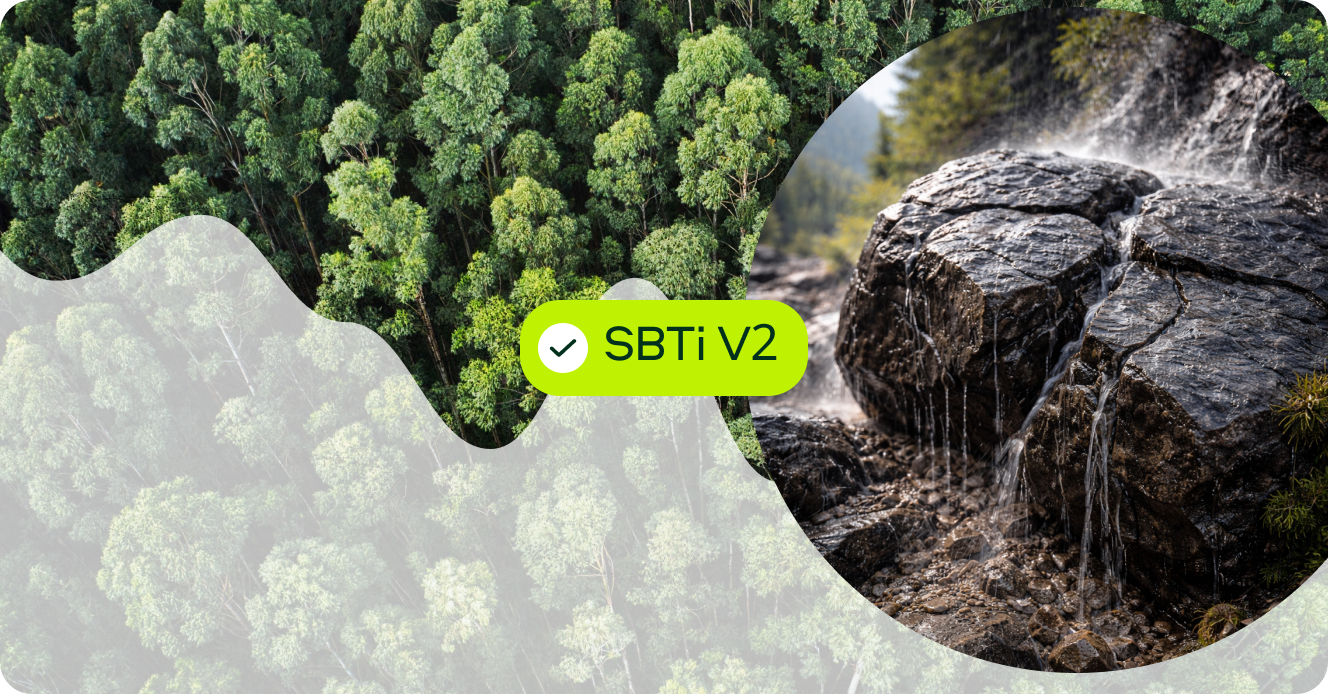
What Changed in SBTi V2
SBTi built its updated standard based on two public consultations and multiple pilot tests to reflect the latest climate science. The result is that 42% of its sections are entirely new.
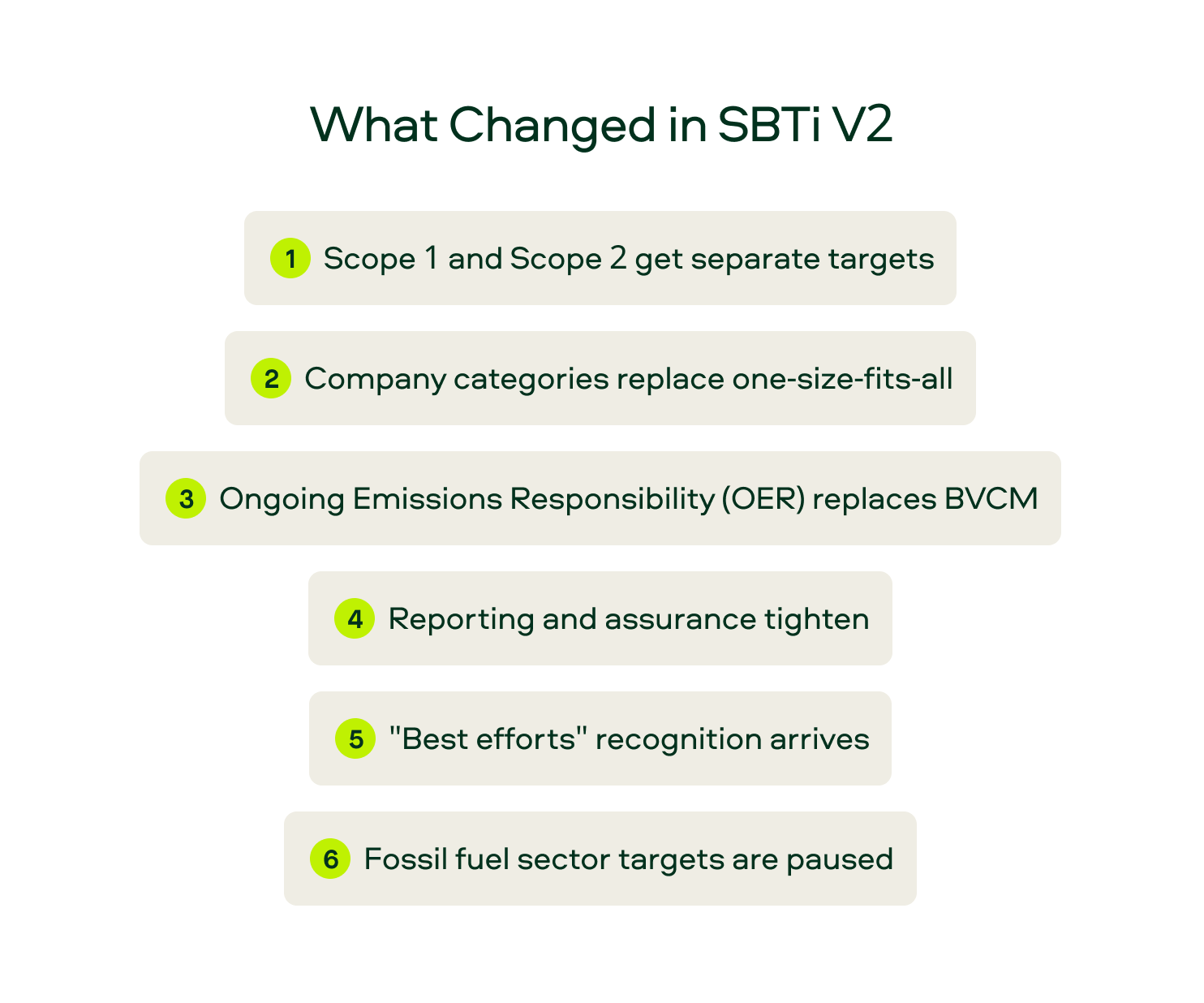
Here are the most important changes:
- Scope 1 and Scope 2 get separate targets: For Scope 2, companies choose between a low-carbon electricity alignment target and an absolute emissions target, and SBTi measures ambition against the location-based inventory. The choice you make decides how much work your energy attribute certificates can do. Long-term targets are also optional for most companies.
- Company categories replace one-size-fits-all: Category A covers large companies everywhere and medium-sized companies in high-income countries. Category B covers smaller businesses and medium-sized companies in lower-income markets, with lighter requirements. SBTi confirms your category during the validation process, and it applies for the duration of the five-year cycle.
- Ongoing Emissions Responsibility (OER) replaces BVCM: OER folds beyond value chain mitigation, carbon removals, and neutralization into one framework, with voluntary recognition tiers for companies that fund climate action beyond their own targets. Starting in 2035, OER will also require Category A companies to support carbon removals, which makes it a significant change for credit buyers. We'll cover this change in greater detail in a few minutes.
- Reporting and assurance tighten: Companies report progress every year, reset their base year each cycle, and close each cycle with an assessment that draws on full-scope GHG inventories. In addition, Category A companies need third-party assurance of their base year data and end-of-cycle progress to make sure their targets are validated and assessed.
- "Best efforts" recognition arrives: Companies that miss their targets because of factors they can't control, like opaque supply chains, can remain within the SBTi framework if they show they used every available lever and openly report the barriers they encountered.
- Fossil fuel sector targets are paused: Companies that are directly involved in fossil fuel extraction or production can't validate targets until SBTi finalizes its sector methods.
Which Timeline Applies to You
Your company's deadline to meet the SBTi V2 standard depends on its current situation.
- You have validated targets running to 2030: Your existing near-term targets remain valid through the end of their target timeframe. SBTi recommends that you set the subsequent cycle, which will cover 2030-2035, under V2 from 2028, and give you enough lead time to implement the new requirements before your next cycle starts
- You plan to set new targets before January 31, 2028: You can use versions 1.3.1 or 2.0 of the SBTi Net-Zero Standard. The current standard, alongside the Near-Term Criteria V5.3, includes numerous flexibilities, such as combined scope targets. So, some companies may prefer it.
- You submit from February 1, 2028: Every company that wants to set science-based targets after January 31st, 2028 must use version 2.0. SBTi won't validate targets submitted under earlier versions after that date.
- You want to become a leader in the space: SBTi expects the SBTi Services Validation Portal to open for SBTi Net-Zero Standard V2.0 submissions in Q1 of 2027. This means that early movers will have access to the full V2 architecture, including recognition tiers, from day one.
It's important to note that financial institutions also apply a separate standard to their financed emissions.
Last but not least, SBTi gives organizations a genuine choice. If you submit under version 1.3.1 before the deadline, you'll buy yourself another cycle of flexibility. If you enter under version 2.0, you'll bring recognition and force data work sooner. Both routes are defensible, but drifting into the deadline without a plan isn't.
From Beyond Value Chain Mitigation to Ongoing Emissions Responsibility
Under SBTi V1, beyond value chain mitigation described climate action funded outside a company's value chain, most often carbon credit purchases. While SBTi encouraged BVCM, it sat outside the target architecture, so companies never received credit for their efforts in this area.
SBTi V2 folds BVCM, carbon removals, and neutralization into Ongoing Emissions Responsibility (OER). It's a single framework that governs how companies address emissions that persist on the path to net zero. For the first time, SBTi gives credits a structured recognition mechanism and, eventually, a mandate. However, credits still sit outside reduction targets, with separate accounting.
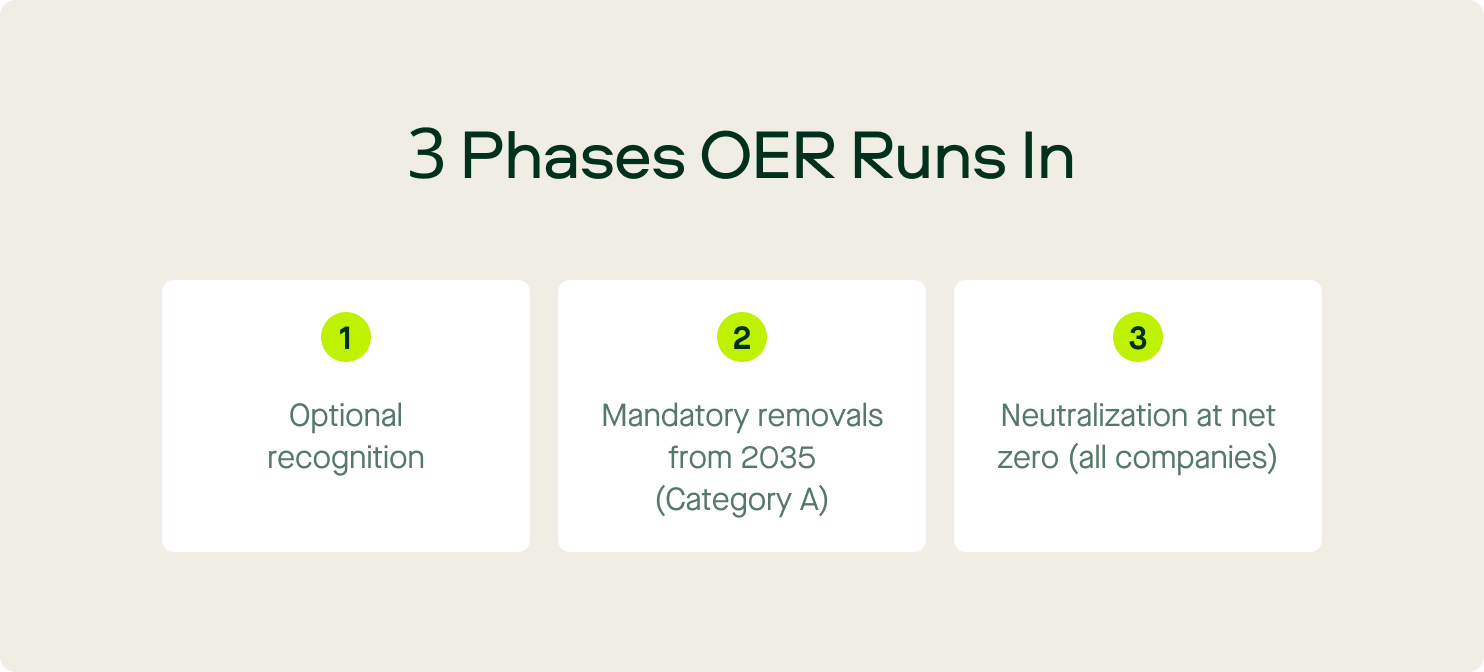
OER runs in three phases, which are outlined in Chapter 6 of the standard:
- Optional recognition: Companies earn Engaged, Advanced, or Leadership status based on the share of ongoing emissions they cover, from 1% up to 100%. At validation, every company must state whether it intends to participate, which makes voluntary action visible and sets participating companies apart.
- Mandatory removals from 2035 (Category A): Category A companies must support eligible carbon removals that cover at least 1% of total ongoing scope 1, 2 and 3 emissions, rising linearly to 100% by the net-zero target year. In addition, a growing share must come from long-lived removals. SBTi refers to this requirement as "illustrative" and plans to review it in Version 3.
- Neutralization at net zero (all companies): At the net-zero target year, companies neutralize all residual emissions with eligible removals, distinguishing net-zero and carbon neutral claims.
It's extremely important to understand that starting in 2035, SBTi V2's mandatory requirement for Category A companies calls for removals. Avoidance credits don't qualify, so if your company falls into Category A, you'll need to adjust your strategy accordingly.
What Counts and What Does Not
The table below connects each decarbonization lever to the way it's treated under SBTi V2.
Put simply, if you build your portfolio on avoidance credits, you'll satisfy today's voluntary framing but fail the 2035 requirement for Category A companies. So, split your holdings by intended use, using some credits for near-term contribution, while keeping removals with proven permanence to neutralize residual emissions.
Why 2035 Is Closer Than It Looks
2035 may seem like the distant future, but for removals, it's right around the corner. Here's why:
- It takes time to build supply: Durable removal projects take years to develop and finance. If your company contracts in 2034, it will compete for capacity that was allocated years earlier.
- Demand has a date: V2 gives a large cohort of companies the same deadline. Sylvera's modeling projects a near 170% rise in SBTi-driven credit demand by 2030 under moderate adoption.
- Price follows: When constrained supply meets scheduled demand, the result is rarely favorable to late buyers.
Now, despite these disadvantages, the "waiting" strategy has merit. Removal costs could fall as technologies scale. You need to decide what you value more: cost or certainty. Your answer will depend on the residual emissions you need to cover and your tolerance for 2034 prices.
One more thing: Recognition tiers change the math, as early procurement buys supply security and formal recognition at the same time. This fact is an important part of the equation.
The Wider Convergence: ISO 14060 and GHG Protocol
SBTi V2 doesn't happen in isolation.
ISO 14060 alignment and GHG Protocol revisions have overlapping timelines through 2027 and 2028. But all three point toward tighter definitions, more assurance, and less latitude on market instruments.
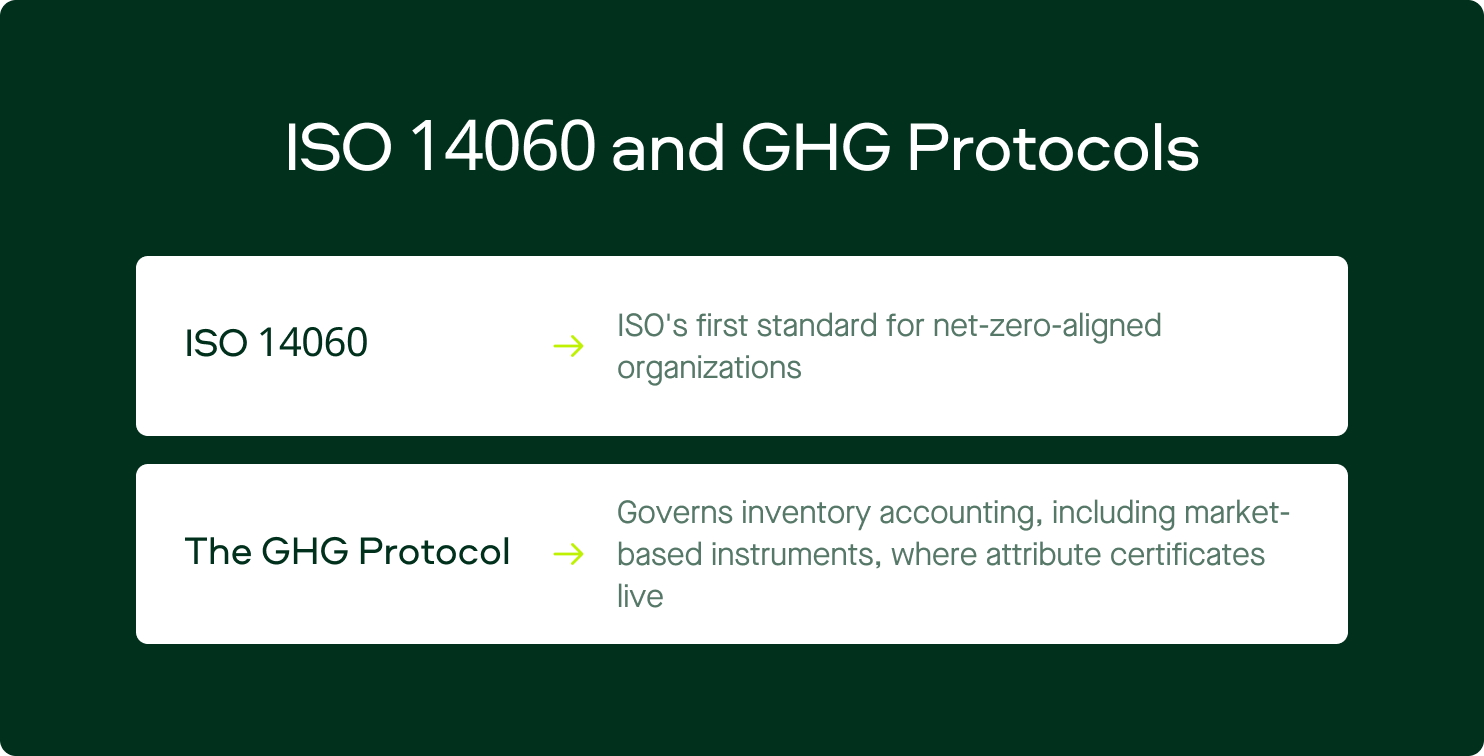
- ISO 14060 is ISO's first standard for net-zero-aligned organizations. ISO released the draft on June 17, 2026, and observers expect the final version in late 2026 or early 2027. It sets requirements for targets, transition plans, and verifiable progress toward net zero ambitions.
- The GHG Protocol governs inventory accounting, including market-based instruments, where attribute certificates live. Its Scope 2 proposal adds hourly matching, with a final standard expected in 2027 and an Actions and Market Instruments standard to follow. SBTi V2 incorporates elements of these new versions, and SBTi plans provisional guidance until they land.
Be aware that optimizing for one framework risks misalignment with another. Instead, build for the strictest plausible interpretation. Doing so will give you a strong foundation across the three.
What to Do With the Transition Window
SBTi describes climate change as an immediate driver of physical and economic risk, not a distant threat. Fortunately, setting targets is beneficial for businesses and the environment.
Based on a recent survey of companies that set targets, 91% reported an overall positive impact, 80% cited strengthened investor perception, 80% noted improved strategic cohesion and long-term vision, and 72% credited targets with building resilience to future regulatory changes.
Here's how to use the next 16 months to make the most of the transition window:
- Choose your version deliberately: As mentioned earlier, both V1.3.1 and V2.0 are viable paths to take before the January 2028 deadline. But you need to intentionally commit to one.
- Separate your credit portfolio by intended use: Near-term contribution and future neutralization need different instruments. Build a strategy that can successfully accomplish both.
- Start building a removals position: Establish supplier relationships, understand various pathways, and learn what quality looks like before the market tightens. That way, you're prepared.
- Get your underlying data assured: Data work takes longer than target setting. Because of this, start preparing targets now, not later, using SBTi's transition resources.
- Check attribute certificate treatment before buying: SBTi needs to share further guidance on commodity attributes. Track the organization's advice on this topic and act accordingly.
- Model your 2035 obligation: Even a rough estimate of required removals volume will change how you approach procurement in the near-term.
Build a V2-Ready Portfolio With Sylvera
Sylvera gives teams the independent data they need to assess credit quality and prepare their portfolios for SBTi V2's requirements. This fact is extremely important for a few different reasons:
- Removal quality now has a deadline: Removal credits vary widely in durability and integrity. Sylvera's Ratings assess carbon accounting, additionality, and permanence. Plus, we score co-benefits separately, and permanence maps directly onto V2's durability expectations.
- CDR pathways get their own scrutiny: At Sylvera, we use a separate framework for every project type, so ARR, REDD+, IFM, cookstoves, and CDR each receive type-specific analysis.
- Portfolio separation needs portfolio data: The Sylvera database covers 3,000+ project ratings on a D to AAA scale. Equally as important, we issue Estimated Ratings for rapid screening, and update our Ratings as new evidence emerges. Also, our biomass data draws on 450 billion ground-truth data points.
- Some companies want to secure supply ahead of the curve: Sylvera's Market Intelligence offers price, demand, and supply projections to 2050. Market Gateway lists over 400 million tCO2e of inventory. And Pre-Issuance Ratings extend quality analysis to projects before they issue credits.
- Compliance eligibility filters help brands see which credits each framework accepts: Sylvera offers country risk evaluations for 50+ countries, plus Article 6 and CORSIA coverage, to help companies understand the market landscape as multiple frameworks diverge on what they accept.
- The market rewards independent verification: Finally, Sylvera doesn't take positions in the market, hold inventory, or take a cut of the transactions our platform supports. Plus, we keep our Ratings team separate from our commercial teams to ensure trustworthiness.
Request a demo of Sylvera to assess your portfolio against V2 requirements, or get free access now.