

“Over the years we’ve invested significantly in our field data team - focusing on producing trusted ratings. While this ensures the accuracy of our Ratings, it doesn’t allow the scale across the thousands of projects that buyers are considering.”

For more information on carbon credit procurement trends, read our "Key Takeaways for 2025" article. We share five, data-backed tips to improve your procurement strategy.

One more thing: Connect to Supply customers also get access to the rest of Sylvera's tools. That means you can easily see project ratings and evaluate an individual project's strengths, procure quality carbon credits, and even monitor project activity (particularly if you’ve invested at the pre-issuance stage.)
Book a free demo of Sylvera to see our platform's procurement and reporting features in action.
Building a quality carbon project is no longer enough to sell its credits. Which market should you sell into? What will buyers actually pay? How do you convince investors your projections will hold?
With buyers becoming more selective and compliance rules shifting year to year, these questions are getting harder to answer, and the cost of getting them wrong is rising.
That makes every decision count, from where you site a project through to how and when you sell its credits. The developers who succeed treat project development like any serious market entry, backed by competitive intelligence, clear positioning, and continuous market feedback.
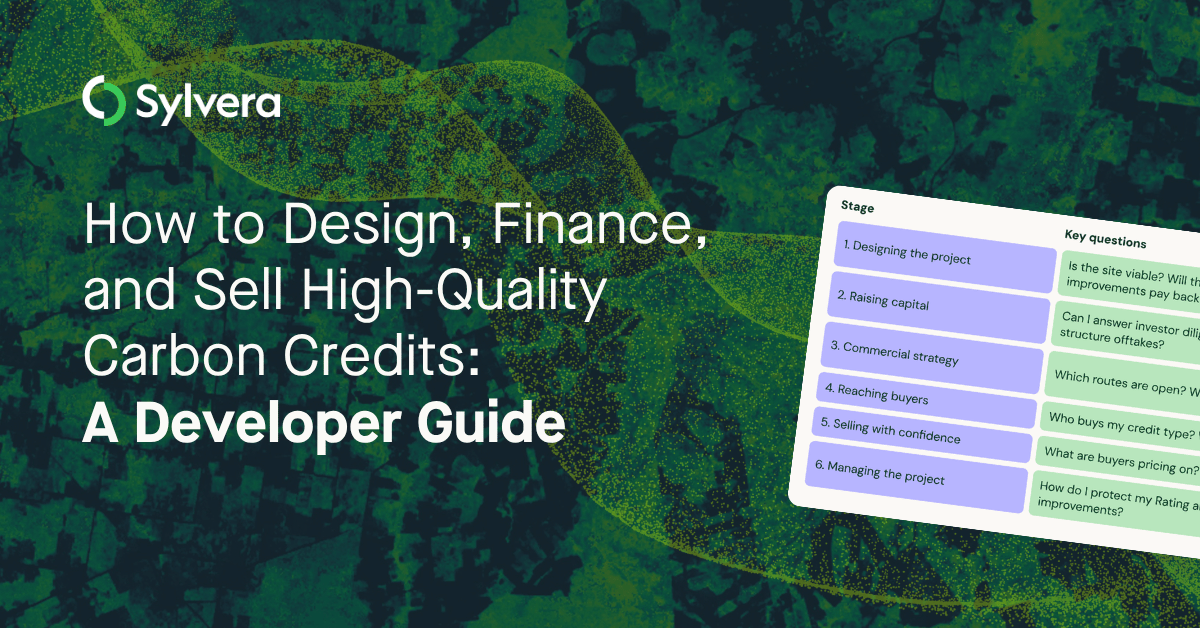
With this in mind, this blog follows a project through each stage from site selection through to reporting. We cover the questions developers ask at each stage, and the data and intelligence needed to answer them.
Download the 2027 Developer's Guide and get the data you need to design, finance, and sell quality credits. Download the guide.

1. Designing a project the market will value
Many decisions that most affect a project's quality and price are made early. Site, methodology, and design choices can set a ceiling on quality, so the smart approach is to think backward from what buyers want, not forward from what is technically feasible.
The questions developers ask:
Is this site viable?
Does it meet methodology requirements?
Will my project earn a strong Rating on its current track?
Which design choices will increase revenue?
Vintage and quality both shape price. Average ARR prices have nearly tripled across vintages, from $9.10 for 2018 credits to $25.32 for 2025. Quality carries its own premium too: AAA-rated biochar projects command around 40% more than BBB equivalents.
The data you need:
Country risk and Article 6 readiness for your host country, how your methodology performs on each quality attribute, and benchmarks against rated projects of the same type and geography.
How Sylvera helps:
Country Profiles and the Article 6 & CORSIA Hub score host-country risk, while Methodology Profiles and the Project Catalog let you benchmark your design.
A Pre-Issuance Rating shows where your project stands while there's still time to act.
2. Raising capital
Investors essentially come to every conversation with a checklist. They’ll triage methodology and geography, then work through volume, the carbon claim, the developer's track record, co-benefits, and data gaps.
The questions developers ask:
What data do investors need?
Can I answer their questions confidently?
Is my data room in order?
Should I take on investment, sell credits forward, or both?
Delivery risk is where many conversations stall. Roughly half of all ARR projects under-deliver against their initial projections, with an average shortfall of around 54%. A single-scenario projection signals optimism. A realistic range, with the steps you're taking to reduce each risk, builds trust.
The pool of forward buyers is also widening. Excluding Microsoft, announced offtake volume almost trebled in the first three quarters of 2026, from 8 million to 23 million tonnes.
In one example, a Latin American ARR developer used a Pre-Issuance Rating to secure an offtake commitment for 65% of its future credits, with funding released against milestones.
The data you need:
An independent view of your expected Rating, issuance projections with a realistic range, and transaction-based pricing to underpin your financial model.
How Sylvera helps:
A Pre-Issuance Rating gives investors an independent view of quality and delivery risk, with monitoring to track milestones.
The Developer Directory shows investors your track record, and Market Intelligence supports your model with real transaction prices.
3. Building a commercial strategy
Compliance and voluntary carbon markets are converging, giving developers several routes to market: the voluntary market, domestic compliance schemes, and Article 6 and CORSIA.
The balance between them is shifting fast. Voluntary buyers accounted for around 85% of demand in 2025, but that share is expected to fall to around 30% by 2033.
The questions developers ask:
Which routes are open to my project?
Should I seek host country authorization?
What price can I defend? How much should I pre-sell?
Authorization is often the bottleneck. Of the more than 80 host countries Sylvera has assessed, only 21% are high confidence for delivering Letters of Authorization and corresponding adjustments.
Pricing is just as easy to get wrong. One Latin American forestry developer found its Ratings were in the top quartile of its peer group, but its median spot price was around 15% below comparable developers.
The data you need:
Eligibility rules for each scheme, authorization status in your host country, prices by route and Rating, and peer benchmarks.
How Sylvera helps:
The Article 6 & CORSIA Hub tracks Letters of Authorization and corresponding adjustments, scores host-country risk, and forecasts CORSIA supply, demand, and price.
Market Intelligence draws on more than 300,000 price points, and the Developer Directory benchmarks your prices against peers.
4. Reaching buyers
The buyers who pay premium prices plan their procurement months or years in advance. By the time your credits issue, they may already have committed elsewhere, so outreach needs to start well before first issuance.
The questions developers ask:
Who buys my credit type?
When do they buy?
Which buyers have a gap against their targets?
Are there active RFPs I can respond to?
Demand is fragmented by sector, and it moves. In Q3 2026, energy and utilities buyers shifted away from REDD+, which fell from 54.2% of their mix to 28.6%, and toward agriculture, which rose from 6.8% to 28.0%. Transportation and logistics buyers, by contrast, bought mainly renewables.
Knowing which companies have retired credits like yours turns cold outreach into informed targeting.
The data you need:
Retirement history by company, project type, and geography, plus live RFPs and procurement timing.
How Sylvera helps:
The Buyer Directory tracks retirement patterns across 40,000+ companies. The Developer Directory lets you showcase pipeline supply to buyers screening for it, and Market Gateway lets you respond directly to buyer RFPs, with no fees.
5. Selling with confidence
Buyers screen first on project type, geography, and vintage. Within those filters, they price on specific quality attributes: carbon accounting, additionality, permanence, and safeguarding and co-benefits.
The questions developers ask:
What are buyers pricing on?
What's the market's perception of my project?
How do I prove it's high integrity?
What will buyers ask in due diligence?
The market is moving up the quality curve. Credits rated BBB and above made up 43% of issuances in the first three quarters of 2026, up from 28% in the same period of 2025. And quality is paying off. In Q3 2026, investment-grade credits made up 18% of rated retirement volume but 42% of rated market value.
Average retirement price by Rating band, Q3 2026. Source: Sylvera.
The data you need:
An independent breakdown of your project's quality attributes, and evidence of the premium buyers pay at your Rating level.
How Sylvera helps:
Sylvera Ratings give buyers an independent, attribute-by-attribute view of quality, and you can share a Rating summary when buyers request one.
Market Intelligence shows the premiums buyers pay by Rating and co-benefits score.
6. Managing your project over its lifetime
Project development doesn't end at first issuance. A Sylvera Rating is a point-in-time assessment, and buyers can see when it was last reviewed and which vintages it covers. So improvements only help your price if they're reflected in your Rating.
The questions developers ask:
How do I report performance to investors?
How current does my Rating need to be?
What Rating would I get if I changed something, and is it worth the cost?
The economics often favor improving. With investment-grade ARR credits trading at around $10 more than those rated BB and below, targeted improvements to additionality, permanence, or monitoring can pay back many times over a crediting period.
The data you need:
Up-to-date Rating evidence, a clear view of which attributes to strengthen, and the price effect of moving up a band.
How Sylvera helps:
Pre-Issuance Ratings include quarterly monitoring and highlight areas for improvement, while the Value Module models how a Rating change affects price.
Market Commentary and the Article 6 & CORSIA Hub flag policy shifts as they happen.
Get the full guide
This is just a snapshot. The 2027 Developer's Guide goes deeper on every stage, with regional and vintage pricing tables, attribute scores by Rating, eligibility rules for compliance and Article 6 buyers, and a stage-by-stage checklist you can use on your own projects.
Download the 2027 Developer's Guide and get the data you need to design, finance, and sell quality credits. Download the guide