.png)


“Over the years we’ve invested significantly in our field data team - focusing on producing trusted ratings. While this ensures the accuracy of our Ratings, it doesn’t allow the scale across the thousands of projects that buyers are considering.”

For more information on carbon credit procurement trends, read our "Key Takeaways for 2025" article. We share five, data-backed tips to improve your procurement strategy.
One more thing: Connect to Supply customers also get access to the rest of Sylvera's tools. That means you can easily see project ratings and evaluate an individual project's strengths, procure quality carbon credits, and even monitor project activity (particularly if you’ve invested at the pre-issuance stage.)
Book a free demo of Sylvera to see our platform's procurement and reporting features in action.
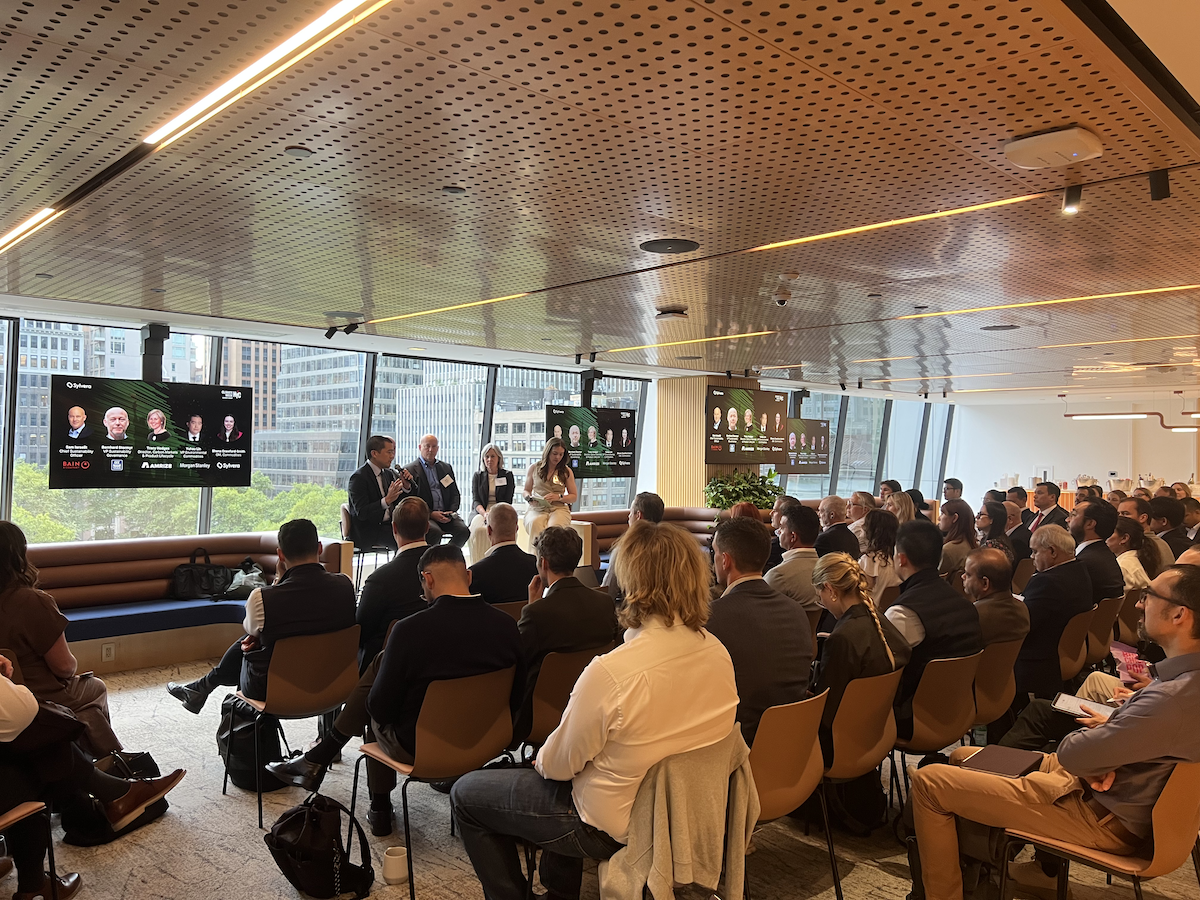
Climate Week NYC brought a packed room to Sylvera's panel, The New World of Corporate Decarbonization: Lower-Carbon Commodities, EACs, and Carbon Credits. Moderated by Shona Crawford-Smith, GM Carbon-Differentiated Commodities at Sylvera, the conversation brought together Sam Israelit (CSO, Bain & Company), Bernhard Stormyr (VP Sustainability Governance, Yara International), Yuhau Lin (VP Environmental Commodities, Morgan Stanley), and Tracy Hodges (Director, Carbon Markets, Amrize) for a candid look at where corporate decarbonization actually stands today.
Here's what we found:
The market's mood has turned
The enthusiasm of the 2021 net-zero wave gave way to skepticism, and many companies parked their decarbonization plans while they waited for clarity. The panel's take; that era is ending. Standards like the SBTi Corporate Net-Zero Standard V2, while still not finalized, are giving buyers the clearest signal yet that it's time to move.
No single lever gets a company to net zero
Buyers are juggling several decarbonization pathways at once, each with its own cost per T of carbon and accounting treatment:
- Direct physical delivery of lower-carbon products
- Mass balance, where lower-carbon inputs are pooled and claims are tracked separately
- Environmental attribute certificates (EACs), including commodity certificates
- Carbon credits, used for residual emissions
Sustainability teams still lead most of these decisions, but procurement is increasingly in the room too, which makes it even more important that the rules are clear. It’s been noted that, once you've seen how complex lower-carbon commodity inputs can be, carbon credits start to look simple by comparison.
Financing depends on getting everyone in the room early
The panel was direct about what's blocking capital from flowing: buyers have historically negotiated as little risk onto themselves as possible, and investors won't write a check without contracted, long-term revenue. That dynamic has to change.
The deals that are working share a pattern. Developers, corporate buyers, and lenders sit down together early, rather than bringing a closed bilateral offtake agreement to a lender after the fact. Production risk can be insured or managed by sizing an offtake to a share of projected output, but residual risk ultimately sits with the buyer; it can't be fully structured or insured away.
The most promising transactions go further still, with buyers co-designing projects alongside developers and producers, specifying methodology, registry, location, and revenue distribution up front.
What has to be true by 2030
The panel converged on a few conditions for the market to scale:
- Reliable demand: The products and pathways already exist. Willingness to pay is the bottleneck, not technology.
- Trusted, credible standards: To speed up transactions, the market needs a quality standard, buyers want to be able to make confident and credible claims
- A path from voluntary to regulatory: Institutionalizing demand will take frameworks that go beyond voluntary commitments.
- More transparency: Multi-stakeholder collaboration builds the trust that closed, bilateral deals don't.
One thread ran through the whole conversation. Buyers need to stop playing defense and start owning their decarbonization story, the same way companies have learned to talk confidently about sourcing claims in food and cosmetics.
How Sylvera supports corporate decarbonization
The conversation at Climate Week NYC pointed to the same underlying need that comes up in every deal: credible, independently verified data that producers can defend in an offtake negotiation and buyers can cite in a disclosure.
Sylvera is already playing a role in removing some of the diligence barriers facing buyers and producers, conducting facility-level carbon intensity assessments and EAC assurance that help unlock offtakes.
For commodity producers looking to optimize their carbon value, our Mechanism Eligibility tools map which compliance and voluntary mechanisms a facility qualifies for, what the gaps are, and what each pathway is worth commercially across CBAM, EU ETS, EACs, and more.
For EAC transactions, our EAC Market Intelligence gives producers and buyers a clear view of where the market is heading, how lower carbon supply is evolving, and who the next buyers are likely to be beyond the ones buying today. For buyers and offtakers, our Commodity Insights platform covers global ammonia, steel, cement, and fuels facilities, giving procurement teams the standardised data needed to compare suppliers on something other than price alone - plus the platform includes Market Gateway, where buyers can connect directly with producers. Get started here on the platform for free.