


.avif)


“Over the years we’ve invested significantly in our field data team - focusing on producing trusted ratings. While this ensures the accuracy of our Ratings, it doesn’t allow the scale across the thousands of projects that buyers are considering.”

For more information on carbon credit procurement trends, read our "Key Takeaways for 2025" article. We share five, data-backed tips to improve your procurement strategy.
One more thing: Connect to Supply customers also get access to the rest of Sylvera's tools. That means you can easily see project ratings and evaluate an individual project's strengths, procure quality carbon credits, and even monitor project activity (particularly if you’ve invested at the pre-issuance stage.)
Book a free demo of Sylvera to see our platform's procurement and reporting features in action.
What "Forest Carbon Verification" Means (In Plain English)
Verification is not the same as validation.
Carbon offset validation happens at the design stage. It's a review to confirm the project's plan is credible before carbon sequestration takes place. Verification happens after. It's the process of confirming that a project reduced or removed greenhouse gas emissions as claimed during the monitoring period.
In the project lifecycle, it looks like this:
Project design → validation → monitoring period → verification → issuance → retirement.
.png)
As you can see, verification sits between the monitoring work and the actual issuance of carbon credits, which is why it matters so much.
Once completed, verification produces a few key outputs: A verification statement or report, a confirmed credit quantity (sometimes with deductions), and a set of conditions or limitations that qualify the findings. Said conditions are important but often overlooked.
What Auditors Actually Check
Auditors conduct a rigorous assessment process to ensure sustainable development and proper outcomes. Here's what they evaluate before they project verification.
.png)
- Project Boundary and Eligibility: Auditors confirm the project area is correctly defined and the land qualifies under the relevant methodology. Land use history, tenure, and eligibility criteria are each reviewed to ensure proper project development.
- Methodology Compliance: Auditors determine if the project aligns with methodology requirements - such as VM0047 or VM0048. They check data sources, calculations, and whether the proposed methodologies or deviations were included in project documentation and approved.
- Baseline Construction: Auditors examine whether the GHG emission reductions are additional, meaning they wouldn't have occurred without the project. A weak or inflated baseline is a common reason projects fail or receive significant credit deductions.
- Monitoring Approach: Auditors assess forest inventory methods like field plot design, remote sensing data, sampling strategy, and QA/QC protocols. Weak monitoring is a major red flag, which is why developers are investing heavily in robust MRV.
- Carbon Accounting: Auditors verify the math is correct and that uncertainty has been treated conservatively and transparently. If the carbon accounting is off, the environmental project won't be verified and the developer will have to make adjustments.
- Leakage and Permanence: For avoided deforestation projects especially, auditors assess whether the project displaced emissions elsewhere (leakage), and whether a credible buffer mechanism protects against future reversals.
- Safeguards and Co-Benefits: Auditors check for project compliance when Gold Standard or Verified Carbon Standard (VCS) projects require stakeholder engagement and biodiversity protections. Only proper compliance leads to verification.
Biomass Is the Foundation (And the Biggest Source of Disagreement)
To understand why forest carbon projects can look similar on paper but produce different outcomes, start with biomass. How carbon stocks are estimated, and the uncertainty that surrounds those estimates, determines how many carbon credits a project can issue.
How Biomass Is Estimated In Forest Carbon Projects
Project developers use three techniques to estimate carbon stored in forest biomass.
- Field Plots and Allometric Equations: Ground crews measure trees across sample plots, and allometric equations convert the measurements into biomass estimates. The species assumptions embedded in these models are important. The wrong allometry for a local tree species can introduce systematic errors into every calculation that follows.
- Remote Sensing: Satellites and aircraft collect data to estimate forest structure at scale. LiDAR is the gold standard for accuracy because it measures canopy height in 3D. Optical imagery is widely available but less precise. Radar can see through clouds, which matters in tropical regions, but has its own limitations.
- Hybrid Approaches: Most high-quality projects combine field plot data with remote sensing. The goal is to use field plots to calibrate the remote sensing model, then apply the calibrated model across the full project area. This produces coverage and accuracy.
The Uncertainty Problem (And Why It Changes Revenue)
Biomass estimation isn't an exact science. The process is fraught with uncertainty because the only way to know the exact biomass of a tree is to cut it down and measure it individually.
When auditors can't confirm that carbon stock estimates are reliable, registries apply conservative deductions to the issuance quantity. The more uncertain the underlying data, the fewer credits the project receives. This is done to ensure environmental impact.
"Good" uncertainty management uses transparent methods that can be audited, enough field plots to produce statistically representative results, credible calibration of remote sensing models, and explicit error bounds reported at every stage. Projects that achieve this protect their issuance volumes. Projects that don't leave credits on the table.
For developers: Uncertainty is a commercial problem. Higher uncertainty means conservative deductions at issuance, which directly reduces the credits you can sell. Investing in better measurement upfront protects your revenue and strengthens your position with investors and buyers.
For investors and offtakers: When evaluating a project, pay close attention to how uncertainty is reported. A project with explicit, well-managed uncertainty is more trustworthy — and more likely to deliver — than one that presents clean numbers without explaining how they were derived.
Common Biomass Red Flags
Some monitoring reports try to hide data quality problems. Watch for these warning signs:
.png)
- Sparse plot data or an unclear sampling design. If a project covers tens of thousands of hectares but only monitors a handful of plots, the estimates are likely unreliable. The sampling may not represent the full range of forest conditions.
- Outdated allometry assumptions. Using species-generic equations from decades old studies—or from entirely different geographies—can systematically overstate biomass.
- Unexplained jumps in biomass over time. Significant increases between monitoring periods that don't align with realistic growth rates signal a data or methodology problem.
- Low transparency on model choice and error bounds. Monitoring reports that don't explain which models were used and why, or don't quantify uncertainty, are problematic.
- "One-and-done" measurement with a weak monitoring plan. Baseline tracking without a plan to detect degradation and disturbance over time creates delivery risk.
From Biomass to Issuance: Why "Verified" Doesn't Always Mean "Delivered"
Even a well-designed project with solid biomass data can run into problems when it tries to issue credits. Verification affects issuance in two key ways: quantity and timing.
- On Quantity: Conservative deductions, uncertainty adjustments, and buffer pool contributions reduce the number of credits on the VCM. A project might verify 100,000 tonnes of emission reductions but issue significantly fewer after deductions are applied.
- On Timing: Verification cycles are often slow. Audit bottlenecks, data gaps, and disputes between the project team and the verifier can push issuance timelines. For buyers with forward contracts or procurement commitments, this creates delivery risk.
Because of these things, the voluntary carbon market needs more than a verification statement. Buyers need to understand if a project's claimed issuance volume is robust or "fragile".
(Note: That distinction comes from the quality of the underlying measurement, not the existence of third-party verification.)
For buyers: A verification statement tells you a project met the standard at a point in time. It doesn't tell you whether the issued volume is robust or fragile — that distinction comes from the quality of the underlying measurement, and whether the project has continuous monitoring in place between verification events.
For registries and standards bodies: Issuance decisions downstream are only as reliable as the data submitted upstream. A QA/QC layer that independently validates developer-submitted biomass data — before verification begins — reduces the risk of over-crediting and protects the integrity of your programme.
What Can Go Wrong (And How to Spot It Early)
The risks that derail forest carbon projects fall into three categories.
.png)
Technical Risks
Data gaps and weak QA/QC can surface mid-audit and delay or reduce issuance.
For example, monitoring periods that don't align, inconsistent measurement approaches between cycles, and missing records create problems that slow down the verification process.
You should also look for forest disturbances, like fire, pest outbreaks, and illegal logging, which can reverse carbon gains. If a project's monitoring plan doesn't include mechanisms for early detection of these events, the damage often compounds before anyone can act.
Then there are leakage challenges in avoided deforestation contexts. If forest protection in one area pushes deforestation activity to a neighboring region, the claimed emission reductions are overstated. Verifiers look at this carefully, and weak leakage accounting triggers deductions.
Operational and Governance Risks
Community conflict that affects site access can impair a project's ability to continue monitoring and maintaining forest cover, as can unclear land tenure and disputes over rights. These issues affect permanence, which is a core criterion for high quality carbon credits.
Relying on the registry process as a signal of project integrity is another common mistake. A registry listing means a project meets the established criteria of a given standard. It doesn't tell you whether the underlying data is of decision-grade quality.
Issuance Execution Risks
In periods of high market demand, the number of projects awaiting audit can exceed auditor capacity, creating delays that impact forward procurement timelines.
In addition, poor documentation readiness—arriving at an audit without organized data rooms, complete QA/QC logs, and consistent plot records—dramatically increases audit time.
Finally, mid-project methodology updates create execution risk. When a registry revises a methodology, the project might be required to update its approach, rerun calculations, or seek approval for changes. Developers must manage this fact proactively to stay on schedule.
A Confidence Checklist for Developers and Buyers
What's the difference between a project that sails through verification and one that gets stuck? Oftentimes, it comes down to preparation.
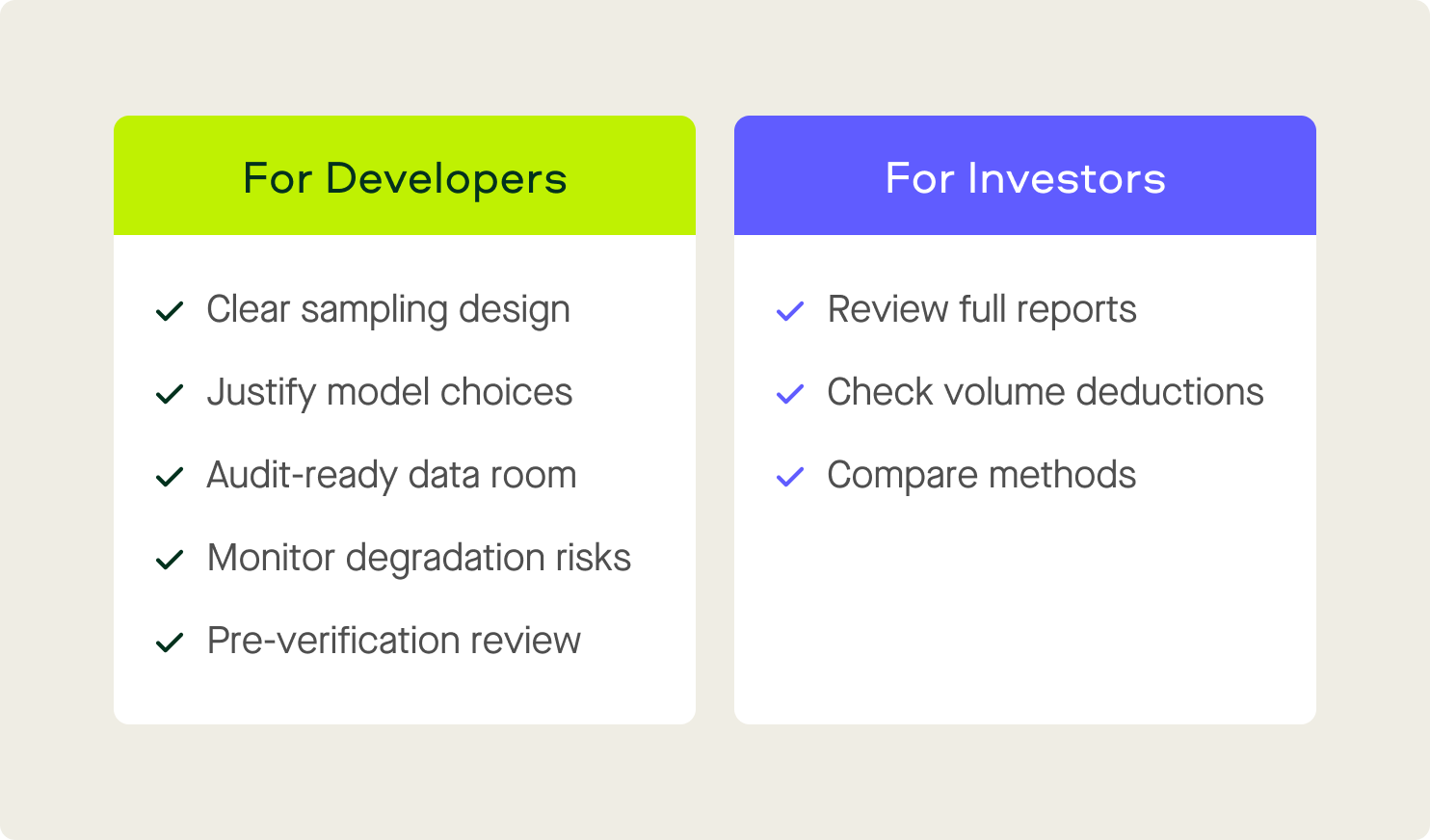
For Developers: How to Improve Verifiability
- Document your sampling strategy and make it clear that your plots represent the full range of forest conditions across the project area.
- Record and justify every allometry choice. If you use species-specific equations, document why they're appropriate. If you use regional models, explain their applicability.
- Build an audit-ready data room before the verifier arrives that includes field plots, imagery archives, QA/QC logs, and change tracking that's organized and accessible.
- Design a monitoring plan that can detect degradation, not just measure growth. Early detection of disturbance is as important as measuring carbon gains.
- Run pre-verification checks. Identify data gaps and inconsistencies before the auditor.
For Offtakers and Investors: How to Interpret Verification Outputs
- Ask for the full verification report, including conditions and limitations. Full reports often contain important information about where a project's data quality is weakest.
- Ask whether the issued volume is consistent with prior monitoring periods and whether any significant deductions were applied. A large deduction is worth investigating.
- Compare verification quality across projects by looking for consistency and transparency in method disclosure. A project with clear uncertainty is more trustworthy.
- Don't treat verification as a substitute for ongoing monitoring. A project verified twelve months ago may look very different today. Independent, continuous biomass data fills the gap between verification events.
For Registries and Standards Bodies: How to Strengthen Quality Assurance at Scale
Use independent biomass data as a QA/QC layer on developer submissions — comparing reported numbers against objective carbon stock estimates before verification begins.
Build uncertainty layers into your crediting framework, so conservative estimates are applied consistently and transparently across your project pipeline.
Feed independent biomass data into registry risk maps to monitor degradation hotspots and buffer pool adequacy between verification cycles — not just at reporting events.
Where Sylvera Fits
Third-party verification is necessary, but insufficient. The confidence that buyers, investors, and project developers need comes from measurement quality, ongoing monitoring, and independent comparison across projects. That's what Sylvera was built to provide.
Forest Biomass Data
Sylvera's Biomass Atlas delivers above-ground biomass and canopy height data, at 10 to 30 meter resolution, with up to 25 years of historical coverage and quarterly monitoring.
Just as important, we built the tool on $10M+ in LiDAR research and calibrated it against 250,000+ hectares of ground-truth data. As such, Biomass Atlas provides independent, science-backed biomass estimates with explicit uncertainty bounds for peak accuracy.
- Project developers use the tool to strengthen their measurement inputs and defend their numbers in audits.
- Offtakers and investors use it to verify project claims before committing capital and monitor performance continuously after.
- Registries use it to independently validate submissions and track reversal risk across their project pipeline.
Methodology Toolkit
Methodology Toolkit provides geospatially derived project design and MRV data aligned to key methodologies. The goal? To identify changes that affect carbon outcomes, including degradation risk, disturbances, and land-cover change. These capabilities support continuous confidence between periodic verification cycles rather than a one-time snapshot during audits.
- Project developers use Methodology Toolkit to produce methodology-aligned outputs — performance benchmarks, baseline carbon stock estimates, stratification, and more — faster and more cost-effectively than consultant-led approaches.
- Investors use it to stress-test project design assumptions and verify that the methodology inputs behind a project hold up.
- Offtakers use it to independently verify supplier claims against methodology requirements, both before procurement and on an ongoing basis.
- Registries and standards bodies use it to produce standardised, audit-ready analysis across their project pipeline — applying the same rigorous methodology to every submission, consistently and at scale.
Want to see these tools in action? Request a free demo of Sylvera today.
Ensure the Quality of Carbon Offsets
Forest carbon verification is necessary, but confidence comes from measurement quality and ongoing evidence. Companies that combine robust biomass measurement, transparent uncertainty management, and continuous monitoring are best able to protect issuance outcomes and buyer trust.
Sylvera's Biomass Atlas, Methodology Toolkit, Ratings, and Market Intelligence turn forest carbon claims into decision-grade evidence. Request a demo to see how.


