




“Over the years we’ve invested significantly in our field data team - focusing on producing trusted ratings. While this ensures the accuracy of our Ratings, it doesn’t allow the scale across the thousands of projects that buyers are considering.”

For more information on carbon credit procurement trends, read our "Key Takeaways for 2025" article. We share five, data-backed tips to improve your procurement strategy.
One more thing: Connect to Supply customers also get access to the rest of Sylvera's tools. That means you can easily see project ratings and evaluate an individual project's strengths, procure quality carbon credits, and even monitor project activity (particularly if you’ve invested at the pre-issuance stage.)
Book a free demo of Sylvera to see our platform's procurement and reporting features in action.
If you’ve moved to a stronger methodology, adopted a dynamic baseline, or invested in better monitoring, your latest work probably reflects your project at its best.
Across the voluntary carbon market, buyers are prioritizing quality. To sell credits today, projects have to prove it, and many are in a transition: moving to the latest methodologies, changing crediting standards to align with the Core Carbon Principles (CCP), and generally leveling up their approach.
Rating agencies have helped drive this shift. There is more data than ever to assess a project’s quality, so buyers are more sophisticated and have fewer reasons not to look closely. Increasingly, the projects that attract buyers are the ones that can evidence their quality.
Buyers know this, and they want more context before they decide. How current the evidence is, and which credits it covers, is becoming one more thing they weigh. That isn’t a judgment on older credits. It’s about buyers having the full picture of what they’re buying.
The question worth asking is whether the Rating buyers are looking at reflects that work too.
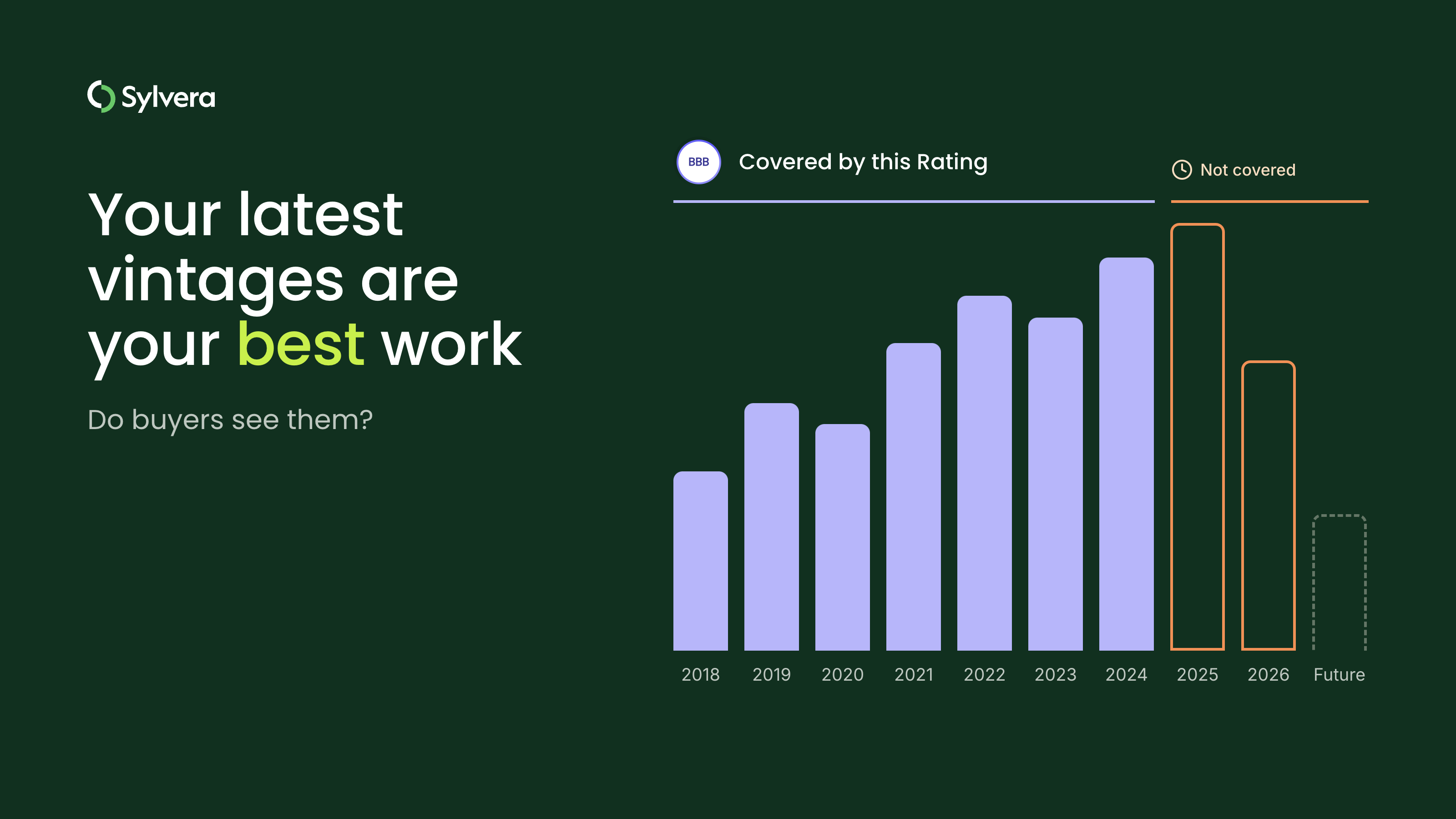
A Rating covers the vintages it assessed. Credits issued since, and improvements made since, may not be reflected until the Rating is updated.
What buyers are asking
Buyers will be asking: does the Rating cover the vintage I’m buying, and does it fit my retirement schedule?
Many buyers aim to match the vintage year of their credits to the year they retire them, usually with a buffer of around three years. For 2026 retirements, that means the oldest credits they’d typically consider are from 2023.
Now take a project rated in 2024: its 2018–2024 vintages are covered, while 2025 and 2026 credits are not, until the Rating is updated. For a buyer retiring in 2026, that puts half of their window, 2025 and 2026, outside the Rating. Buyers can see this.
Every Sylvera project page shows three signals:
- Vintage coverage, flagging credits outside the assessed vintages. Buyers choose credits by vintage, so this shows at a glance whether the credits they’re considering are covered.
- The Rating date, flagged when it hasn’t been reviewed within a year. Projects, standards, and evidence keep moving, so the date tells buyers how recently the evidence behind the Rating was reviewed.
- The framework version, noting when a newer one exists. We update our frameworks annually to follow scientific best practice, add detail, and cover new project types. A Rating formed under an older version may not reflect the latest approach, as the dynamic baseline and biochar examples below show.
It’s worth knowing what your Ratingssays.
Check your project in the Sylvera Project Catalog here.

Showcasing the latest information about your project
Here are four examples of how newer information can change the picture for certain projects.
Stronger methodology: cookstoves example.
Cookstove projects have faced scrutiny over how emission reductions are calculated. Verra’s VM0050, released in 2024, requires digital monitoring, updated fractions of non-renewable biomass (fNRB), and stove-use monitoring.
The ICVCM has approved it as meeting the CCPs, while the legacy VMR0006 has not been approved. From the 2027 vintage, all cookstove projects in the VCS Program must use VM0050.
Among Sylvera-rated cookstove projects, the median Rating under VM0050 is BBB, compared with B under VMR0006, though the VM0050 sample is still small. If your newer vintages are issued under VM0050, make sure your Rating reflects it.
Dynamic baselines: REDD+ example
Over-crediting concerns have made dynamic baselines the standard for REDD+, and leading registries now require them by default in place of static, ex-ante baselines.
Our latest framework tests a project’s baseline using proprietary biomass data. We identify comparable areas beyond the project boundary, matched on ecology, location, time period, and land tenure, and test the baseline against them, so conservative assumptions show up in the Rating.
A Rating formed under an earlier framework version doesn’t include this test until it’s updated. We update our frameworks regularly to ensure that they reflect scientific and market best-practice. Make sure the changes you are making are assessed under the latest framework version.
Technological improvements: biochar example
Biochar production technology has advanced quickly in recent years. While previous frameworks weren’t as explicit in defining the differences between different methods, recent frameworks give each one its own assessment pathway, from rudimentary open-kiln methods to managed batch and continuous industrial systems.
That captures what sets each project apart while keeping its Rating comparable with other durable CDR projects. If you’ve upgraded your production technology, make sure your Rating reflects this.
Additional information: land and concession rights
A project’s first Rating found no evidence of land or concession rights. The developer submitted evidence of both as part of a Rating update, and the Rating moved from BBB to A. A Rating can only reflect the evidence it has seen, and that evidence needs to be up-to-date.
What to share, and when
The changes most worth sharing are the ones that affect how your project is assessed:
- New monitoring or verification reports
- Methodology transitions and baseline changes
- Design changes, such as adding fire mitigation
- Land, concession, and ownership documentation
- Any developments buyers will want to know about
Updates can move a Rating in either direction, which is part of what makes it credible to buyers.
Keeping expectations straight
To be clear, recency isn’t a way to a better score. Ratings are evidence-based, and they assess the whole project across every vintage, not just the latest one. A Rating that shifted with every new data point couldn’t support the multi-year contracts buyers sign.
What changes is visibility: your latest work reflected in the Rating, with the date and vintage coverage showing how current it is.
What developers can do
Your newest vintages are often your strongest. Keeping us in the loop as your project evolves is how you make sure buyers are looking at them, rather than waiting for the next Rating cycle to catch up.
Talk to our team about updating your Rating, or check your project in the Sylvera Project Catalog here.


