

“Over the years we’ve invested significantly in our field data team - focusing on producing trusted ratings. While this ensures the accuracy of our Ratings, it doesn’t allow the scale across the thousands of projects that buyers are considering.”

For more information on carbon credit procurement trends, read our "Key Takeaways for 2025" article. We share five, data-backed tips to improve your procurement strategy.

One more thing: Connect to Supply customers also get access to the rest of Sylvera's tools. That means you can easily see project ratings and evaluate an individual project's strengths, procure quality carbon credits, and even monitor project activity (particularly if you’ve invested at the pre-issuance stage.)
Book a free demo of Sylvera to see our platform's procurement and reporting features in action.
The use of biochar dates back thousands of years, when indigenous civilizations discovered that adding charred biomass to soil improved fertility. In recent years, biochar has gained renewed attention for its potential to combat climate change, thanks to its ability to sequester carbon. This has led to the rise of biochar production projects aimed at generating carbon credits.
But what exactly is biochar, and why is it significant?
What is Biochar?
Biochar is a carbon-rich material created through pyrolysis, a process that involves heating organic biomass—such as agricultural residues or forestry waste—under low-oxygen conditions. During pyrolysis, not all carbon becomes biochar. Some are converted into bio-oil and syngas, but the remaining biochar is stable, carbon-dense, and has multiple applications, including soil enhancement and carbon removal.
Biochar projects are emerging as a key method for carbon dioxide removal (CDR) because they lock carbon into a stable form for hundreds, even thousands, of years.

Market potential
Carbon markets are increasingly embracing biochar as a credible CDR solution. Studies have projected that biochar could sequester between 143 GtCO₂ (Caldecott et al., 2015) and 477 GtCO₂ (IPCC, 2013) by 2100.
In 2023, biochar projects delivered over 90% of all issued carbon credits from removal projects, driving global market valuation to $600 million. Methodologies from registries like Puro.Earth, Isometric, and Carbon Standards are helping to facilitate biochar’s growth in the voluntary carbon market.
However, the market is still young. Like other biomass-based projects, biochar projects may face challenges around Life-Cycle Assessment (LCA) and leakage assessment, where an increase in biochar production could unintentionally drive demand for fossil fuels.
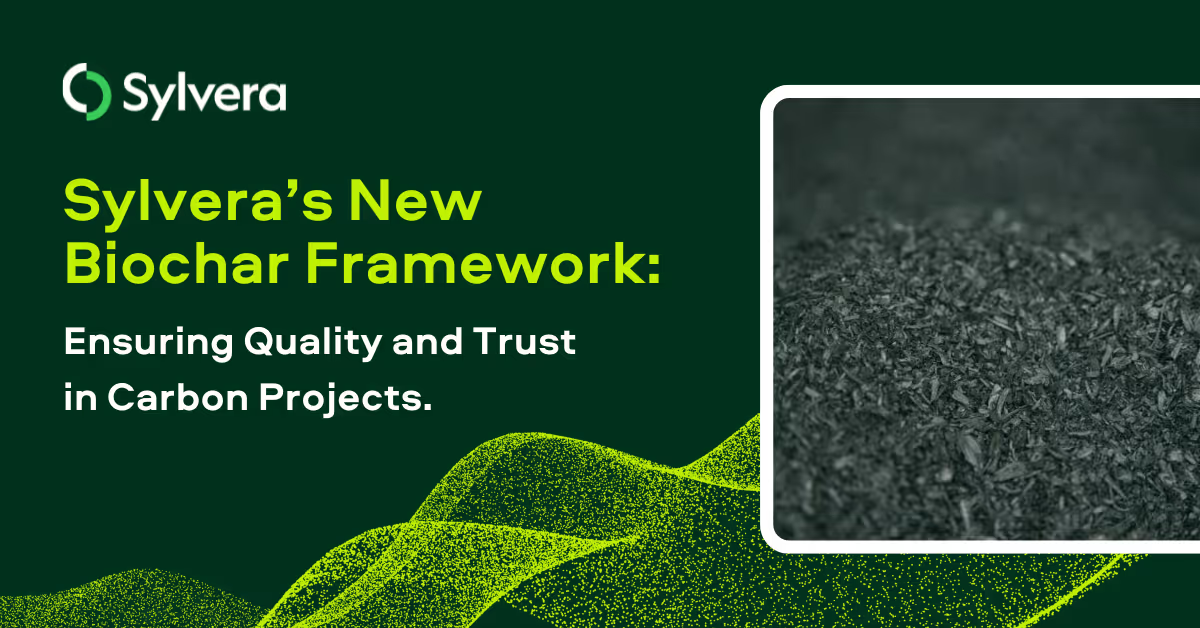
Introducing Sylvera’s Updated Biochar Framework
To address these concerns and provide greater confidence in biochar projects, Sylvera has developed a new Biochar Ratings Framework. This framework evaluates projects to ensure they meet robust criteria for carbon removal, permanence, and economic feasibility.
Our approach follows Sylvera’s standard of rigorous, data-driven assessment, shaped by a 10+ strong team of internal and external experts. The framework builds upon dozens of academic studies and leverages Sylvera’s proprietary Field Data Science and Machine Learning datasets.
To ensure quality and trust, the framework has undergone peer reviews and oversight by an external Framework Review Committee.
Engagement with the industry
At Sylvera, collaboration is key. We work closely with biochar project developers to gather up-to-date, real-world data on project activities, life cycle assessments, and financial models. Our Assessments Team analyzes both developer-provided and public data to ensure transparency and reliability.
When developers engage in good faith, they receive their rating results with the opportunity to provide feedback. Even after publication, we stay engaged, addressing any concerns or new data within 30 days.
What's new
When we launched Sylvera's Biochar Ratings Framework previously, we set out to bring rigour and trust to the leading CDR solutions on the market. As the market matures, so must the standards we apply to it.
That's why we've implemented targeted updates to our biochar assessment framework to strengthen scientific robustness, consistency, and transparency across projects.
Here's what's changed.
Carbon
Within the Carbon pillar, leakage assessment now evaluates both completeness of project-level analysis and inherent feedstock leakage risk. We introduced additional scrutiny on data quality through two new components: testing credibility and sampling rigour. Gross removal modelling has been updated to reflect a 200+ year timeframe, incorporating multiple recognised decay models and applying a range of plausible values for comparative assessment. Lifecycle boundaries are now cradle-to-grave, with continued focus on key emission drivers such as feedstock, energy, and infrastructure. Weighting between lifecycle emissions and gross removals has been refined, and carbon scores are now mapped to a transparent 1–10 scale.
Additionality
For Additionality, greater emphasis is placed on financial transparency and carbon rights clarity. Financial analysis now carries more weight relative to grant assessment, and score caps prevent weak financial additionality from being offset by strong performance in other subtests. The overall scoring logic has been streamlined to better reflect true dependency on carbon revenue.
Permanence
In Permanence, we enhanced geospatial risk assessment at the biochar application level, refined application method logic to distinguish best practice approaches such as deep soil incorporation, and updated soil classification using USDA texture mapping with adjusted weighting. Non-soil applications and general end-use monitoring are assessed with greater emphasis on MRV quality and traceability. Anthropogenic risk now appropriately constrains final permanence scores.
Safeguarding & Co-benefits
Under Safeguarding & Co-benefits, SDG evaluation has shifted to an activity-based, evidence-supported approach. Biodiversity and community impacts are assessed separately. Two new feedstock safeguards have been introduced: feedstock certification or proof of waste, and feedstock chain of custody. Contaminant and pollution prevention criteria have also been expanded.
Overall, these refinements were implemented to strengthen comparability, scientific robustness, and confidence in project ratings, while maintaining clarity and consistency for both developers and buyers.
See the updated biochar framework here.

Biochar Ratings Live In-App
Our Biochar Ratings are live on the Sylvera platform.
Already a platform user? Log in now to explore project Ratings.
Not yet on the platform? You can view the Ratings in our free access version, try it here.