

“Over the years we’ve invested significantly in our field data team - focusing on producing trusted ratings. While this ensures the accuracy of our Ratings, it doesn’t allow the scale across the thousands of projects that buyers are considering.”

For more information on carbon credit procurement trends, read our "Key Takeaways for 2025" article. We share five, data-backed tips to improve your procurement strategy.
One more thing: Connect to Supply customers also get access to the rest of Sylvera's tools. That means you can easily see project ratings and evaluate an individual project's strengths, procure quality carbon credits, and even monitor project activity (particularly if you’ve invested at the pre-issuance stage.)
Book a free demo of Sylvera to see our platform's procurement and reporting features in action.
Africa sat out much of the international carbon market activity that defined the Kyoto Protocol, watching other regions capture the bulk of the Clean Development Mechanism (CDM) demand and investment. That story is changing.
Now, in the Paris Agreement era, African countries have moved quickly to build the legal frameworks, institutional capacity, and project pipeline behind a supply of Internationally Transferred Mitigation Outcomes (ITMOs). It means the continent is already the most relevant in terms of ITMO supply, not just a promising one for the future.
This post looks at what that progress looks like in practice, where the region still faces real challenges, and why getting Article 6 right in Africa matters for the credibility of the market as a whole.
Data in this post is powered by Sylvera's Article 6 & CORSIA Hub.
From Bystander to Builder
We are now firmly in the era of Article 6 implementation, but overall progress across the market still lacks ambition. That gap matters, because it's the difference between Article 6 delivering on its promise and airlines, governments, and buyers falling short of binding climate commitments.
According to Sylvera's Q2 2026 Carbon Data Snapshot, of the roughly 300 million credits potentially eligible for CORSIA's first compliance phase, only 38 million have cleared the two hurdles — a host-country Letter of Authorization and either a corresponding adjustment or qualifying insurance — that convert a credit into a fully eligible unit. That's just 23% of the 163 million units Sylvera expects the market will ultimately need for CORSIA CP1 demand (2024-2026).
On the bilateral track, 148 Article 6.2 agreements or MOUs have been signed globally, yet only a handful of actual ITMO transfers have gone through so far — Thailand's transactions with Switzerland chief among them.
Against this backdrop, Africa's trajectory stands out. Having largely missed the opportunities of the Kyoto Protocol's Clean Development Mechanism (CDM) era, African countries and institutions are determined not to miss this one. Africa's CDM participation was minimal by any measure: UNFCCC figures put the continent's share of registered CDM projects at just over 2% of the global total, with just a handful of countries — South Africa chief among them — accounting for most of that.
Governments across the continent have moved proactively to stand up Article 6 governance structures, and that momentum is matched by geography: Africa holds enormous natural potential for carbon credit supply, from nature-based removals to renewable energy and clean cooking. Institutional progress combined with that resource base has already made the region a leading ITMO supplier — not a future one.
That progress has been reinforced by a wave of capacity-building work across the continent: regional alliances, dedicated regional workshops on CORSIA eligible emissions units and Letters of Authorization, and partnerships aimed squarely at closing the data and readiness gap, including the Carbon Data Access Partnership (CaDAP) that Sylvera and UNDP Africa launched to help accelerate Article 6 implementation across the region.
Already Delivering: Africa's ITMO Track Record
Sylvera and the Climate Action Center of Excellence (CACE) developed an Article 6 Readiness Blueprint that maps out everything a country needs to have in place — primary arrangements, experience, and integrity guardrails — to be considered Article 6 ready. Few African countries tick every box on that list yet.
But a number of them are moving into action faster than the readiness checklist would predict, and that gap between "not fully ready" and "already active" is exactly what shows up in the numbers below — across CORSIA eligibility and Article 6 more broadly.
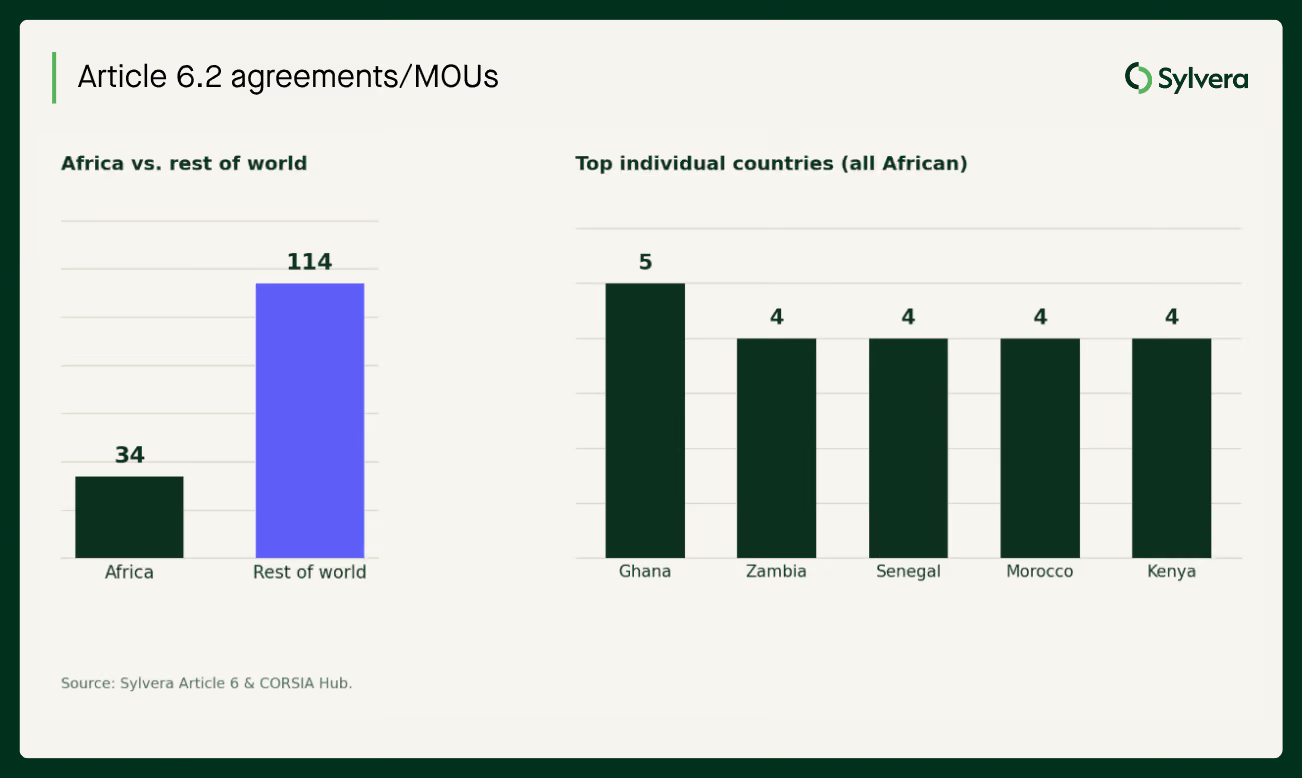
Of the 148 signed Article 6.2 agreements or MOUs recorded globally — spanning 68 sellers and 13 buyers — African countries account for 34, and the top 5 seller countries in the world are all African: Ghana (5), Zambia (4), Senegal (4), Morocco (4), and Kenya (4).
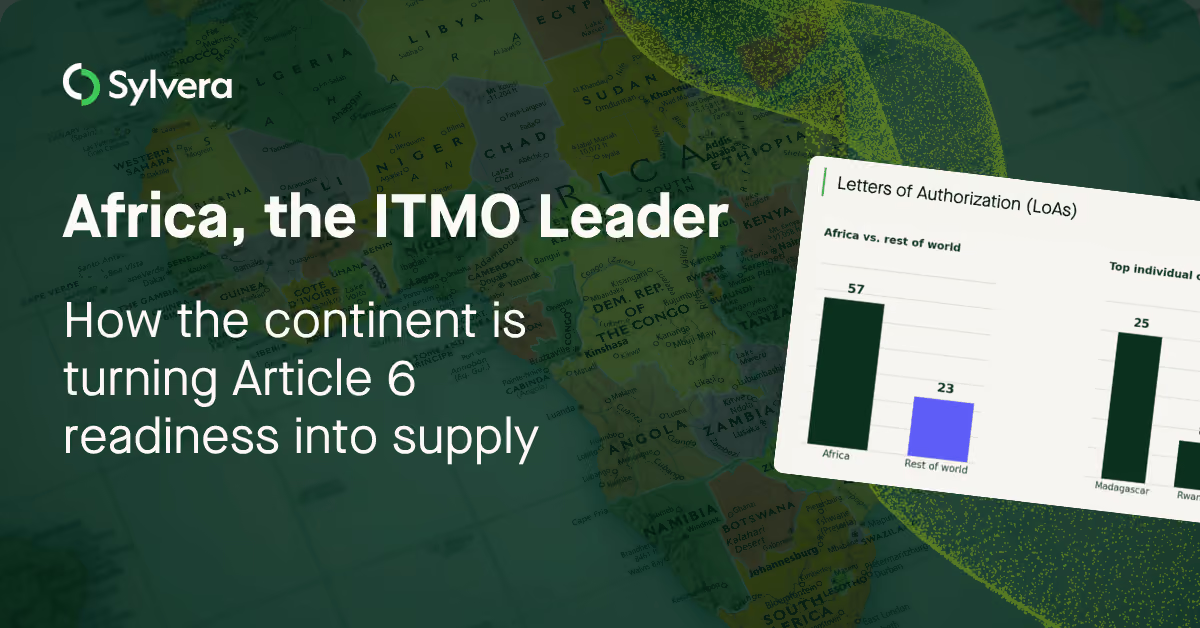
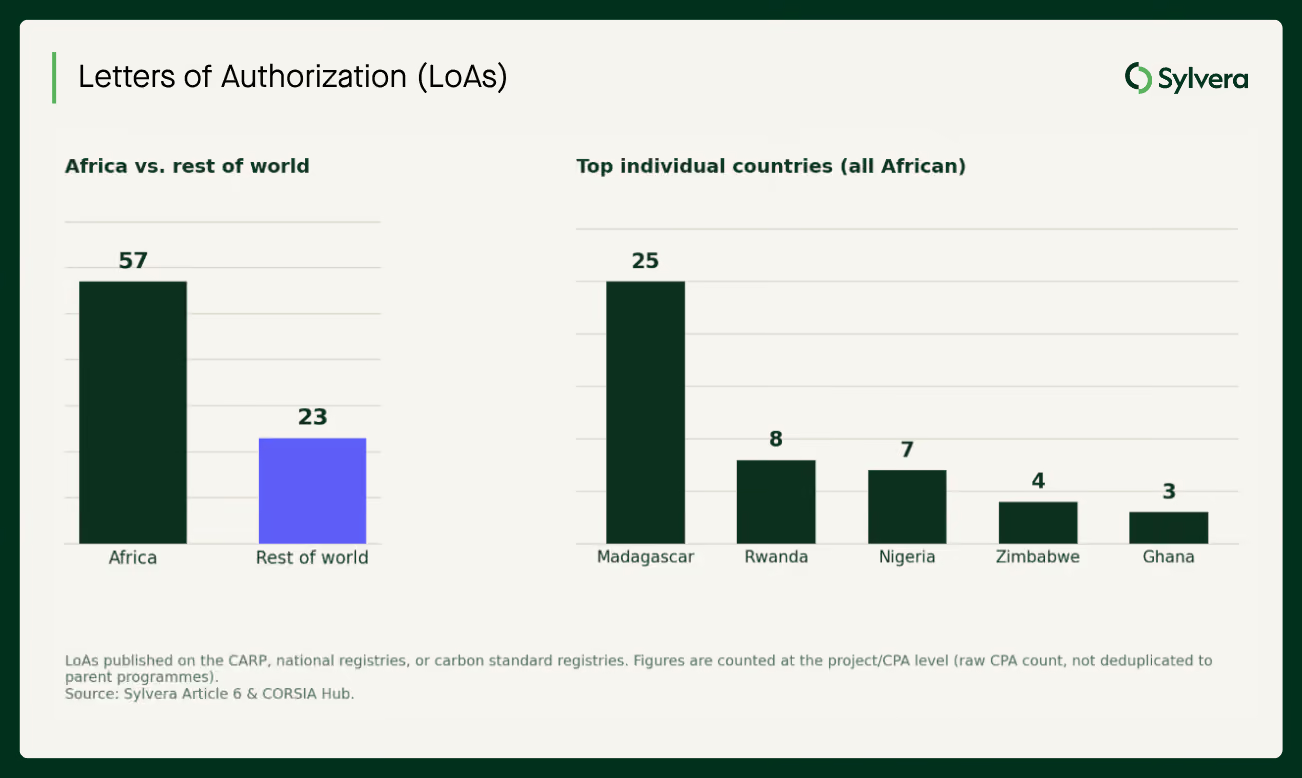
The pattern repeats for Letters of Authorization. Of the 80 LoAs published (in the UNFCCC CARP, national registries, or carbon standard registries) globally for cooperative approaches or activities, African countries hold 57, and the five countries with the most are all African: Madagascar (25), Rwanda (8), Nigeria (7), Zimbabwe (4), and Ghana (3, tied with several others).
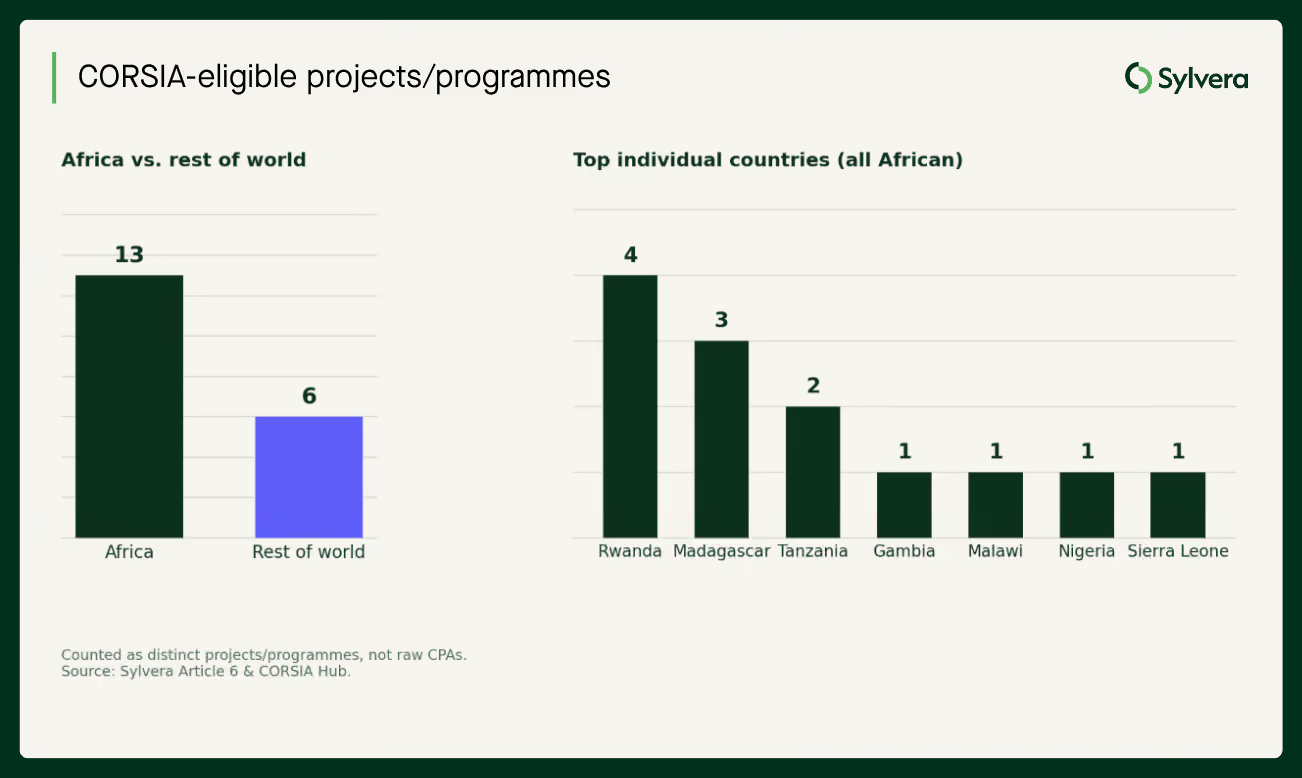
CORSIA eligibility tells the same story, though the headline project count needs a caveat. Of the 72 CORSIA-eligible projects and CPAs tracked at the project level, several of the largest African entries are grouped programmes where many CPAs sit under a single overarching project.
Counted as distinct projects rather than individual CPAs, Africa still leads clearly: of roughly 19 distinct projects or programmes globally, 13 (around 68%) are African, spanning Rwanda, Madagascar, Tanzania, Gambia, Malawi, Nigeria, and Sierra Leone.
Beyond the Headline Leaders
Several other countries are moving fast in ways the top-line rankings don't fully capture yet.
CASE STUDY: DRC: building the institution before the pipeline. In November 2025, the Democratic Republic of Congo launched a national digital Carbon Credit Registry aligned with Article 6, governed by a newly created Carbon Market Regulatory Authority (ARMCA), and announced an international stakeholder forum in Kinshasa for 2026 to support project accreditation and the monetization of its carbon credits. It's a useful case precisely because DRC is starting from close to zero institutionally — but it's building Article 6 infrastructure fast, backed by the scale of the Congo Basin, the world's second-largest carbon sink.
CASE STUDY: Uganda: the legal groundwork laid early. Uganda built the legal basis for Article 6 host-country authorizations directly into its National Climate Change Act 2021 — years ahead of many peers who are still drafting equivalent legislation. Combined with its role in the East African Alliance's Article 6 negotiation handbook, Uganda is a case of legal infrastructure built ahead of the deal flow, positioning it to move quickly once agreements and LoAs start scaling up.
Leading Early, Learning Fast
Being early has put Africa in the spotlight. But being early also means encountering problems before anyone else has solved them.
Many African governments are new not just to Article 6, but to international carbon markets altogether. The Paris Agreement's Enhanced Transparency Framework (ETF) introduced reporting requirements for governments that never had this type of obligation under the Kyoto Protocol, and those requirements are genuinely even more complex under the Paris Agreement.
Given that, perfection from the outset isn't a realistic bar. The Article 6 Technical Expert Review (TER) analysis has flagged inconsistencies across recent rounds of initial reports, and corresponding adjustments reported to date have shown inaccuracies. But the priority right now is momentum, not perfection: the market needs to keep moving, and finance needs to keep flowing, and that means learning by doing rather than waiting for a flawless system that doesn't yet exist anywhere.
Sylvera's Article 6 & CORSIA Hub country assessments are built for exactly this — surfacing the LoA and corresponding-adjustment risk associated with host countries. Risk in early-stage markets is unavoidable; the goal shouldn't be to find a risk-free supplier but to understand and manage risk and move towards corrections. Being informed is the first step, and our assessments are designed to help countries, buyers, investors, and project developers get there — supporting African nations as they refine their frameworks, and giving international partners the confidence to engage.
The Road Ahead
Africa's ITMO story is still being written, but the direction is clear: a region that missed the last carbon market cycle is already leading this one. Sustained support from partners like UNDP Africa, transparency from the likes of Sylvera's Article 6 & CORSIA Hub data, and continued government commitment will determine how far it extends — and how fast.
If you have a stake here, the practical challenge is knowing which countries, projects, and programmes are ready today, and which still carry LoA or corresponding-adjustment risk.
That's exactly what Sylvera's Article 6 & CORSIA Hub is built to answer:
- Sovereign buyers and airlines facing CORSIA compliance obligations can track eligible supply against demand and see which host countries are positioned to deliver authorized credits on the timelines compliance deadlines require.
- Project developers can identify which African markets have the regulatory and institutional readiness to get a project through authorization and corresponding adjustment without unnecessary delay.
- Investors get sovereign risk scoring and LoA/CA tracking to underwrite host-country political and procedural risk before committing capital.
- Intermediaries — brokers, registries, and market makers — can use live, traceable data to advise clients with confidence instead of relying on public disclosures that lag the market by months.
Head here to find out more about the Article 6 & CORSIA Hub, and book your 1-2-1 demo.