

“Over the years we’ve invested significantly in our field data team - focusing on producing trusted ratings. While this ensures the accuracy of our Ratings, it doesn’t allow the scale across the thousands of projects that buyers are considering.”

For more information on carbon credit procurement trends, read our "Key Takeaways for 2025" article. We share five, data-backed tips to improve your procurement strategy.
One more thing: Connect to Supply customers also get access to the rest of Sylvera's tools. That means you can easily see project ratings and evaluate an individual project's strengths, procure quality carbon credits, and even monitor project activity (particularly if you’ve invested at the pre-issuance stage.)
Book a free demo of Sylvera to see our platform's procurement and reporting features in action.
Across the carbon market — from corporate sustainability teams to fund managers to project developers — the tools used to track, value, and report carbon credit portfolios are lacking.
Not because the people using them aren't smart. But because spreadsheets weren’t made for this job.
The problem with how carbon portfolios are usually managed
Ask a corporate buyer how they track the quality of their retired credits, and you'll likely hear some version of the same answer: a spreadsheet, maintained by one person, updated manually, that goes stale the moment it's saved.
Ask an investor how they mark their carbon holdings to market, and they'll tell you about the hours spent chasing broker quotes across vintages and methodologies, trying to stitch together a view that will hold up to scrutiny for maybe a week.
Ask a project developer if they have an aggregated view of up-to-date quality and pricing insights across their projects. They’ll be pulling information from various sources, trying to make decisions on instinct or broker conversations.
Ask an advisory firm how they manage due diligence across multiple client portfolios simultaneously, and you'll find institutional knowledge scattered across email threads, personal folders, and the heads of people who might not be on the team next quarter.
The carbon market has grown enormously in sophistication. The tools used to manage carbon credit portfolios need to keep pace.
Without the correct tools and data, those key decisions — what to buy, what to hold, what to retire, how to price, how to report — are being made on stale, disconnected data.
In a market where quality varies enormously and prices can move fast, that's a problem.
Why we built Portfolios
Sylvera was built to bring independent, rigorous analysis to carbon markets — to give all market players the data they need to make better decisions.
Our Ratings cover thousands of projects. Our pricing data reflects real market dynamics.
But until now, that data lived at the project level. You could research a project. You could look up a price. What you couldn't do was bring your entire portfolio into one place and see it all — quality, pricing, performance — in a single, live view.
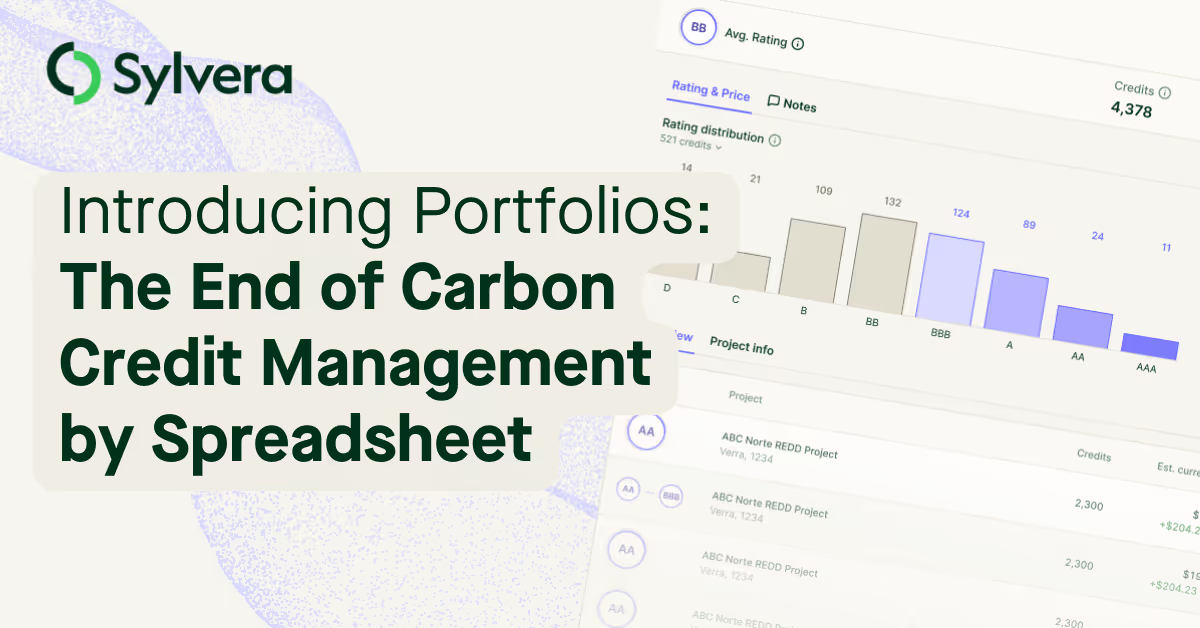
The introduction of Portfolios changes that. It's the missing layer between project-level data and portfolio-level decisions.
What you can do with Portfolios
Build and manage portfolios across the full project universe.
You can create multiple portfolios from Sylvera's catalog of 23,000+ projects. Or, add your own manually entered, unregistered projects. Whether you're managing purchased credits, a pipeline of prospective purchases, or a set of already-retired credits, you can build a portfolio that reflects your reality.
Get a live quality and pricing view across your holdings.
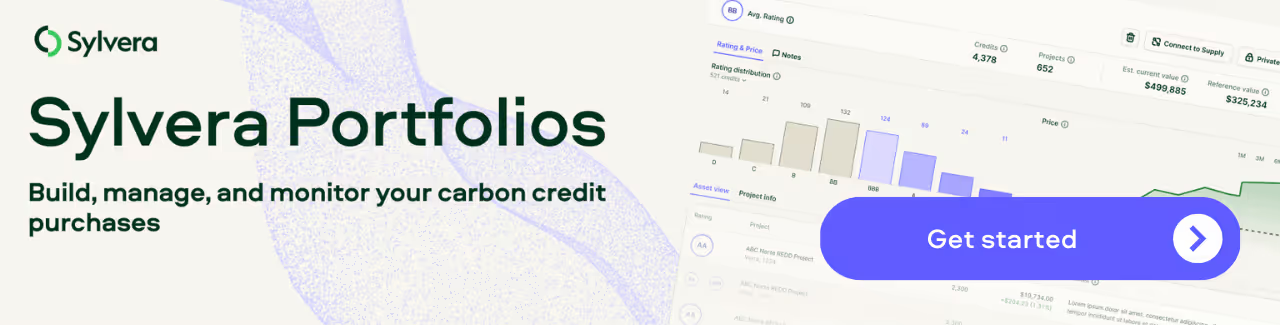
Every portfolio gives you an aggregated quality breakdown and a portfolio-wide valuation summary. This is powered by Sylvera's independent ratings and live pricing data. So, when a Rating changes or a price moves, your portfolio updates automatically.
Track financial performance at the vintage level.
For each project in your portfolio, you can log your outlay price and track it against the current market price over time — giving you a clear picture of where you stand, without a single formula.
Share views across your team.
Portfolios can be kept private or shared with your organisation on a view-only basis — so teams stay aligned without losing control of proprietary data.
Switch between Asset View and Project Info.
Asset View gives you the proprietary picture: your volumes, your valuations, your performance. Project Info gives you the full Sylvera context: ratings, current pricing, and pillar scores for every project in your portfolio.
How would you use Portfolios?
Portfolios is designed to serve:
Corporate buyers and sustainability teams
Track, monitor, and defend your offset portfolios with independent quality and pricing data — and give your organisation a credible, always-current answer on portfolio integrity.
Investors and funds
Mark carbon holdings to market with independent pricing and quality signals at the vintage level, directly in the app or via API into their own systems.
Project developers
Build personalised price indices across your projects, calculate a volume-weighted Sylvera Rating across your holdings, and showcase that view to align teams and present to buyers or investors.
Advisors and intermediaries
Manage multiple client portfolios in one workspace, with embedded ratings, live pricing, and shared notes that keep institutional knowledge in one place across the team.
What's coming next
Portfolios are live today, and we're already building the next layer.
Expect deeper benchmarking capabilities, richer API access for teams running their own systems, and expanded sharing and collaboration features.
Try it now
Portfolios are available free to access on our platform. You don't need to be an existing customer to start building your first portfolio.
[Try Portfolios for free on the Sylvera platform →]
If you'd like a walkthrough of what's possible for your specific use case, get a demo here.