

“Over the years we’ve invested significantly in our field data team - focusing on producing trusted ratings. While this ensures the accuracy of our Ratings, it doesn’t allow the scale across the thousands of projects that buyers are considering.”

For more information on carbon credit procurement trends, read our "Key Takeaways for 2025" article. We share five, data-backed tips to improve your procurement strategy.
One more thing: Connect to Supply customers also get access to the rest of Sylvera's tools. That means you can easily see project ratings and evaluate an individual project's strengths, procure quality carbon credits, and even monitor project activity (particularly if you’ve invested at the pre-issuance stage.)
Book a free demo of Sylvera to see our platform's procurement and reporting features in action.
Most carbon project quality is decided at the design stage. Here's how developers and investors can understand a project's likely Rating before committing spend.
Quality is decided earlier than most people think
By the time a carbon project is registered, most of the choices that determine its quality have already been made. The baseline approach, the carbon pools counted, how tree mortality is modeled, the permanence safeguards in place: these are design decisions. They're set long before the first credit issues.
Yet for many developers, the first independent view of quality arrives later. A Rating is commissioned once the project is mature enough to assess. If it reveals weaknesses, fixing them can mean redesigning monitoring, renegotiating with landowners, or revising documentation. Worse, some issues can't be fixed at all.
It means developers spend time and money on projects that won't achieve the quality buyers want. Investors commit capital without a clear signal of how a project is likely to perform. Buyers increasingly pay a premium for higher-rated credits, so a weak design leaves real value on the table.
What actually drives a Rating
Sylvera Ratings assess carbon credit quality across a set of core pillars. Three of them shape the overall Rating:
- Carbon Accounting. Are the credits claimed in line with the carbon actually removed or avoided? This covers baselines, removal rates, and which carbon pools are included.
- Additionality. Would the project have happened without carbon finance? Scale, commerciality, and the policy context all matter here.
- Permanence. How likely is the carbon to stay stored, and what protects it against reversal?
Safeguarding & Co-Benefits are also assessed, giving a fuller picture of the project's wider impact.
Within each pillar, some questions matter far more than others. For an afforestation, reforestation, and revegetation (ARR) project, for example, whether mortality is accounted for in the carbon model can move the outcome significantly. A single design choice can be the difference between a sub-investment-grade result and an investment-grade one.
The important point here is that quality- or a potential Rating grade - isn't a mystery revealed at the end. It follows from specific, identifiable design choices. If you know which choices matter most, you can make them deliberately.
Thinking in probabilities, not single scores
At the earliest stages, a project is full of unknowns. Some design choices haven't been made. Some data doesn't exist yet. Any honest early view of quality has to reflect that uncertainty.
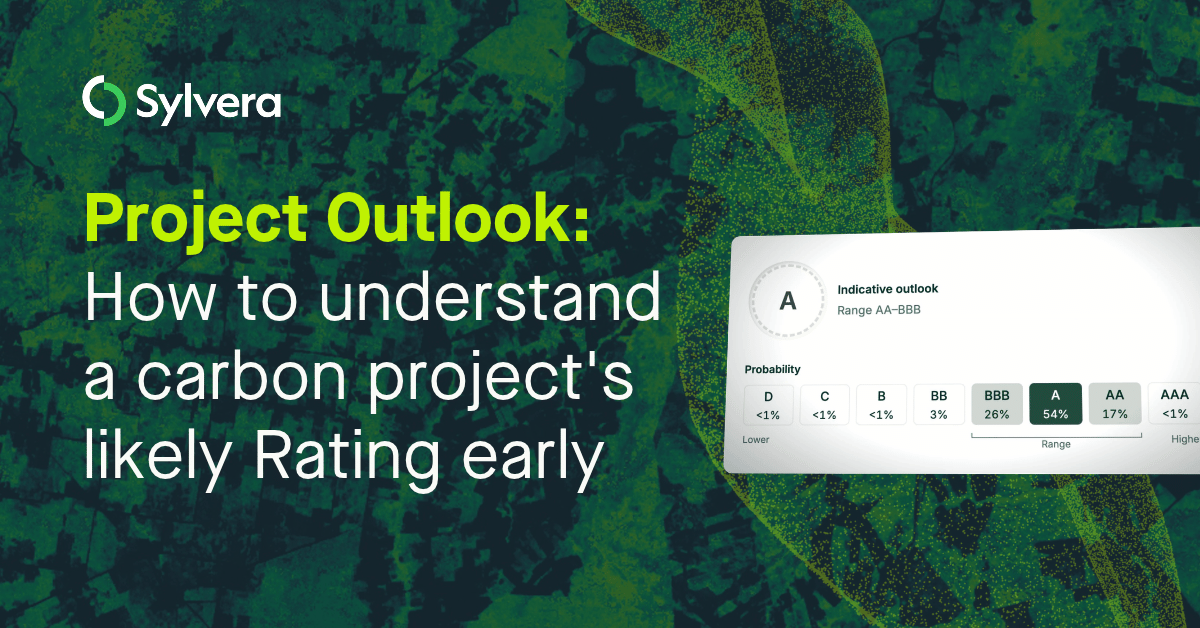
This is where Project Outlook is useful. Instead of saying "this project is an A", it says "A is the most likely outcome, BBB and AA are plausible, and here's the areas for improvement". You can see how much confidence to place in the result, and which answers would reduce the uncertainty.
It also makes trade-offs visible. If changing one design choice moves the most likely outcome from B to BBB, that's a clear, quantified signal of where effort pays off.
What is Project Outlook?
Project Outlook is a self-serve tool that brings this thinking into practice. It gives developers and investors an instant, indicative view of a project's likely Sylvera Rating.
It works in three steps:
- Describe your project. Answer a short questionnaire. Flexible answer options cover choices you haven't made yet.
- We apply the Rating framework. Our models combine your answers with country and policy data, then apply the same logic that powers Sylvera Ratings.
- See your outlook. Get your most likely Rating, the probability of other outcomes, a breakdown by pillar, and the factors with the greatest influence on your result.
Because you report facts and Sylvera evaluates them against its Ratings frameworks, the same inputs always produce the same outlook.
Four ways teams use it
Optimize project design. Answer the questionnaire with your intended design. The pillar breakdown shows where you're strongest and weakest. Influential factors highlight the choices with the biggest impact. Change an answer and see the effect instantly, then compare scenarios side by side.
Prioritize which projects to rate. Run an outlook for each project in your pipeline and compare them side by side. Put your Rating budget behind the projects most likely to perform.
Demonstrate integrity early. Fundraising or onboarding landowners before your design is final? An outlook gives investors and offtakers a credible, framework-driven signal of quality at the earliest stage. A shareable PDF summary is coming soon.
Triage projects quickly. Investors and buyers can answer the questionnaire using a project's PDD to get a fast read on unrated projects they've been pitched. Market context shows where the project sits among similar rated projects, and influential factors show which risks to investigate first.
What Project Outlook is, and what is isn’t
An outlook is an indicative insight based on unverified, self-reported information. It is not a Sylvera Rating. A Full Rating involves independent analysis of project evidence, geospatial data, and documentation.
The two work together. Project Outlook helps you understand where a project is likely to land and what would improve it. A Sylvera Rating gives buyers and investors an independent verdict they can rely on.
Available across 8 project types
Project Outlook supports ARR, REDD+, improved forest management (IFM), landfill methane, safe drinking water, artisanal biochar, industrial biochar, and cookstoves.
If you're designing, financing, or evaluating carbon projects, get in touch to get started with Project Outlook.