



“Over the years we’ve invested significantly in our field data team - focusing on producing trusted ratings. While this ensures the accuracy of our Ratings, it doesn’t allow the scale across the thousands of projects that buyers are considering.”

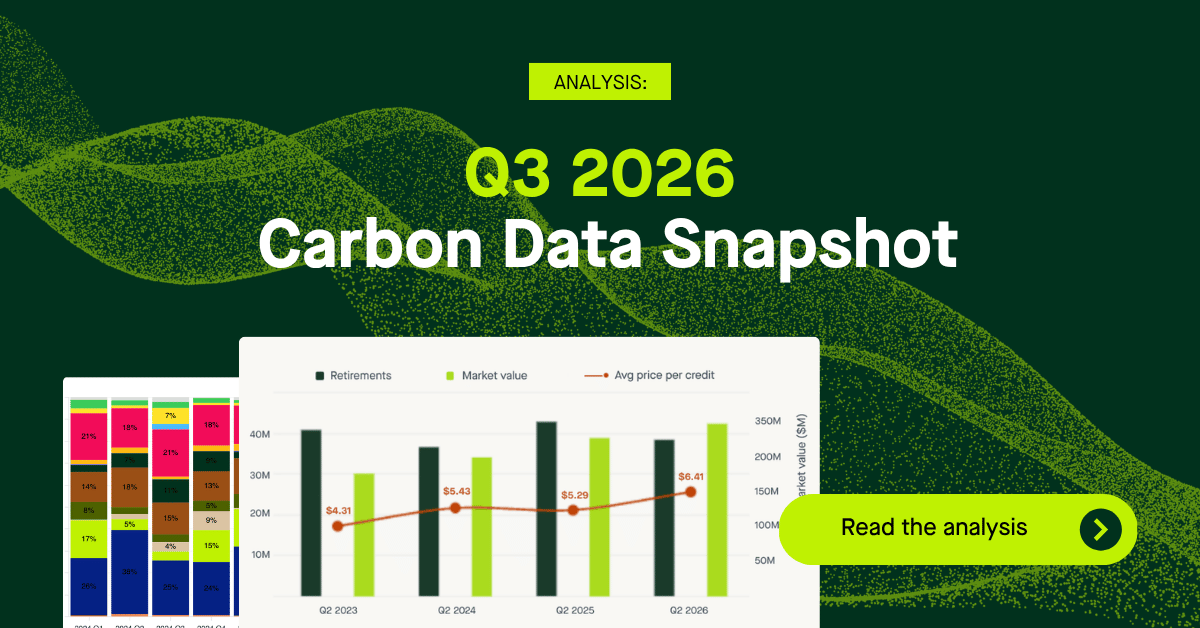
For more information on carbon credit procurement trends, read our "Key Takeaways for 2025" article. We share five, data-backed tips to improve your procurement strategy.
One more thing: Connect to Supply customers also get access to the rest of Sylvera's tools. That means you can easily see project ratings and evaluate an individual project's strengths, procure quality carbon credits, and even monitor project activity (particularly if you’ve invested at the pre-issuance stage.)
Book a free demo of Sylvera to see our platform's procurement and reporting features in action.
Why companies buy SAF certificates
Sustainable aviation fuel (SAF) is made from feedstocks such as waste oils, residues, or captured carbon. It typically cuts lifecycle emissions by around 80% compared with fossil jet fuel, but costs more. SAF certificates (SAFc) let companies buy that emissions reduction separately from the fuel.
Under a “book and claim” system, the fuel goes into the aviation fuel supply where it’s delivered, and its emissions reduction is sold as an environmental attribute certificate (EAC). The supplier (or the SAFc intermediary) retires the certificate on behalf of the buyer on a registry - so no one else can claim the same Scope 1 or Scope 3 reduction, and the premium they pay helps fund additional SAF.
What SBTi’s new standard allows
SBTi published its Corporate Net-Zero Standard V2.0 on 11 June 2026, and it takes effect on 1 February 2027. In this new standard, SBTi introduced the ‘implementation hierarchy’, a decarbonization priority list. It recognizes energy and commodity certificates, traded through mass balance or book-and-claim, as a way to report progress against your targets, subject to conditions:
Direct action comes first.
Companies assess and implement direct action where feasible, such as flying less or booking shares of physical SAF before relying on book-and-claim certificates. These are physical interventions at the activity or network level. Only when activity-level solutions are structurally limited, and such limits evidenced, you can move to sector-level actions with certificates.
Book-and-claim certificates are reported separately.
Targets and reduction claims rest on your physical inventory, which these certificates sit outside. They support a claim that you’re contributing to decarbonizing aviation, alongside direct action. Whether your reported footprint stays the same or not is currently a gray area, with SBTi expected to update on this in the coming months.
Integrity criteria apply.
Certificates must match the fuel in your inventory, come from a relevant fuel system, be quantified conservatively, relate to activity within 12 months unless a longer period is justified, never exceed your activity volume, and be serialized and retired in a secure registry.
SBTi has said it will develop criteria for recognizing third-party frameworks, standards, and programs, so no registry has its recognition yet.
How we bought SAF certificates
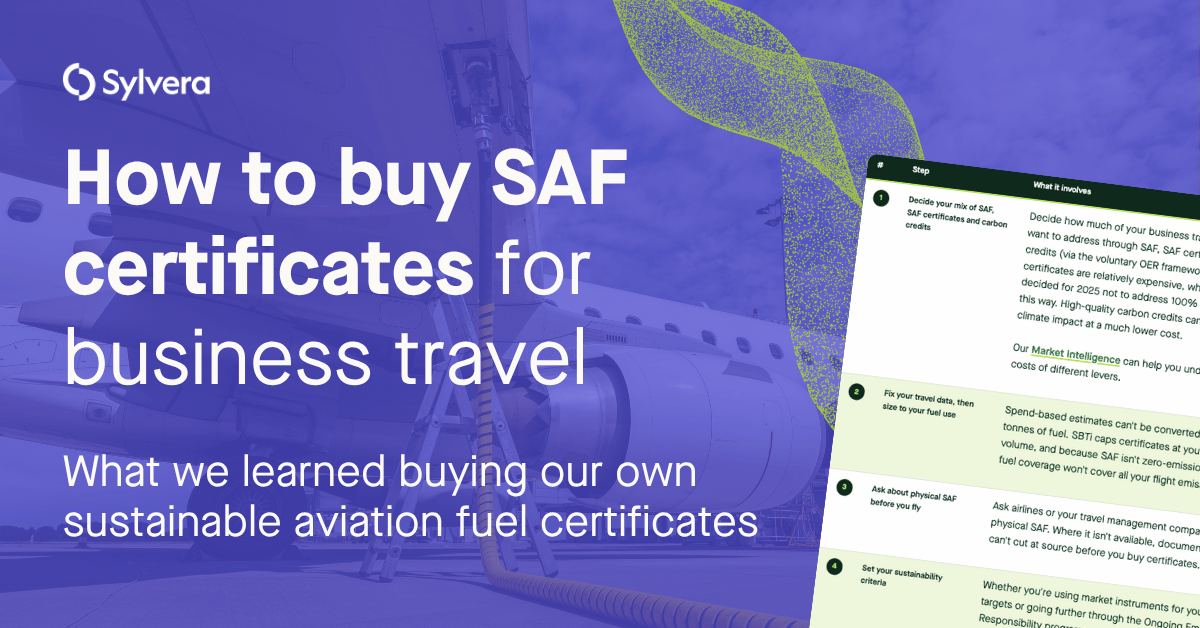
We ran the process ourselves, on our own targets, so we could help customers do the same.
Sylvera is an SME (Category B under SBTi V2) with a validated near-term target and a net-zero commitment. Our footprint is small but growing and dominated by Scope 3. A large share of it comes from flights: business travel and the survey flights behind our field data. That made aviation the place to start.
We set out to match all our flight fuel with SAF certificates and to commit to the Leadership level of SBTi’s Ongoing Emissions Responsibility (OER) program, which uses carbon credits and other climate contributions.
Our Commodity Market Gateway handled the sourcing. It brought us around 20 SAF certificate offers in under a week, which we compared against our budget and SBTi’s criteria. Sylvera’s Market Intelligence across carbon credits and commodities, instead, showed us what each option would have cost: SAF certificates on one side, and carbon credits for each OER level on the other.
We used our market data to optimise for maximum SBTi impact.
Certificates and carbon credits draw on the same budget, and SBTi asks companies that skip OER to explain why, so price both before you set the budget. In the end, we bought SAF certificates for c.10% of our aviation emissions as a pilot and committed to OER at the Advanced level.
Not all SAF certificates are equal
Certificates for the same volume of SAF can carry different claims and reduction figures. When we asked suppliers whether their certificates met SBTi’s criteria, they pointed us to the integrity and additionality rules of certification schemes and the registries.
Following this, we suggest you look closely at these six things:
1. The claim.
A certificate can carry the airline’s Scope 1 claim, the end user’s Scope 3 claim, or both. Many airline programs and intermediaries sell the Scope 3 part only.
2. The calculation.
The reduction depends on the fuel’s certified carbon intensity and on the fossil baseline it’s measured against. CORSIA uses 89 gCO₂e/MJ, and the EU’s RED II, which ReFuelEU Aviation relies on, uses 94 gCO₂e/MJ. At the same carbon intensity, the reduction looks larger against the EU baseline.
On top of this, the carbon intensities vary depending on the underpinning certification scheme methodology, in some cases allowing zeroing out renewable energy and infrastructure emissions. This creates a risky accounting mismatch across certificates. In the absence of clear indications from SBTi, being conservative is your best option.
3. Data type.
The metrics varied, making the comparisons more challenging: quotes came to us in gCO₂e/MJ, in tCO₂e per tonne of fuel, or as a percentage with no baseline stated.
4. The certification.
ISCC EU and ISCC CORSIA certify against EU schemes (e.g., RFNBO) and ICAO criteria, while ISCC PLUS is a broader voluntary standard. RSB operates on similar ground as ISCC, but sets stricter acceptance criteria, and SAFc has the most stringent additionality requirements.
A CORSIA label means the producer was certified against ICAO’s sustainability criteria. It doesn’t validate your Scope 3 claim. Check the scheme, the feedstock sustainability criteria, and carbon reduction on the fuel’s Proof of Sustainability.
5. The registry.
Registries differ on how they split Scope 1 and Scope 3 claims, whether fuel used for compliance can be sold for Scope 3, and whether they independently check additionality or rely on self-declaration.
6. The additionality.
If the SAF behind your certificate was used to meet a mandate such as ReFuelEU Aviation or the UK SAF Mandate, the additionality of your Scope 3 claim is likely to be very low. For example, the SAFc Registry doesn’t allow Scope 3 claims for SAF used to meet ReFuelEU Aviation, while RSB allows retiring under multiple additionality systems.
The certificate landscape is fragmented, different integrity criteria, additionality requirements and carbon accounting methodologies. This is where our experience in mechanism eligibility and value assurance assessments helped us navigate the space.
A checklist for buyers
Use these checks to make sure a certificate’s characteristics match your SBTi requirements:
Why move now
Moving first lets you learn a market with tight supply before demand picks up. IATA expects SAF to make up 0.8% of jet fuel use in 2026, and part of that supply goes to meet EU and UK mandates. Few of the offers we saw had the data an SBTi claim needs. Early buyers get time to understand how to deal with different integrity schemes and registries, and to set coverage targets that fit their budget. Demand is likely to grow as companies adopt V2, which takes effect in February 2027.
Moving first also lets you own the narrative, your decarbonization story. As our Climate Week NYC panel heard, no single lever gets a company to net zero: buyers are combining physical supply, mass balance, certificates, and carbon credits. In the most promising deals, buyers set the criteria up front, such as methodology, registry, and location. Buyers who do the same can explain what they bought, what it claims, and what it doesn't, before standards and stakeholders ask.
Sylvera supports each step.
Commodity Market Gateway lets you request SAF certificates that match your criteria and compare offers.
Our EAC assurance and Mechanism Eligibility assessments help identify the highest-quality, most SBTi-relevant schemes and registries, and Sylvera Ratings cover the carbon credits you may buy for OER.
Finally, our Market Intelligence provides high-quality price data to make a final decision. You can explore Ratings, insights, and supply data across carbon credits and commodities by signing up for a free account here.
This article reflects SBTi’s Corporate Net-Zero Standard V2.0 as published in June 2026. It is for information only and is not legal or financial advice.