

“Over the years we’ve invested significantly in our field data team - focusing on producing trusted ratings. While this ensures the accuracy of our Ratings, it doesn’t allow the scale across the thousands of projects that buyers are considering.”

For more information on carbon credit procurement trends, read our "Key Takeaways for 2025" article. We share five, data-backed tips to improve your procurement strategy.

One more thing: Connect to Supply customers also get access to the rest of Sylvera's tools. That means you can easily see project ratings and evaluate an individual project's strengths, procure quality carbon credits, and even monitor project activity (particularly if you’ve invested at the pre-issuance stage.)
Book a free demo of Sylvera to see our platform's procurement and reporting features in action.
Sylvera Article 6 & CORSIA Hub Exclusive Content
Carbon markets have existed for decades — but the market for credits authorized and accounted for by national governments is new. Its existence, legitimacy, and integrity hinge on one thing: national reporting.
Under guidance for Paris Agreement Parties (national governments) participating in international carbon markets, they can choose to authorize the use of carbon credits toward an emissions target other than their own. In doing so, they commit to applying corresponding adjustments (CAs)—adding the authorized GHG emissions reductions or removals back to their national emissions balance so they are not double-counted toward the host country's target and another target.
But a CA is only as real as the reporting that substantiates it. Securing this commitment in a Letter of Authorization (LoA) is only the beginning of what becomes a decade or more of national tracking, accounting, and reporting requirements — both domestically and under the Paris Agreement.
Those navigating this genuinely new territory include host countries issuing LoA; airlines preparing to comply with CORSIA, the Carbon Offsetting and Reduction Scheme for International Aviation — a sector-wide emissions measure that runs parallel to the Paris Agreement; sovereigns using authorized credits to meet their Paris targets; and investors backing carbon projects.
For many host countries, the reports they are filing to fulfill Article 6.2 guidance far exceed the complexity of any preceding developing-country reporting requirements. Climate change officials — who may lack in-house economists or modelers — are wrestling with questions like: "How many credits can we afford to transfer and still meet our target?" Or: "Can we reduce emissions from this source without foreign direct investment?"
Here, learning by doing is not just expected; it is inevitable. Examining where early movers are struggling is precisely how the broader market learns and how today’s and future participants do better. National Article 6.2 reporting is the invisible infrastructure behind every internationally transferred mitigation outcome (ITMO) that underpins an authorized carbon credit — and right now, it is the part that everything else depends on.
5 Key Takeaways
- Reporting is the backbone of Article 6.2 implementation — without it, CAs cannot be credibly applied, and the environmental integrity of ITMOs cannot be verified.
- Having a Letter of Authorization (LoA) does not equal low risk. A country can have issued authorizations and still carry significant LoA and CA risk, for example, that it will not issue another LoA, or might not ultimately account for ITMOs as committed. This could occur if its reporting obligations are delayed, incomplete, or inaccurate.
- Three types of reporting gaps matter: timeliness, completeness, and accuracy — and all three have been observed in early submissions.
- Reporting flexibility for least developed countries (LDCs) or small island developing states (SIDS) is a grace period, not a permanent exemption — and even within it, missing GHG inventory data creates downstream problems for CA application.
- Airlines with CORSIA offsetting obligations, sovereign buyers, and insurers all face concrete financial and legal exposure. When a host country falls behind on its reports that reflect GHG accounting, it is impossible to demonstrate that a carbon credit's GHG mitigation has not been double-counted.
No Transparency, No System — Why Reporting Is the Foundation of the Paris Agreement
Article 13 of the Paris Agreement establishes the Enhanced Transparency Framework (ETF), which underpins reporting requirements for all Parties. Decision 18/CMA.1, concluded at COP 24 (Katowice, 2018), sets out the modalities, procedures, and guidelines (MPGs) for the ETF and requires Parties to submit a Biennial Transparency Report (BTR).
For countries applying Article 6.2 guidance, two subsequent decisions layer on additional requirements: Decision 2/CMA.3 from COP 26 (Glasgow, 2021) and Decision 6/CMA.4 from COP 27 (Sharm El-Sheikh, 2022). These require an Initial Report (IR) for each new authorization/scope or credited activity, alongside quantitative annual and biennial information. Together, these form the full reporting architecture for Article 6.2.
Article 6.2 Reporting Requirements by COP Decision
What Article 6.2 Participants Are Required to Submit
Countries that issue LoAs — signaling their intent to account for ITMOs for Nationally Determined Contributions (NDC) use, CORSIA, or other international mitigation purposes (OIMP) — take on a set of reporting obligations that go well beyond those of non-participating Parties. These obligations begin at the moment an LoA is issued, because the LoA is, in essence, a country's promise that it will apply corresponding adjustments. Reporting is how that promise is made verifiable.
Full Reporting Obligations for Article 6.2 Participants
* In practice, there is an expectation by the UNFCCC Secretariat that an LoA under CARP will have an accompanying IR.
Least Developed Countries (LDCs) and Small Island Developing States (SIDS) have some leeway to submit their BTRs — and by extension, their GHG inventories — with flexibility on deadlines. However, this flexibility was never designed to be an exemption. Chronic delays in BTRs and GHG inventory submissions create a compounding problem: without an up-to-date inventory, the adjustment of emissions balance cannot be conducted reliably. The absence of an inventory is not a technicality; it is a structural blocker for CA integrity.
A Timeline of Obligations — When the Clock Starts Ticking
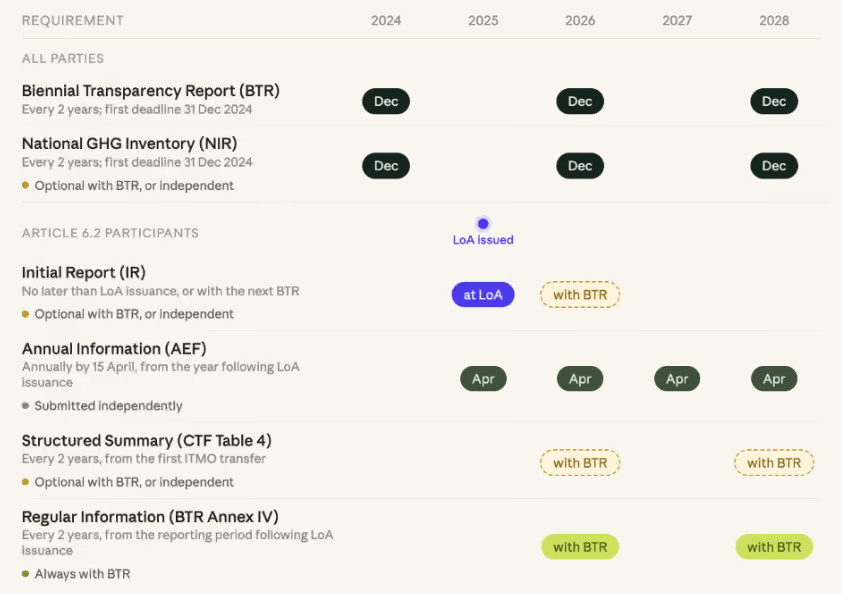
The moment a country issues a Letter of Authorization, a cascade of reporting obligations begins. Some are immediate — the Initial Report must be filed at the point of authorization. Others follow within months, like the first Annual Information submission due the following April. The biennial obligations — the Structured Summary and Regular Information — align with the BTR cycle and continue indefinitely. The figure below maps these obligations across a five-year window, showing what is required when.
Early Lessons from the Field — Three Reporting Patterns to Watch
The first wave of LoAs and CAs has given us an early dataset of real-world reporting behavior. At Sylvera, our assessment of LoA and CA risk is directly informed by what we observe in these submissions. Across them, three patterns stand out as areas where there is meaningful room for improvement:
Timeliness — Late but Not Yet Disqualifying
Delays are understandable, especially for pioneering countries working through genuinely novel processes. But timeliness has limits. As CORSIA Phase 1 compliance draws closer, persistent lateness will shift from an administrative concern to a material risk factor for credits already in circulation. In the case of LDCs and SIDS, flexibility is not expected to be indefinite, and Sylvera scores give them a 1-year leeway before jeopardizing the reliability of an LoA.
Completeness — Missing Data Matters
Some submissions are missing key data fields — particularly around ITMO volumes, vintage information, or CA methodology. Incomplete reports can prevent validation that a CA has been correctly applied, which undermines the entire basis of the credit's environmental claim.
Accuracy — Misalignment Across Reports or With Article 6 2 Guidance
Perhaps the most technically serious issue: data that appears in one registry or report (say the Annual Information report) does not reconcile with data in another (such as the CTF4 Structured Summary). These misalignments may reflect genuine errors, differing interpretations of Article 6.2 guidance, or simply the difficulty of coordinating across ministries. Whatever the cause, breaks in the line of sight for the same data in multiple reports, or inaccurate interpretations and application of Paris guidance, signal to buyers and auditors that the country's reporting system is not yet robust.
What Bad Reporting Means for You — Buyers, Investors, and Insurers
An LoA is a signal of intent, not a bulletproof guarantee, that the country will apply the accounting needed to avoid double-counting. The carbon market has yet to fully internalize what it means when the host country behind a credit cannot demonstrate reliable, timely, complete, and accurate reporting. Here is what it means in practice for each stakeholder group:
For Buyers: CORSIA-Compliant Airlines and Sovereigns
Airlines and sovereign buyers carry the same underlying authorization risk, but it surfaces differently. CORSIA only requires airlines to buy and cancel tagged units, with no obligation to track or demonstrate the basis for tagging. Even so, the host country's reporting isn't irrelevant to airlines: it underpins the integrity of the supply itself, supporting things like insurance backing for the units, even though airlines bear no direct verification burden themselves. Sovereign buyers face that exposure more directly, since their ability to legitimately offset emissions depends entirely on the same reporting holding up.
CORSIA requires airlines to surrender eligible emissions units to offset their international aviation emissions above the baseline. For a unit to be CORSIA-eligible, it must come from a host country that has properly authorized it and applied — or committed to apply — a CA. If the host country's reporting is incomplete or inaccurate, the CA may not be verifiable. Due to CORSIA's requirements of certification standards bodies to “wear” this risk, they must have measures in place to compensate for authorized units that are not ultimately accounted for, creating compliance uncertainty at exactly the moment regulators and auditors will be paying closest attention.
Governments using / countingITMOs for NDC compliance face a different but equally serious risk. If the host country's reporting does not clearly establish that its ITMOs have been subtracted from its own NDC accounting, the sovereign buyer country cannot demonstrate that its own NDC targets are being met through legitimate means. Bilateral Article 6.2 agreements rely on both sides maintaining credible records — poor reporting on one side erodes the integrity of the whole cooperative approach. For sovereigns using Article 6.2 credits as part of their climate commitments, this is not a theoretical risk.
For Investors and Project Developers
Investors and project developers share a common vulnerability: both have committed capital or resources on the basis of an Article 6.2 authorization that may prove harder to substantiate than it appeared at the time. Project valuations, revenue projections, and financing structures that assume CA integrity should be stress-tested against the host country's actual reporting capacity and track record.
For investors, the risk is not simply that a host country revokes an LoA — it is that a country's delay or gaps in meeting its reporting obligations retroactively undermine the authorization it has granted. An authorization that exists on paper but cannot be substantiated through the required reporting chain is functionally impaired, even if it has never been formally withdrawn.
For project developers, the consequences are more operational. A project hosted in a country with a weaker reporting track record faces friction at every stage of the credit lifecycle — from buyer due diligence to registry recognition of its LoA coverage to issuance to secondary market liquidity. Early movers who built pipelines assuming reliable reporting by host countries may find themselves holding authorized credits that are nonetheless difficult to sell, use, or defend under audit — not because the underlying project hasn’t delivered, but because the sovereign infrastructure around it has.
For Insurers
The insurance market for carbon credit delivery risk is still developing, but underwriters are beginning to ask harder questions about the underlying country risk embedded in Article 6.2 credits. Reporting quality is increasingly relevant to how insurers price and structure coverage. A policy written against credits from a country with repeated reporting deficiencies carries a different risk profile than one from a country with a clean, timely, and internally consistent reporting record. As the market for carbon insurance matures, reporting gaps will likely translate directly into higher premiums or coverage exclusions.
The Path Forward — What Good Looks Like
The good news is that reporting frameworks exist; the templates are available; and the UNFCCC technical support infrastructure is expanding. Several things would make a material difference:
- Host countries investing in dedicated Article 6.2 reporting capacity — ideally cross-ministry coordination between environment, finance, and statistics offices.
- Buyers and investors making reporting quality a standard due diligence criterion, not an afterthought.
- CORSIA eligible programs and accreditation bodies incorporating host country reporting track records into their eligibility assessments.
- Insurers and rating agencies building country reporting scores into their risk models.
Sylvera's Article 6 & CORSIA Hub Host Country Analysis offers a rigorous assessment of LoA and CA risk at the country level. With the CORSIA Phase 1 compliance deadline approaching — requiring airlines to surrender eligible units against their 2024–2026 emissions — and sovereign buyers racing to meet 2030 NDC targets, the window for treating reporting quality as a secondary concern is closing. As more data becomes available through successive transparency cycles, the picture will sharpen — for better and for worse.