“Over the years we’ve invested significantly in our field data team - focusing on producing trusted ratings. While this ensures the accuracy of our Ratings, it doesn’t allow the scale across the thousands of projects that buyers are considering.”

For more information on carbon credit procurement trends, read our "Key Takeaways for 2025" article. We share five, data-backed tips to improve your procurement strategy.
One more thing: Connect to Supply customers also get access to the rest of Sylvera's tools. That means you can easily see project ratings and evaluate an individual project's strengths, procure quality carbon credits, and even monitor project activity (particularly if you’ve invested at the pre-issuance stage.)
Book a free demo of Sylvera to see our platform's procurement and reporting features in action.
Company: FCF India (Fair Climate Fund India)
Industry: Carbon Project Development
Region: India
Use Case: Building buyer trust and accelerate transactions for an agroforestry project
Sylvera Products Used: Sylvera Ratings
Impact: Sylvera Pre-Issuance A Rating increased buyer engagement, streamlined due diligence, and validated the approach to community-centered carbon projects
--
FCF India (Fair Climate Fund India) works at the intersection of carbon markets and smallholder livelihoods, developing projects across India, Nepal, Ethiopia, and Rwanda.
As developers increasingly compete for buyer, investor, and intermediary attention, earning an A Pre-Issuance Rating from Sylvera on its flagship Odisha agroforestry project became a tool for FCF India to help interested parties move faster.
The challenge
Standing out in a market with too much information and too little time
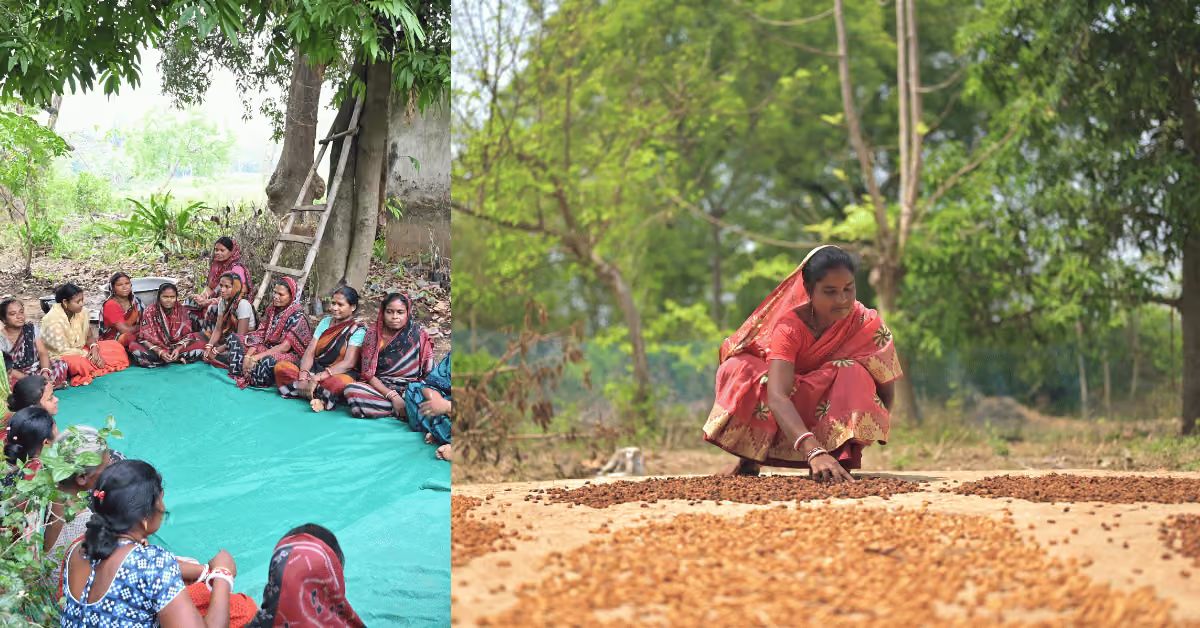
At its ARR project in the Mayurbhanj district, Odisha, FCF India works with tribal communities to restore barren uplands through agroforestry - planting fruit-bearing and forest trees on land that would otherwise sit degraded.
But turning strong project fundamentals into closed transactions proved a lengthy and complex process. Selling directly to corporate buyers meant long sales cycles - often a year or two - built from the ground up with custom project documentation and financial models.
Ratings were seen as the key to unlocking faster due diligence.
Without a rating, intermediaries, corporate buyers and investors had to spend significant time evaluating dense, technical data rooms before deciding whether a project was worth pursuing. Those parties now rely largely on ratings as a first filter.
However, initially, the FCF India team was hesitant to invest in a third-party assessment.
Engagement with Sylvera had begun two years before this project - first through free assessments Sylvera conducted at the request of investors already looking at FCF India's portfolio.
One of these projects received a BBB rating, and as that project began attracting noticeably more interest compared to the rest of FCF India's portfolio - this shifted how the team thought about ratings.
"For us, pursuing the Sylvera assessment was about demonstrating the integrity of our work through an independent lens. As the voluntary carbon market matures, buyers are looking for greater transparency and evidence alongside project documentation.”
— Jasmeet Singh, Founder & Director, FCF India
The solution
Building trust gradually, then committing to a Pre-Issuance Rating
When it came time to pursue a Pre-Issuance Rating for the Odisha project, FCF India compared Sylvera against other providers, drawing on two years of positive interactions in working directly with Sylvera's technical team.
The Odisha project - an ARR project registered under Gold Standard - achieved an A Pre-Issuance Rating from Sylvera, reflecting performance across the quality pillars.
Carbon Accounting
The project's carbon accounting approach is generally conservative, resulting in a low potential over-crediting risk. Modeling choices are largely robust, and the project's projected removals claims and monitoring procedures are considered conservative.
Additionality
The project's smallholder-led agroforestry activities demonstrate strong additionality. It exceeds regional common practice, demonstrates a strong need for carbon finance based on developer-provided data, and operates independently of existing policy incentives.
Permanence
Non-permanence risk is moderate. The project's design helps mitigate risks: small, dispersed plantation plots using a mix of native and naturalized species reduce the likelihood of plantation failure and limit the potential impact of concentrated natural hazards.
Safeguarding & Co-benefits
The project is very likely to deliver a high net benefit to local ecosystems and communities, with safeguards ensuring a low risk of harm. Polyculture plantations on degraded land are likely to increase biodiversity without disrupting existing ecosystems, and the project places local communities - including women-led institutions - at the center of its design and implementation.
The results
1. A faster filter
The rating gives buyers, investors, and intermediaries a fast, credible way to prioritize FCF India's project among a growing pool of options, without requiring them to comb through detailed project documentation before deciding it was worth their time.
2. Validation for portfolio-wide confidence
Having seen how a rating affected buyer interest in one project, FCF India now plans to extend this approach to verified quality across its broader portfolio.
3. A new way to market project quality
Beyond the technical details of the assessment, FCF India found that the Sylvera A Rating was a strong marketing asset to use for promoting its flagship project.
“Receiving a Pre-Issuance A Rating reinforces the strength of our project and helps build confidence in the quality of the outcomes we're delivering for communities, biodiversity and the climate."
— Jasmeet Singh, Founder & Director, FCF India
About FCF India
FCF India (Fair Climate Fund India), headquartered in New Delhi, has worked in carbon markets since 2009 and operates projects across India, Nepal, Ethiopia, and Rwanda. The company develops nature-based solutions, clean cooking, water purification, and electric mobility projects, with a focus on generating sustainable livelihoods for smallholder farmers and vulnerable communities alongside carbon revenue.