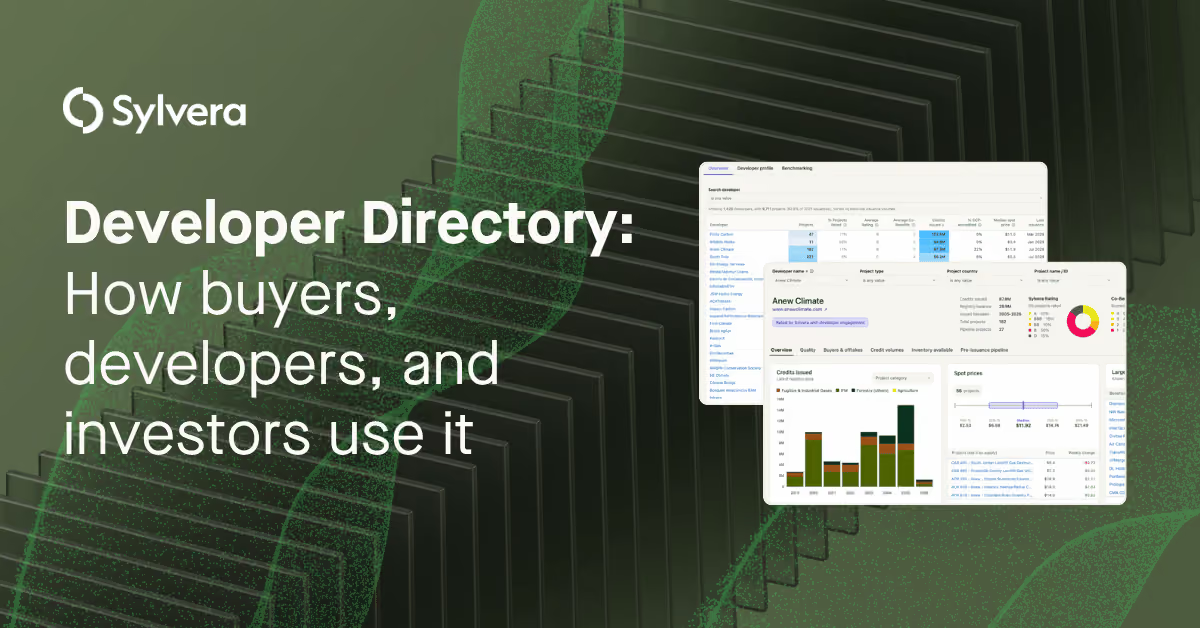


“Over the years we’ve invested significantly in our field data team - focusing on producing trusted ratings. While this ensures the accuracy of our Ratings, it doesn’t allow the scale across the thousands of projects that buyers are considering.”

For more information on carbon credit procurement trends, read our "Key Takeaways for 2025" article. We share five, data-backed tips to improve your procurement strategy.
One more thing: Connect to Supply customers also get access to the rest of Sylvera's tools. That means you can easily see project ratings and evaluate an individual project's strengths, procure quality carbon credits, and even monitor project activity (particularly if you’ve invested at the pre-issuance stage.)
Book a free demo of Sylvera to see our platform's procurement and reporting features in action.
For years, lower-carbon commodities such as hydrogen attracted enormous excitement - ambitious cost curves, huge fundraising, and a climate movement that seemed to guarantee demand. With an expectation of an immediate price premium, the hype met an impasse when scale did not appear immediately. The political winds have since shifted, the climate argument no longer carries the weight it once did, and the market has landed somewhere more sober: producers, buyers, and lenders trying to work out what actually comes next.
The companies still in the room are doing the hard work - building real commercial models that prove the potential and value of the market. The opportunity is genuine, but it is locked behind levels of complexity: fragmented compliance schemes, maturing but inconsistent EAC markets, and carbon intensity frameworks that differ across mechanisms and geographies.
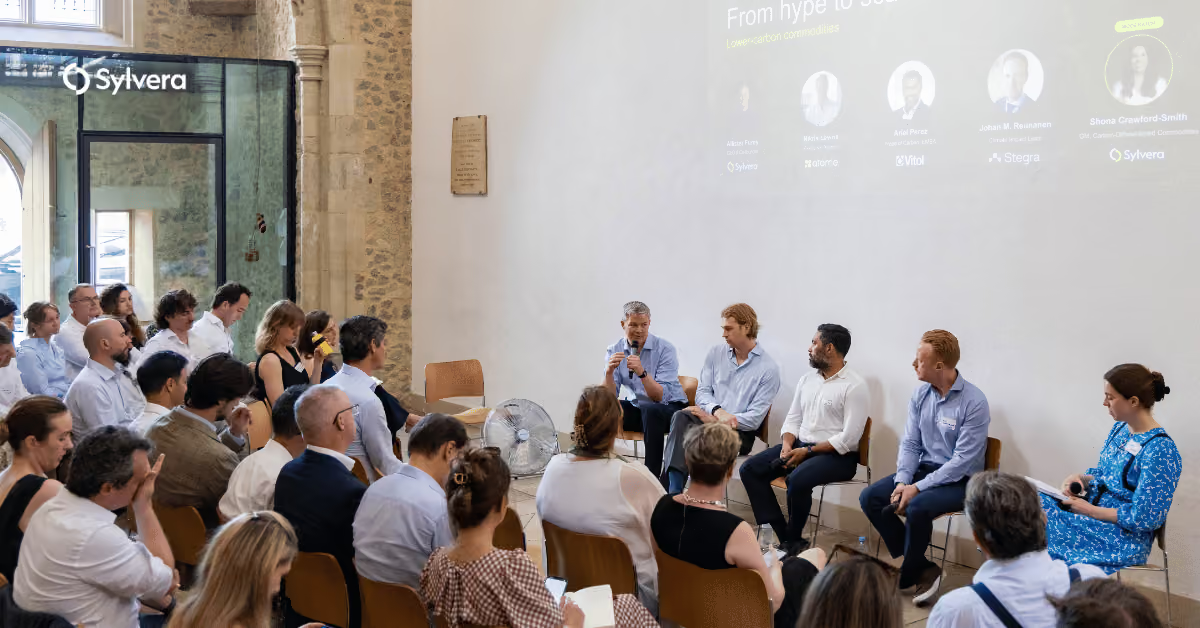
At London Climate Action Week, Sylvera hosted a panel discussion bringing together voices from across the lower-carbon commodity value chain. The conversation was frank, grounded in deal experience, and arrived at a clear conclusion: the goal for these markets is to become boring. Here’s what we heard.
Panellists:
- Ariel Perez, Head of Carbon EMEA, Vitol
- Johan Reunanen, Director of Sustainability, Strategy & Climate, Stegra
- Nikita Levine, Executive Director, ATOME
- Allister Furey, CEO, Sylvera
- Shona Crawford-Smith, General Manager Lower-Carbon Commodities, Sylvera (moderator)
‘Boring’ is the aim for a functional lower-carbon commodity market
The measure of success for this market is not excitement; it’s bankability.
Boring in this sense means a buyer can source lower-carbon steel or ammonia like any other tonne - in a trusted, verified way, without the complexity or the bespoke process that comes with every deal today.
We’re not there yet. What we have is a market with genuine proof points - real projects, real offtakes, real investment. But it’s also a market where every deal is still hard-won.
The proof points are out there
Two of the panellists are building the proof of concept in real time.
Stegra: green steel at scale
Stegra is constructing the world’s first large-scale green steel plant in Boden, Sweden - a 740MW electrolyser project targeting approximately 95% lower CO₂ than conventional steelmaking.
- Offtake book: ~1.5 million tonnes per year
- Buyers include Mercedes-Benz, Porsche, BMW, Volvo, Scania, IKEA, Cargill and Microsoft
- Total financing: ~€8 billion
ATOME: green fertiliser in Paraguay
ATOME reached a final investment decision on its Villeta green fertiliser plant in April 2026 - a $665 million project producing roughly 260,000 tonnes per year of green calcium ammonium nitrate from hydropower.
- Backed by IFC (~$130m), EIB Global (~$95m) and Hy24 (~$115m)
- Long-term offtake relationship with Yara anchors the demand side
What unlocks project finance
Both projects highlight the same commercial reality: producers require highly predictable, long-term cash flows. That means blue-chip offtakers willing to sign fixed-premium contracts, something that runs against the grain of how most commodity buyers typically operate.
Lenders tend to require at least 50% of offtake locked in on those terms before financing moves. Getting there currently demands a bespoke commercial approach every time.
Compliance is the clear imperative
Voluntary demand alone will not scale these markets. The panel was clear: compliance is the imperative.
California’s LCFS
California’s Low Carbon Fuel Standard (LCFS) is an example of compliance driving demand through carbon pricing. Tradable credits mean there are rewards as well as penalties, and it has created the world’s largest low-carbon fuel market.
The contrast with Europe is instructive: very high carbon prices under the EU ETS, but very low prices for Guarantees of Origin and other environmental certificates, because the two are not yet meaningfully linked.
RPS
North American Renewable Portfolio Standards (RPS) offer a clear comparison. State-level RPS mandates force utilities to surrender Renewable Energy Certificates (RECs), giving those certificates real value:
- Compliance RECs in New Jersey: ~$200/MWh
- Voluntary RECs in Texas: ~$2–3/MWh
Same electrons, same product - but different compliance obligations. Where compliance creates durable demand and the underlying data is trusted, a real market forms.
The market needs certainty and stability
The EU’s back-and-forth on including ammonia and fertiliser within CBAM is a cautionary tale about single-basket dependency. Predictable policy sustained over decades is what capital needs - and what the market is still waiting for.
Mechanisms are hard to navigate, but there’s an opportunity to be had
The mechanism landscape is complex: CBAM, RFNBO standards, Energy Attribute Certificates (EACs), book-and-claim systems, Article 6, SBTi frameworks, and carbon-intensity rules that differ materially across jurisdictions.
But complexity creates opportunity. The producers, buyers and traders who learn to navigate it first will capture the value.
The role of EACs
EACs are designed to decouple the green attribute from the physical commodity - much as RECs separate renewable credits from the power itself. This matters especially for geographically constrained commodities like cement, where producers cannot necessarily sell all output into a local market willing to pay a premium.
But the SBTi picture is honest about the limits. Decarbonisation is voluntary, SBTi is voluntary, and use of EACs within SBTi frameworks is itself voluntary. That structure is not the foundation for a liquid market. EACs are a useful transitional tool, and the commercial preference, where possible, is physical offtake.
Pricing needs to be defined by intensity, not a colour
CBAM and ETS-style pricing already price every kilogram of CO₂e. Extending that logic to commodity premium structures - pricing on a continuous carbon intensity curve rather than a colour category or threshold - would make incremental improvements much more commercially valuable.
Sylvera’s own data illustrates why this matters. Across ammonia facilities, the spread in carbon intensity runs from roughly 0.25 to 5.5 kgCO₂e per kg of ammonia - a more than twenty-fold range. The variance is vast, the data to capture it now exists. What is missing is the market infrastructure to price it.
What needs to happen by 2030?
Asked what needs to happen by 2030 for this market to be boring and scalable, the panel converged on four things:
- Compliance must become the driver. Countries with legally binding emissions obligations need to meet them efficiently — voluntary commitments alone won’t get us there.
- Large buyers and financiers need to engage earlier in project development, not at the point of procurement.
- Predictable, long-horizon policy — with taper mechanisms designed now — is the key to unlocking project finance at scale.
- The effort must shift to demand. The integrity work on carbon markets is largely done. The priority now is creating coherent compliance demand for environmental attributes.
Explore the data
If you want to explore lower-carbon commodity data such as facility-level carbon intensity and offtake tracking across ammonia, cement and other commodities, you can create a free account here.