





“Over the years we’ve invested significantly in our field data team - focusing on producing trusted ratings. While this ensures the accuracy of our Ratings, it doesn’t allow the scale across the thousands of projects that buyers are considering.”

For more information on carbon credit procurement trends, read our "Key Takeaways for 2025" article. We share five, data-backed tips to improve your procurement strategy.
One more thing: Connect to Supply customers also get access to the rest of Sylvera's tools. That means you can easily see project ratings and evaluate an individual project's strengths, procure quality carbon credits, and even monitor project activity (particularly if you’ve invested at the pre-issuance stage.)
Book a free demo of Sylvera to see our platform's procurement and reporting features in action.
Sylvera, in partnership with Singapore's National Climate Change Secretariat (NCCS), has developed a global statistical model for predicting deforestation rates in High Forest Low Deforestation (HFLD) jurisdictions. This post sets out the key principles emerging from that work.
A full technical paper is available here.
Why this matters now
JREDD+ enjoys broad market acceptance — preferential treatment under CORSIA, eligibility under Singapore's carbon tax mechanism, and backing from the LEAF Coalition — but scepticism around HFLD credits has persisted, centred on additionality and accounting integrity. Unlike standard REDD+, HFLD credits issued under ART TREES are calculated using historical average emissions plus a conservative proxy for future forest loss, making an evidentiary case for future emissions risk particularly critical.
The ICVCM's recent determination that ART TREES v2.0 HFLD requires remedial action before qualifying for CCP approval has brought these questions to a head. The remedial conditions — including requirements for participants to demonstrate that reference period emissions will materially understate the true baseline, and for VVBs to independently cross-check baseline inputs — are consistent with Sylvera's view that any uplift beyond historic rates must be grounded in evidence. The path to CCP approval remains open but uncertain, and with approximately 75% of current CORSIA supply derived from Guyana's HFLD TREES programme, the stakes for the market are significant.
The HFLD designation alone is not a reliable signal of future risk
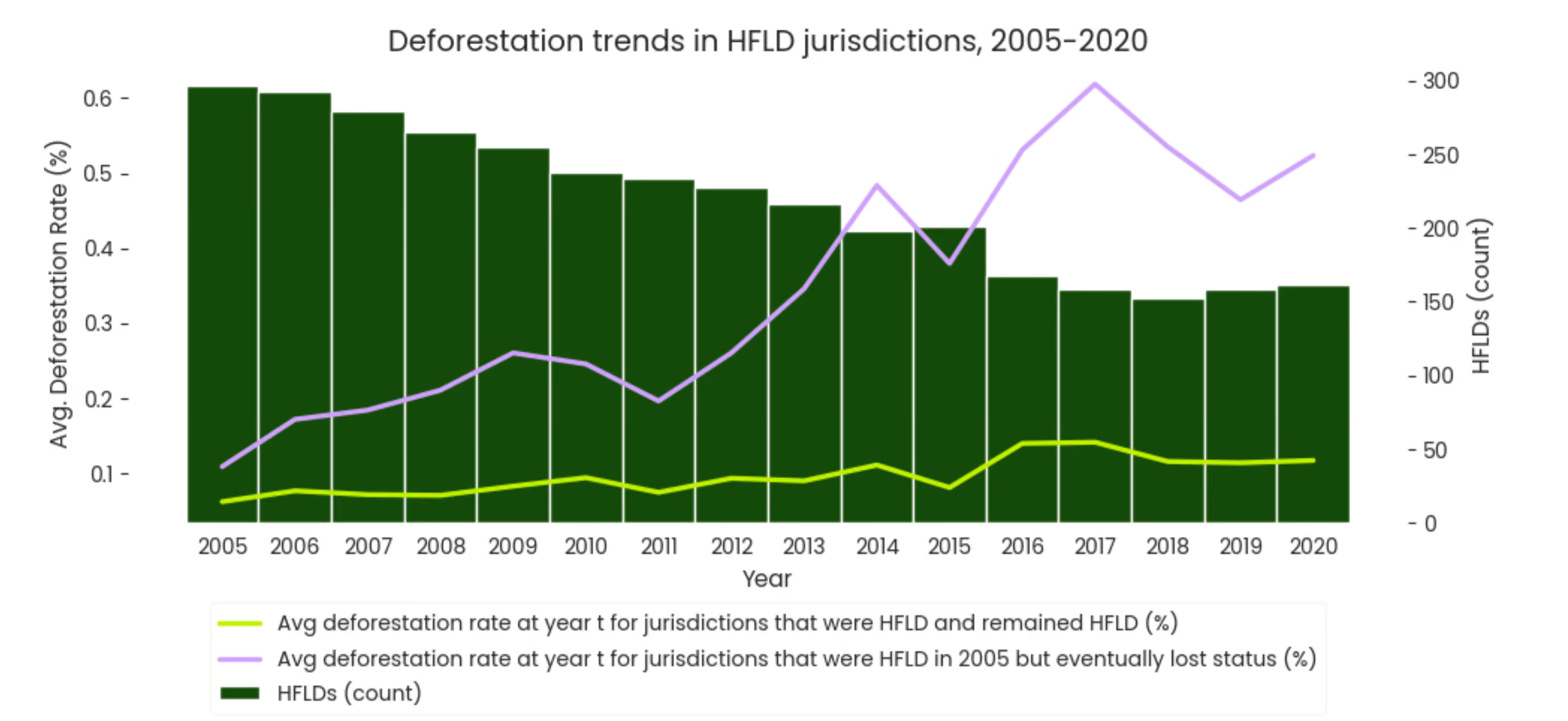
Not all HFLD jurisdictions are equal. Our analysis shows that the number of jurisdictions meeting HFLD status has declined over time, and those that have lost their status exhibit accelerating deforestation rates. At the same time, jurisdictions that have maintained their status demonstrate persistently low deforestation — suggesting that for a meaningful subset, the risk of transition is genuinely low.
The implication is significant: universal approaches that apply a blanket baseline uplift based on HFLD designation alone fail to distinguish jurisdictions at genuine risk from those where low historical activity is likely to continue without the need for any intervention. Evidence-based frameworks are required to determine which jurisdictions are at greater risk of forest loss.
Historical averages cannot capture forward-looking risk
The standard JREDD+ approach — anchoring baselines in historical average deforestation rates — cannot account for emerging threats. Jurisdictions with persistently low past deforestation can still face elevated future risk due to changing economic pressures, infrastructure development, or policy shifts. Deforestation risks for HFLD jurisdictions are non-linear, spatially-specific and context-dependent. Baselines built solely on historical rates systematically underestimate emissions in some jurisdictions and overestimate them in others. This is a structural limitation that undermines baseline integrity in dynamic risk environments, and it supports the case that high-integrity baselines can legitimately exceed historical averages — provided that deviation is empirically justified.
Three principles for high-integrity HFLD credits
Sylvera proposes three principles that could facilitate the development of more credible HFLD baselines:
- HFLD baselines should be forward-looking. A credible baseline reflects the likely future trajectory of deforestation, not solely historical activity. Methods that rely exclusively on historical rates are likely to over- or under-predict true deforestation risk, sometimes very substantially.
- Deviations from historical rates must be empirically grounded. Any approach that sets a baseline above observed historical rates should be anchored in evidence. This can operate at different scales — from global statistical models as discussed in this paper that draw on cross-jurisdictional relationships between deforestation and its key drivers, to country-specific models that capture local dynamics, to project-level approaches that reference areas subject to comparable enabling conditions.
- Baseline methods should discriminate between jurisdictions. Drivers of forest loss — access, infrastructure development, socioeconomic conditions — differ meaningfully across jurisdictions. A high-integrity baseline should be sensitive to these differences, whether through global models that incorporate country-level covariates or localised approaches that reflect jurisdiction-specific conditions more directly. Approaches that treat all HFLD jurisdictions as equivalent risk the same systematic error.
A hierarchy of approaches
These principles point toward a tiered framework:
- Universal approaches — applying a fixed uplift to all HFLD jurisdictions — are the simplest method but carry the weakest integrity.
- Global statistical models, such as the one developed by Sylvera with NCCS, occupy the middle tier.By modelling the relationship between deforestation rates and observable covariates across jurisdictions, they generate forward-looking predictions grounded in empirical evidence.
- Location-specific models, which use known drivers of forest loss and their empirical relationships to produce forward-looking spatial risk maps from which baselines are derived, represent the highest standard of integrity and align most closely with ICVCM's emerging requirements for HFLD programmes.
Sylvera's global statistical model is set out in full in the accompanying technical paper. Sylvera is also working with a leading Article 6 nation in assessing HFLD baselines using country specific spatial models.
For the full technical methodology, findings, and model outputs, read the complete paper here.
The carbon stock inputs underpinning this analysis use Sylvera's Biomass Atlas — our wall-to-wall, lidar-calibrated forest carbon dataset — which serves as an independent and auditable source for validating the carbon stock estimates that sit at the heart of credible baseline construction.


.png)
