



“Over the years we’ve invested significantly in our field data team - focusing on producing trusted ratings. While this ensures the accuracy of our Ratings, it doesn’t allow the scale across the thousands of projects that buyers are considering.”

For more information on carbon credit procurement trends, read our "Key Takeaways for 2025" article. We share five, data-backed tips to improve your procurement strategy.

One more thing: Connect to Supply customers also get access to the rest of Sylvera's tools. That means you can easily see project ratings and evaluate an individual project's strengths, procure quality carbon credits, and even monitor project activity (particularly if you’ve invested at the pre-issuance stage.)
Book a free demo of Sylvera to see our platform's procurement and reporting features in action.
A new draft international standard has just put environmental attribute certificates on the agenda again. ISO/DIS 14060, the draft standard for net zero aligned organizations, went out for ballot last week, 17th June 2026, and is open for comment until September.
It is still a draft, so the wording will move before publication, but the direction it points in is the part worth paying attention to. It confirms a pattern that is now visible across nearly every framework touching these instruments: additionality and integrity are becoming a precondition for an attribute being worth anything at all.
We covered the SBTi Corporate Net-Zero Standard V2 treatment of commodity certificates last week. ISO/DIS 14060 is the second major standard in a month to give these instruments a defined, guardrailed role. Read together, and alongside what buyers are already doing in cement and the built environment, they tell a consistent story.
One instrument, several names
First, a note on language, because the same instrument travels under different labels and it causes real confusion. What the market broadly calls environmental attribute certificates (EACs), and what buyers in steel, cement and ammonia tend to call commodity certificates, ISO formally names environmental commodity certificates (ECCs).
They are the same idea: a contractual instrument representing a verifiable environmental attribute of a low-carbon product or technology, sold separately from the physical molecule. Throughout this piece we use the three terms interchangeably, because the standards do too.
What the ISO draft actually says
ISO defines an environmental commodity certificate (clause 3.3.9) as a contractual instrument representing a verifiable environmental attribute related to greenhouse gases, associated with a low carbon product or technology. It is explicit that carbon credits are not ECCs, and that energy attribute certificates are a subset of them.
Today the live examples are mostly in energy (biogas, sustainable aviation fuel, electricity), with agricultural and industrial commodities emerging.
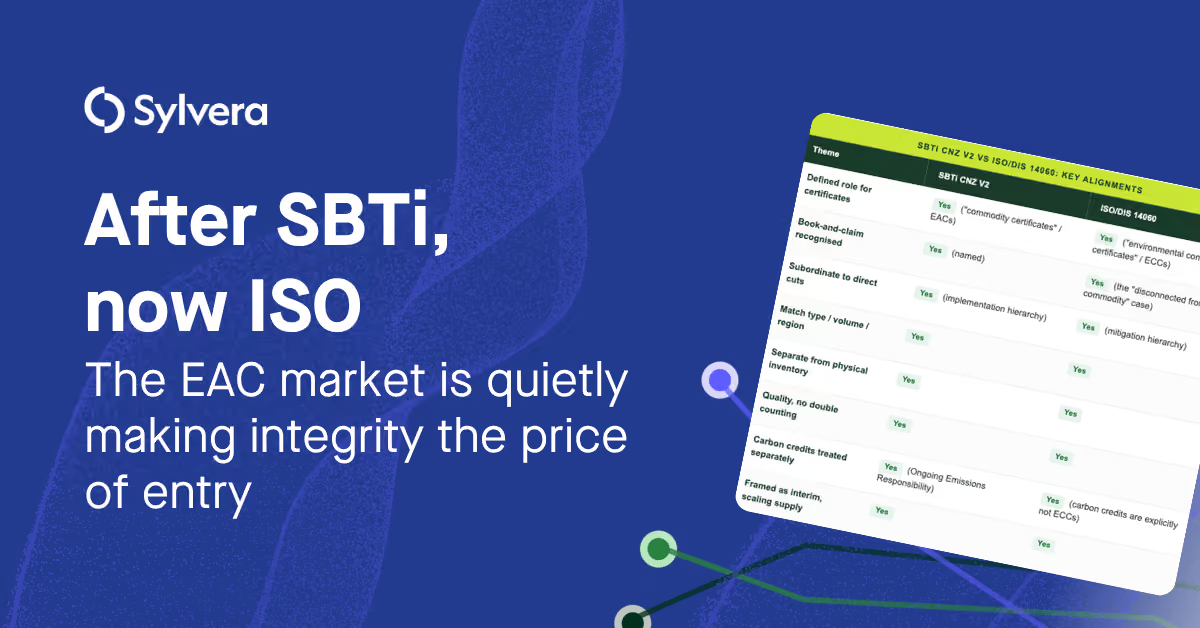
The substantive rules sit in clause 11.2, on scaling low carbon solutions, and the standard is careful to scope it to certificates that are disconnected from the underlying commodity, which is the book-and-claim case. The guardrails attached will look familiar to anyone who read the SBTi rules:
- Subordinate to the mitigation hierarchy. ECCs cannot substitute for cutting emissions inside the inventory.
- A barriers test. The organisation has to explain why it cannot procure the low-carbon product directly, and how the certificate grows global supply and long-term traceability.
- Built-in additionality and sunset. As a low-carbon market scales, ECCs “may no longer be additional, needed, or appropriate to use”.
- Type, volume and region matching. The certificate should map to an equivalent emissions source in the inventory and, ideally, the same region.
- Separate accounting. ECCs are reported distinctly from physical emissions accounting, never blended into the headline number.
- Quality, transparency and no double counting. Organisations should use best-practice frameworks, prioritise robust quantification, avoid double counting, and avoid lock-in and deforestation.
ISO is more principles-based than SBTi here. It does not enumerate certificate types or set sector-specific rules. But the floor it describes, additional, verifiable, matched, separately accounted, is the same floor.
SBTi + ISO convergence, not coincidence
Two standards arriving at near-identical guardrails within a month is a signal. Both treat book-and-claim as the mechanism nascent markets need. Both make additionality and integrity the condition of use rather than a footnote. Both insist the instrument sits outside the physical inventory and supports a contribution claim, not a reduction claim.
The philosophical framing differs (SBTi's best-efforts and implementation hierarchy, ISO's principles and net zero pathway), but the practical demands on a certificate converge almost exactly.
The commodities market is already running ahead of the standards
Here is the part that goes beyond the draft. The standards describe a floor; buyers and buyer coalitions are already setting a higher bar, and that is where the real direction of travel shows.
Cement and concrete. The Sustainable Concrete Buyers Alliance (SCoBA) is procuring environmental attribute certificates for low-carbon concrete collectively, built on the Book and Claim for Cement and Concrete framework from GMA and RMI. It has gone straight to multi-year offtake RFPs, supporting up to 250,000 tonnes of low-carbon cement a year from 2027. The point of the framework is to make commodity certificates bankable by making them credible, not simply available.
Concrete and steel, stricter still. The Microsoft and Carbon Direct Criteria for High-Quality Environmental Attribute Certificates set a notably tougher bar than either standard's baseline. Their criteria span seven areas, including qualifying conditions, social and environmental harms and benefits, additionality and baselines, catalytic impact, verifiability and leakage. On additionality specifically they require attributes to go beyond efficiency savings, subsidised upgrades, regulatory requirements and common practice, alongside independent verification and safeguards against double counting. That is a deliberately high screen designed for a buyer that wants its EAC dollars to do real, additional work.
Put the four together, ISO, SBTi, SCoBA and Microsoft/Carbon Direct, and the conclusion is hard to avoid: across standards and buyer-led frameworks alike, additionality and integrity have moved from differentiator to prerequisite. A certificate that cannot demonstrate them is increasingly not a cheaper certificate; it is an unsellable one.
What it means for producers selling commodity certificates
For producers of low-carbon commodities looking to sign offtakes, the implication is direct. You are no longer competing only on price or volume. You are competing to prove two things to a buyer at once.
First, that your certificate is the best spend of a buyer's EAC dollars. Buyers applying a Microsoft/Carbon Direct-style screen are asking whether the attribute is genuinely additional and catalytic: does demand for it pull more low-carbon supply into existence, or is it dressing up business-as-usual? Producers who can evidence catalytic impact, robust baselines and credible MRV will clear that screen. Those who cannot will be filtered out before price is even discussed.
Second, that the certificate will still be worth something under SBTi and ISO. A buyer is purchasing an attribute partly for what it lets them claim. If the issuing programme is not the kind of credible third-party framework these standards will recognise, with proper registries, serialisation, transparent retirement and independent assurance, the certificate may not support the contribution claim the buyer needs. Producers who invest early in robust assurance become the counterparties the market can actually transact with. The rest hold attributes that are technically real, but commercially stranded.
Integrity, in other words, is the differentiator that determines access to premium, standards-aligned demand. That was the takeaway from the SBTi rules, and ISO plus the buyer frameworks only sharpen it.
What it means for buyers
For buyers, the floor is rising in your favour, but it raises the diligence burden. The cheapest certificate is rarely the one that counts. Procurement and sustainability teams need to assess provenance, additionality, registry quality and assurance before committing, and to align purchases with what SBTi and ISO will recognise, not just what is on offer today. Buying credible attributes against documented constraints protects your standing under best-efforts frameworks in a way that buying loosely governed ones, or doing nothing, does not.
The through-line
ISO/DIS 14060 is only a draft, and much of the detail across all these frameworks is still to come. But the signal across standards and markets is now consistent and unambiguous: environmental attribute certificates, commodity certificates, environmental commodity certificates, whatever you call them, are in. Quality is the currency. The market is sorting fast into attributes that can prove additionality and integrity, and attributes that cannot, and only the first group will be worth holding.
Where this leaves producers
The producers who win in this market will be the ones who can prove, independently, what a buyer now has to check anyway. That proof runs in the same order the standards do: first whether a claim can even proceed, then how credible it is, then what it is worth.
Eligibility comes first, ideally before a certificate is ever issued. These are the gateway checks: is the carbon accounting methodology aligned with the relevant PCR, is there a representative EPD or a verified LCA behind it, does the product sit in scope under frameworks like GMA-RMI and SCoBA, and is the claim free of any overlap with compliance obligations. If a claim fails here, nothing downstream matters.
Integrity is the harder question, and it is where the real differentiation sits: an independent reconstruction and benchmarking of carbon intensity, baseline integrity tested against a regional counterfactual, financial additionality (would the project stand up without certificate revenue at all), whether the purchase is genuinely catalytic in pulling new low-carbon supply through, and the ESG factors behind the claim. These are the tests SBTi, ISO and the stricter buyer frameworks now treat as the price of entry.
Value follows from both. Integrity is not an abstract score, it sets a price: the stronger the evidence, the higher a producer can credibly sit between the cost of low-carbon production and what the market will pay. That is the difference between a self-reported figure and a number a producer can defend in an offtake negotiation.
This is the work we do with producers at Sylvera. We did it with CURA, a low-carbon cement producer, where we independently confirmed their carbon intensity, evaluated additionality, and assessed the ESG factors behind the claim. The work confirmed an 85% emission reduction versus conventional cement and placed CURA in the top 0.1% of cement products worldwide. As the standards tighten, that kind of independent proof is what turns a low-carbon advantage into offtakes and investment.
Sylvera’s mechanism eligibility assessments across EACs, CBAM, EU ETS and more for supports commodity producers navigating compliance and voluntary scheme complexity.
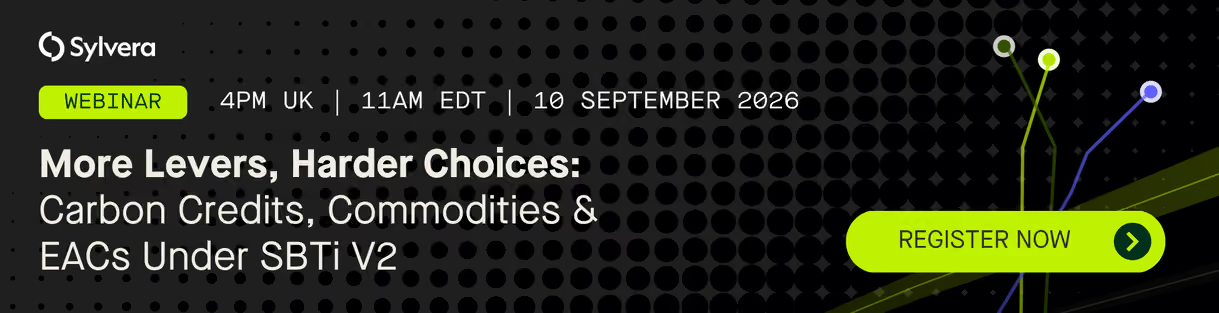
More Levers, Harder Choices: Carbon Credits, Commodities & EACs Under SBTi V2
Now that there's more than one way to move a scope 1/2/3 number, the core questions buyers keep asking is simple: what are the real options? What does each cost per tonne? And where do they actually count?
Carbon credits, physical lower-carbon supply, and EACs are usually priced and evaluated on their own terms. This webinar will place them in one room and price them against each other.