



“Over the years we’ve invested significantly in our field data team - focusing on producing trusted ratings. While this ensures the accuracy of our Ratings, it doesn’t allow the scale across the thousands of projects that buyers are considering.”

For more information on carbon credit procurement trends, read our "Key Takeaways for 2025" article. We share five, data-backed tips to improve your procurement strategy.

One more thing: Connect to Supply customers also get access to the rest of Sylvera's tools. That means you can easily see project ratings and evaluate an individual project's strengths, procure quality carbon credits, and even monitor project activity (particularly if you’ve invested at the pre-issuance stage.)
Book a free demo of Sylvera to see our platform's procurement and reporting features in action.
SBTi recent context
Three years ago, SBTi was seen as a headwind facing the voluntary carbon market. Its guidance was generally unsupportive of carbon credits. As SBTi validation had become the standard of corporate climate credibility, this carried significant weight.
This contributed to a cooling of corporate demand at a time when the market needed confidence. Many companies that wanted to be seen as credible climate leaders felt they had to choose between SBTi alignment and carbon credit procurement.
The second draft of its Corporate Net-Zero Standard V2, published for public consultation in late 2025, changed this narrative. For the first time, SBTi proposed formal recognition tiers for companies that use carbon credits as part of their net-zero strategy:
- Recognised status: Mitigate at least 1% of Scope 1-3 emissions.
- Leadership status: Mitigate at least 40% of Scope 1-3 emissions, applying a minimum $80/ton carbon price to 100% of all scope 1-3 emissions.
Post-2035, mandatory action kicks in for large companies and medium-sized companies in high-income countries, with CDR credits playing a growing and eventually dominant role.
The expected announcement could refine, confirm, or strengthen these tiers. And there’s the potential addition of introducing an intermediate level between Recognised and Leadership.
Whatever the details, the direction of travel would seem to be that carbon credits are moving to being formally endorsed.
Where companies are and where they'd need to be
We analysed credit retirement patterns against SBTi-aligned company emissions to model what formal recognition would actually require.
The current picture
SBTi-aligned companies - roughly 11,000 globally, covering an estimated 34billion tCO₂e of total Scope 1-3 emissions - retired approximately 20 million tonnes of credits in 2026.
That's just 0.06% of their total emissions. Non-SBTi companies are even further behind, at 0.02%.
The threshold for even basic "Recognised" status under the draft framework is 1% of emissions. Companies are currently running at one-sixteenth of that level.
The current picture:
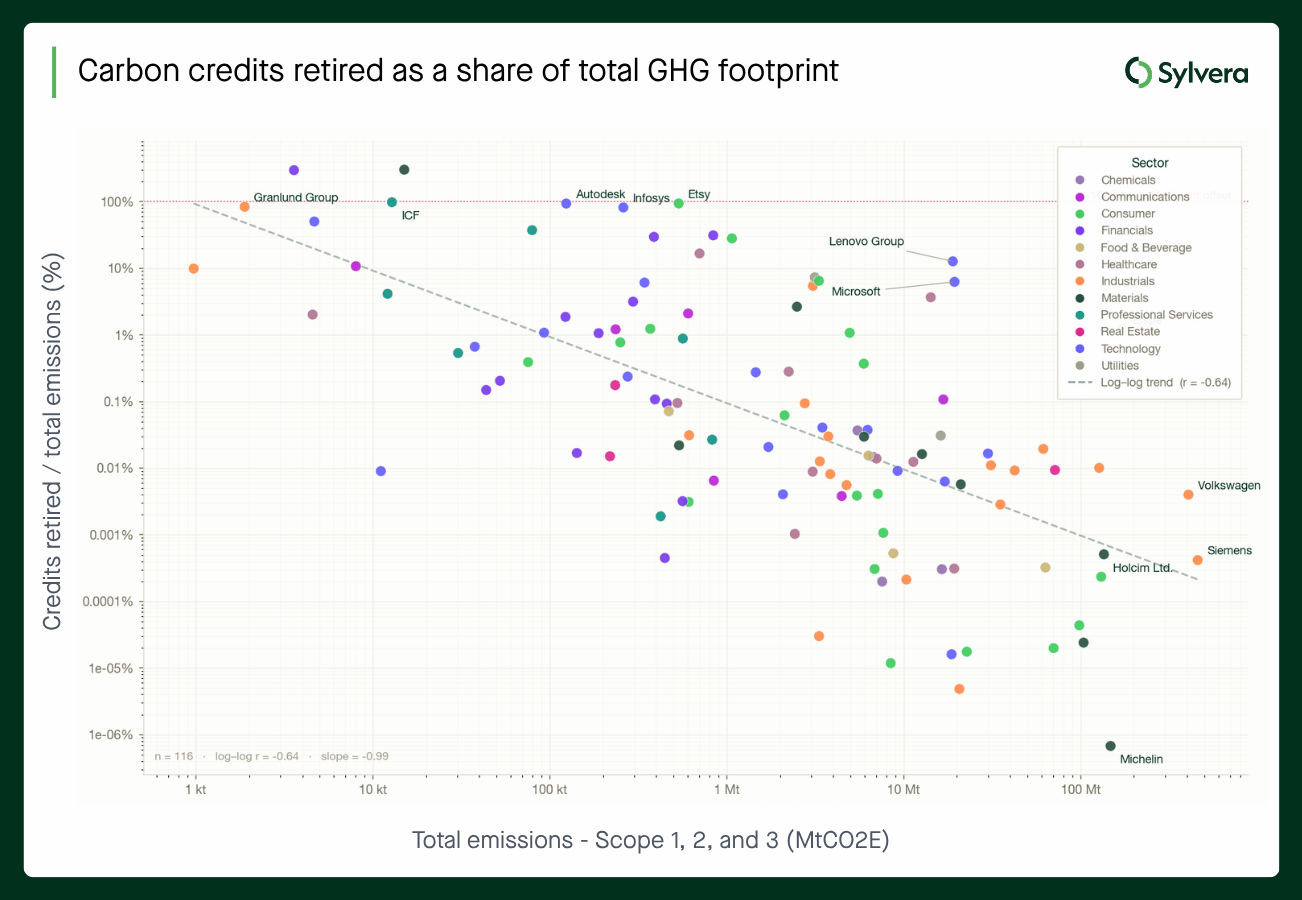
For example, as shown in the scatter plot chart above, across 116 SBTi signatories with CDP-reported data, almost no company is currently offsetting at the level the standard would require. A small number of lighter emitters offset a significant share of their footprint, but the pattern in the bottom-right of the chart shows how the heaviest emitters are offsetting the least, many at less than 0.01% of total Scope 1, 2, and 3 emissions.
What the numbers look like if companies respond
We modelled three scenarios for how the market might respond to formal SBTi recognition, assuming SBTi-covered corporate emissions remain stable.
Scenarios for SBTi companies:
*Quantified in terms of percentage of SBTi-company emissions (scope 1, 2, 3) falling under companies aligned with leadership and recognition status respectively
Resulting total credit demand from SBTi-aligned companies*:
*Assuming SBTi-covered emissions remain stable through 2030-35, potentially if the rate of emissions reductions are matched against the rate of increased SBTi participation.
To put this in context, if carbon credit demand is 20 million tonnes annually (from SBTi companies) - even a moderate adoption scenario (Scenario A) would see an almost 60% increase in market demand by 2030. A more bullish scenario sees demand approaching 1.2 billion tonnes by 2035.
The Leadership tier is a different challenge entirely. At 40% offset of total Scope 1-3 emissions, the bar is extremely high. Our analysis suggests virtually no current SBTi-aligned companies would qualify. Even the Recognition level will stretch most buyers significantly.
What to watch
SBTi is expected to formally endorse carbon credits within corporate net-zero pathways within days. When that happens, the market dynamic shifts fundamentally.
The numbers above show just how large the gap is between where companies currently stand and where they'll need to be. Closing it will require credible supply, quality signals the market can trust, and buyers willing to move.
We'll publish further analysis and what it means for the market when the details land.